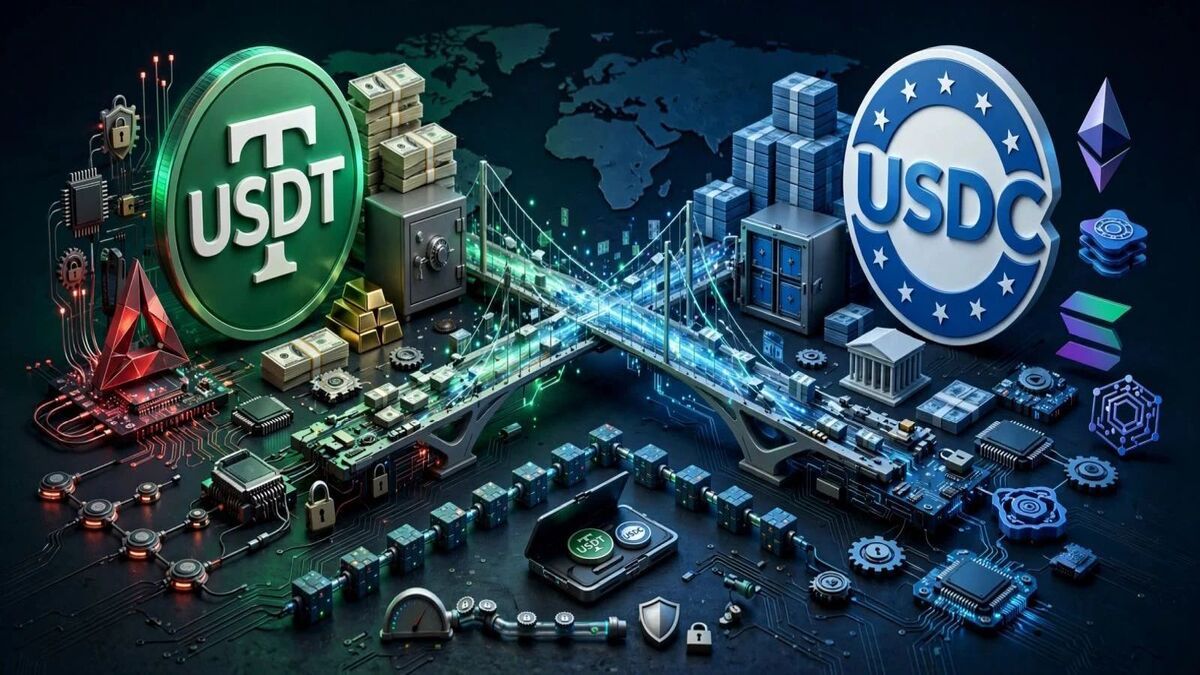
USDT and USDC target the same dollar value, but they are not interchangeable pieces of payment infrastructure.
At first glance, they seem to do the same job. Both aim to stay close to USD 1, both exist on multiple blockchains, and both can move between wallets without waiting for a bank to open.
For a developer, however, the similarities only go so far.
Behind these tokens are different issuers, reserve policies, distribution models, and cross-chain systems. Even the same stablecoin on two networks does not represent one globally accessible balance. Those are separate contracts or asset implementations, separate ledgers, and separate operational dependencies.
After 25 years in traditional finance, my instinct is to look past the label and follow the money. Who holds the reserves? Who can redeem? Which institution actually delivers the final payout? What happens when one part of the process stops working?
Those questions matter just as much in stablecoin architecture as they do in banking.
If an application accepts one stablecoin on one network, integration can look like a straightforward token transfer. Once it needs to accept deposits, maintain customer balances, send payouts, move liquidity between networks, and convert tokens back into fiat, the problem becomes a distributed payment system.
That is the perspective I use throughout this guide.
What Are USDT and USDC? The Short Answer
USDT is Tether’s dollar-linked stablecoin. USDC is Circle’s dollar-linked stablecoin. Both rely on centrally managed reserves and issuer-controlled issuance and redemption.
USDT’s biggest practical strength is distribution. It is widely used across exchanges, peer-to-peer markets, over-the-counter trading desks, remittance services, and multiple blockchain networks.
USDC, issued through Circle’s regulated entities, combines a dollar-linked token with institutional minting and redemption infrastructure, reserve disclosures, and native cross-chain transfer tooling. Circle describes its USDC issuance, redemption, and supported-network model as the foundation for these services.
Both are commonly classified as fiat-backed stablecoins. That classification does not mean every reserve asset is a dollar sitting in a bank account. It means their primary stabilization model depends on issuer-managed reserves and fiat redemption, rather than an autonomous algorithm or cryptocurrency collateral locked in a decentralized lending protocol.
The issuer’s responsibilities include:
- Receiving fiat from eligible customers.
- Managing reserve assets.
- Issuing new tokens.
- Processing token redemptions for fiat.
- Managing privileged controls in token contracts or their network-specific equivalents.
- Implementing legal and compliance decisions.
The blockchain handles token transfers and records ownership. It does not hold the off-chain dollars, and it does not decide who qualifies for direct redemption.
That distinction is the foundation of everything that follows: the token ledger is on-chain, but the financial backing and redemption relationship are not.
Why a Stablecoin Balance Is Not a Bank Balance
A wallet balance shows ownership of a particular token on a particular network, not a bank deposit or an unconditional right to an immediate wire transfer.
When a wallet displays 1,000 USDC or 1,000 USDT, it is showing a quantity of tokens associated with a specific contract, mint, or asset identifier.
The economic usefulness of that balance depends on several layers:
- The issuer must manage its reserves.
- Eligible participants must be able to mint and redeem.
- Exchanges and market makers must provide sufficient liquidity.
- The blockchain must continue processing transactions.
- The token implementation must behave as expected.
- The off-ramp provider must accept that exact token implementation on that exact network.
Holding USDC or USDT in a wallet is not the same as holding an FDIC-insured bank deposit. The presence of bank deposits somewhere in the reserve structure does not turn the token itself into an insured retail bank account.
For an EVM application, the practical identity of a token starts with:
chainId + token contract addressOn non-EVM networks, the equivalent might be the network plus a mint address, asset ID, or another native identifier.
A database that stores only currency = "USDC" does not contain enough information to run a reliable payment system.
At a minimum, the relevant asset and transaction records should capture:
asset
network
chain_id
contract_or_asset_id
decimals
amount_in_base_units
transaction_hash
block_number
confirmation_status
Additional fields, including block hashes and event indexes, become important when handling duplicate events and reorganizations.
I would treat this as a money-control issue, not merely a database-design preference. An incomplete asset model eventually creates an incorrectly credited deposit, an unsupported withdrawal, or a reconciliation problem that someone has to resolve manually.
How Does USDT Work?
USDT has a variable supply managed by Tether through issuance, redemption, and treasury operations.
Unlike Bitcoin, USDT does not have a predetermined maximum supply. Its circulating supply expands and contracts as eligible customers move between fiat and tokens.
Primary-Market Issuance and Redemption
The primary market is where an eligible, verified customer deals directly with Tether.
A simplified issuance flow looks like this:
- The customer completes the required identity and compliance checks, including know-your-customer and anti-money-laundering screening.
- The customer sends fiat to Tether.
- Tether confirms receipt of funds and approves the issuance request.
- Tether allocates USDT from its authorized treasury inventory or creates additional tokens as needed.
- The requested tokens are released into circulation and delivered on a supported network.
There is an important accounting distinction here. Tokens created and held in Tether’s treasury may be classified as authorized but not issued. Their existence on-chain does not necessarily mean they have entered circulation or that an equivalent amount of new customer money has just arrived.
Redemption runs in the opposite direction:
- A verified customer sends USDT to Tether.
- The tokens are removed from circulation, returned to treasury inventory, or burned through the issuer’s operational process.
- Tether sends fiat to the customer’s verified bank account, subject to its terms, eligibility requirements, and fees.
Tether’s requirements for direct redemption into fiat specify a minimum redemption amount of USD 100,000 equivalent.
That makes direct redemption a very different product from a typical retail cash-out.
For most users, the practical exit is selling USDT on an exchange or through an eligible local OTC provider, not submitting a redemption request directly to Tether.
Secondary-Market Transfers and Trading
Buying USDT on an exchange usually transfers existing tokens rather than causing Tether to issue new ones.
If a user buys 500 USDT, the seller might be another customer, a market maker, or the exchange’s own inventory.
The same distinction applies to most activity an application observes:
- Sending USDT between wallets.
- Swapping USDT for another token.
- Moving funds between customer deposit addresses and treasury wallets.
- Trading on a centralized exchange.
- Depositing USDT into a DeFi protocol.
These activities change ownership or allocation of existing tokens. By themselves, they do not necessarily change USDT’s total supply.
The relationship between primary and secondary markets helps support the peg.
If USDT trades below USD 1, an eligible participant may buy it at a discount and seek redemption through Tether. If it trades above USD 1, an eligible participant may obtain tokens through the primary channel and sell them into the market.
This is not automatic smart contract arbitrage. It depends on banking access, redemption eligibility, fees, market liquidity, and confidence that the issuer will process the transaction.
What Backs USDT?
USDT is backed by a portfolio of reserve assets, not exclusively by cash deposits.
Tether states in its reserve and circulation disclosures that its reserve assets exceed its liabilities.
Its published reserve reports have included categories such as:
- U.S. Treasury bills.
- Cash and bank deposits.
- Money market funds.
- Reverse repurchase agreements.
- Secured loans.
- Precious metals.
- Bitcoin.
- Other investments.
The precise allocation is time-sensitive and should be checked in the applicable reserve report.
A broader reserve portfolio is not automatically proof of inadequate backing. It does mean that “backed by reserves” should not be translated into “every token has one cash dollar sitting in a separate account.”
From a treasury perspective, I want to understand valuation, liquidity, counterparty exposure, and the speed at which assets can support redemptions under stress.
I also keep attestations and audits separate.
An attestation or examination provides assurance about specified information against defined criteria, often at particular reporting dates. A financial statement audit has a broader scope covering financial statements for a reporting period and considers relevant internal controls as part of the audit process.
An audit does not automatically include a separate opinion on the effectiveness of internal controls. More importantly, neither type of engagement is a permanent guarantee of solvency or liquidity.
The scope of the actual report matters more than the label used in a marketing summary.
USDT Is a Multichain Token, Not Its Own Blockchain
USDT runs on existing networks, and each implementation has its own technical and operational characteristics.
Tether’s supported protocols and integration guidelines describe implementations across networks including Ethereum, Tron, Solana, Avalanche, TON, Near, Aptos, Celo, Kaia, Tezos, Liquid, Polkadot Asset Hub, and the Kava-based Cosmos implementation.
Different networks use different token standards or asset systems:
- ERC-20 on EVM-compatible networks.
- TRC-20 on Tron.
- SPL tokens on Solana.
- Jettons on TON.
- Fungible Assets on Aptos.
- Asset IDs on Polkadot Asset Hub.
From the issuer’s perspective, supported USDT implementations are intended to provide equivalent nominal dollar-linked value. From an application’s perspective, they must be managed as separate network-specific assets.
USDT on Ethereum cannot be sent directly inside a Tron transaction.
Moving between those environments requires an exchange, bridge, issuer-supported chain swap, or another intermediary mechanism. Depending on the route, tokens may be transferred into inventory, locked, burned, released, or issued on the other side.
Support status also changes.
Tether identifies Omni, EOS, Algorand, Kusama, and Bitcoin Cash SLP as legacy implementations on which it no longer issues tokens or remains obligated to provide redemption.
A token contract or asset record can continue to exist after issuer support changes. Transfers may still be technically possible. Neither fact proves that the issuer or a particular exchange will accept those tokens.
For a production system, network support is an actively maintained dependency, not a configuration file you write once and forget.
Why Ethereum USDT Requires Special ERC-20 Handling
Ethereum USDT uses an older token implementation whose transfer function does not return the Boolean value expected by many modern ERC-20 integrations.
A Solidity contract that assumes every successful transfer explicitly returns true can fail when interacting with a token that returns no value.
Tether’s integration guidance recommends a compatibility wrapper. In practice, I would use OpenZeppelin’s SafeERC20 utilities for compatible token transfers.
The following contract is an integration demonstration only. It has no access control, so anyone could call send and transfer tokens held by the contract. Do not fund or deploy it as a production treasury contract.
// SPDX-License-Identifier: MIT
pragma solidity ^0.8.20;

import {IERC20} from
    "@openzeppelin/contracts/token/ERC20/IERC20.sol";
import {SafeERC20} from
    "@openzeppelin/contracts/token/ERC20/utils/SafeERC20.sol";

contract StablecoinPayout {
    using SafeERC20 for IERC20;

    function send(
        IERC20 token,
        address recipient,
        uint256 amount
    ) external {
        token.safeTransfer(recipient, amount);
    }
}
The example demonstrates how to accommodate tokens that do not consistently return values in the way a conventional ERC-20 interface expects.
It does not provide authentication, transaction limits, emergency pause controls, token allowlisting, or secure administration.
Allowance management also deserves attention. Ethereum USDT can require an existing nonzero allowance to be reset before another nonzero allowance is approved. OpenZeppelin’s forceApprove utility addresses this type of compatibility issue.
The broader lesson is simple: using an ERC-20 interface does not guarantee identical behavior across every token.
How Does USDC Work?
USDC uses the same basic issuer-controlled mint-and-redeem model, but pairs it with a different reserve framework and a more standardized developer ecosystem.
Circle issues USDC through its regulated entities. Direct institutional issuance and redemption are available through Circle Mint, subject to eligibility and onboarding.
USDC Minting and Redemption
An eligible institution connects an approved bank account to Circle Mint. Once the required fiat funds are received and the issuance request is processed, Circle delivers the corresponding nominal amount of USDC on a supported network.
For redemption:
- The institution sends supported USDC to Circle Mint.
- Circle removes the corresponding USDC from circulation through its redemption process.
- Fiat is sent to the institution’s linked bank account.
The token-side workflow and the bank-side settlement are related, but they are not the same event. Banking schedules, compliance review, and the available payment method can still affect timing.
Circle’s institutional minting and redemption eligibility requirements make clear that Circle Mint is not a retail account product.
Individuals do not qualify for Circle Mint. A smaller company should not assume that an API key alone provides access, either. Eligibility depends on the business, jurisdiction, intended activity, and Circle’s approval.
Retail users and smaller businesses commonly access USDC through:
- Centralized exchanges.
- Regulated on-ramp and off-ramp providers.
- Neobanks.
- Wallet applications.
- Local payment partners.
This is an important product distinction.
“USDC is redeemable one-to-one” does not mean every holder can call a Circle endpoint and immediately receive a bank transfer. Direct access depends on the applicable legal relationship and operational eligibility.
What Backs USDC?
USDC’s reserve framework centers on cash, short-dated U.S. government instruments, and other highly liquid cash equivalents.
Circle explains its USDC reserve composition and disclosure framework through regular public reporting.
The Circle Reserve Fund, an SEC-registered government money market fund managed by BlackRock, has been a major reserve vehicle. Its permitted holdings include:
- Cash.
- Short-term U.S. Treasury securities.
- Overnight reverse repurchase agreements collateralized by U.S. Treasuries.
Circle’s disclosures also describe Treasury and reverse-repo holdings through custodial accounts or separately managed accounts, not only through the fund. Cash reserves are held at financial institutions.
That distinction matters when comparing reserve reports over time. I would not assume a particular percentage remains inside the fund simply because an older article used that figure.
The fund publishes daily portfolio information. Circle publishes weekly reserve and mint/burn data, together with monthly reserve reports receiving independent third-party assurance. Deloitte has provided that monthly assurance; the signed report identifies the provider and scope for each reporting period.
Compared with Tether’s broader disclosed reserve mix, this is a narrower and generally more liquid reserve model.
It is not a risk-free model.
Banking, custody, operational, regulatory, and issuer risks remain. USDC temporarily lost its dollar peg during the March 2023 banking crisis, illustrating how uncertainty about access to bank-held reserves can affect a token that trades around the clock.
My takeaway is not that reserve transparency is unimportant. It is that transparency helps us evaluate a dependency. It does not remove the dependency.
Native USDC vs. Bridged USDC
Native USDC is issued directly by Circle on a supported blockchain. Bridged USDC is a separate representation created through another transfer mechanism.
At the time of this October 2026 review, Circle’s product information lists native USDC on 38 blockchains. These include Ethereum, Solana, Base, Arbitrum, OP Mainnet, Polygon PoS, Avalanche, Stellar, Aptos, Sui, Near, Celo, Linea, and ZKsync, among others.
The network count will change. The distinction between native and bridged assets remains fundamental.
A conventional bridged representation is often created when a bridge locks USDC on one network and issues another token on the destination network.
On some chains, that representation uses the symbol USDC.e. Naming conventions vary, so the suffix alone is not a universal classification system.
A bridged token may track USDC’s price, but it:
- Was not necessarily issued directly by Circle.
- May not be supported by Circle Mint.
- May not be accepted at a Circle deposit address.
- Adds exposure to the bridge contracts and verification system.
- Can have its own liquidity conditions.
- Can use a different contract address and redemption route.
The ticker shown by a wallet is not proof of authenticity or issuer support.
I would verify every supported deployment against Circle’s official USDC contract and asset identifiers. Examples include:
| Network | Native USDC identifier |
|---|---|
| Ethereum | 0xA0b86991c6218b36c1d19D4a2e9Eb0cE3606eB48 |
| Base | 0x833589fCD6eDb6E08f4c7C32D4f71b54bdA02913 |
| Arbitrum | 0xaf88d065e77c8cC2239327C5EDb3A432268e5831 |
| Solana | EPjFWdd5AufqSSqeM2qN1xzybapC8G4wEGGkZwyTDt1v |
| Polygon PoS | 0x3c499c542cEF5E3811e1192ce70d8cC03d5c3359 |
Treat this table as a reference, not as a substitute for production verification.
Before enabling an asset, compare its identifier with the issuer’s documentation and the relevant block explorer. Do not approve contracts solely because they appear in a blog post, chat message, or search result.
Native issuance, Circle Mint support, and CCTP support are also separate capabilities. A network having native USDC does not automatically mean every Circle product supports it.
How USDT and USDC Maintain Their Dollar Pegs
USDT and USDC maintain their pegs through redemption economics, liquidity, and confidence in their issuers, not through a smart contract that forces the market price to USD 1.
Neither token uses an oracle to command exchanges to trade at a fixed price.
The peg depends on a combination of:
- Minting and redemption access for eligible participants.
- Exchange liquidity.
- Arbitrage.
- Reserve quality and liquidity.
- Confidence in the issuer.
- Access to banking infrastructure.
Suppose USDC trades at USD 0.995 on an exchange.
An institutional participant with working Circle Mint access may buy it at a discount and redeem it at its nominal dollar value, after accounting for relevant costs and settlement constraints. That buying pressure can help reduce the discount.
If USDC trades above USD 1, an eligible participant may obtain USDC through the primary market and sell it at the higher secondary-market price. The additional market supply can help reduce the premium.
USDT uses the same basic economic logic, but under Tether’s eligibility rules, redemption minimums, banking arrangements, and reserve policy.
There is no guarantee that this process is instantaneous or frictionless. Fees, capital requirements, compliance checks, banking interruptions, and uncertainty can all weaken arbitrage.
Dollar parity is an economic target supported by a redemption system. It is not an immutable property of either blockchain token.
Can USDT and USDC Be Frozen? Centralization Matters
USDT and USDC can be subject to issuer-controlled restrictions, even when held in a self-custody wallet.
Both operate on public blockchains, but their issuance and administration are centralized.
Depending on the network and implementation, privileged controls can include:
- Creating new tokens.
- Burning tokens.
- Pausing transfers.
- Blocking individual addresses or token accounts.
- Upgrading contracts or redirecting operations through migration mechanisms.
- Managing authorized minters.
Ethereum USDT includes functions such as addBlackList, removeBlackList, and destroyBlackFunds. USDC’s FiatToken architecture also supports address blocking and pausing.
I see two sides to this design.
The first is compliance and incident response. An issuer may be able to act in connection with theft, sanctions, court orders, or law-enforcement requests.
The second is counterparty control. Holding the private key does not place the token beyond the issuer’s administrative reach.
A private key lets the holder authorize a transaction. The token’s rules still determine whether that transaction can execute.
For a payment application, monitoring the numerical balance is therefore not enough. There must be procedures for funds that are:
- Received from an address associated with suspicious activity.
- Frozen after receipt.
- Connected to a sanctioned entity.
- Visible on-chain but currently unspendable.
- Affected by an authorized recovery, destruction, or other administrative action.
These controls do not rewrite blockchain history. They change what the token implementation permits or how balances are handled going forward.
The exact powers must be evaluated for each deployment. I would never assume that every USDT or USDC implementation exposes precisely the same administrative functions.
Why Cross-Chain Transfers Require Separate Accounting
Blockchains do not share one global token ledger, even when the token names are identical.
If a user holds 100 USDC on Ethereum and wants USDC on Base, the existing Ethereum balance cannot simply appear inside a Base transaction.
Some mechanism must take responsibility for the source-side value and make corresponding value available on the destination.
Three common models illustrate the trade-offs.
Lock-and-Mint Bridges
A lock-and-mint bridge locks the original token in a contract and issues a wrapped representation on another network.
Its risks can include:
- Vulnerabilities in the bridge contracts.
- Compromised validators or signers.
- Incorrect accounting of locked collateral.
- Limited liquidity for the wrapped token.
- Dependence on bridge administrators or operators.
The destination token is a claim on the bridge arrangement as well as an indirect exposure to the original issuer.
Liquidity Bridges
A liquidity bridge receives tokens on the source network and arranges payment from available liquidity on the destination network.
This introduces considerations such as:
- Liquidity-provider risk.
- Slippage.
- Route availability.
- Dynamic fees.
- Relayer reliability.
- Pool imbalances and capacity limits.
The user may receive an already existing native token on the destination chain, but the route still depends on intermediary liquidity and execution.
Burn-and-Mint Transfers
An issuer-supported burn-and-mint process destroys tokens on the source network and authorizes issuance on the destination network.
Circle’s CCTP uses this model for native USDC.
The advantage is that the recipient receives native USDC without a permanent third-party wrapped token and without requiring a conventional bridge pool to hold matching liquidity on both sides.
That removes particular bridge dependencies. It does not remove issuer, contract, or infrastructure risk.
How Circle CCTP Moves Native USDC Across Chains
Circle’s Cross-Chain Transfer Protocol, or CCTP, moves native USDC between supported networks through a coordinated burn-and-mint process.
The CCTP architecture for native cross-chain transfers is permissionless at the protocol-integration level. A developer does not need a Circle Mint account simply to build around supported on-chain CCTP transfers.
That does not mean CCTP is trustless. Circle’s attestation infrastructure remains part of the system.
For an EVM-to-EVM CCTP V2 transfer, the basic process is:
- The user approves the source-chain
TokenMessengerV2contract to spend USDC. - The application submits a burn request, commonly through
depositForBurn. - The source-side contracts burn USDC and emit a cross-chain message.
- Circle’s Iris service observes the event and signs an attestation after the applicable finality requirements are met.
- The application retrieves the message and attestation.
- The application or a forwarding service submits them to
MessageTransmitterV2on the destination network. - The destination-side contracts validate the message and authorize native USDC minting to the specified recipient.
Circle’s technical guide to CCTP message passing explains how these components fit together.
The contract names above are specific to the EVM V2 architecture. Non-EVM integrations use network-specific programs, instructions, account formats, and asset-handling rules.
The same flow, viewed as an operational handoff, looks like this:
- User and application: Authorize the transfer and submit the source transaction.
- Source blockchain: Burn USDC and publish the transfer message.
- Circle Iris: Observe the burn and produce a signed attestation.
- Application or forwarder: Deliver the message and attestation to the destination.
- Destination blockchain: Validate the authorization and mint native USDC for the recipient.
Here, “attestation” means a cryptographic authorization for a cross-chain message. It is not the same thing as an accountant’s reserve attestation.
CCTP avoids permanently locking the transferred USDC in a third-party bridge pool. The transfer still depends on source-chain execution, Circle’s signing infrastructure, destination-chain execution, and correctly configured contracts.
A successful burn is therefore not the same as a completed transfer. The application must track the process until the destination mint is confirmed.
Standard Transfer vs. Fast Transfer
Standard Transfer prioritizes stronger source-chain finality and lower protocol cost. Fast Transfer can authorize destination minting before hard finality by using Circle’s Fast Transfer allowance.
Under the documented fee model, Standard Transfers have no CCTP protocol fee. Network gas and optional service charges can still apply.
Fast Transfers can incur a protocol fee. Circle’s CCTP fee model and quoting guidance describe a range of 0 to 13 basis points, depending on the source network and route.
Those figures are configuration, not constants.
By default, the protocol fee is deducted when USDC is minted on the destination network. Supported upfront-fee workflows can instead arrange payment on the source side so that the recipient receives the intended transfer amount.
The fee endpoint is documented as:
GET /v2/burn/USDC/feesA route-specific request includes the source and destination domain identifiers:
GET /v2/burn/USDC/fees/{sourceDomainId}/{destDomainId}CCTP domain IDs are not interchangeable with EVM chain IDs. They belong in separate configuration fields.
The application then specifies maxFee in the burn request. This is a maximum fee amount in USDC base units, not a basis-point rate.
An insufficient fee allowance can prevent the intended Fast Transfer behavior. The documentation discusses fee-related reverts and possible degradation to Standard Transfer, so I would verify the behavior of the exact deployment rather than assume an automatic downgrade.
A production integration should quote current fees, validate its parameters, simulate where possible, and handle the resulting state explicitly.
Circle’s global Fast Transfer allowance mechanism limits the amount that can be minted through Fast Transfer before the corresponding burns reach hard finality.
This allowance is shared across supported networks. It is not a separate capacity pool reserved for your application or route.
When it is exhausted, Fast Transfers can become temporarily unavailable until earlier transfers finalize and capacity replenishes.
The application therefore needs an explicit policy:
- Wait for additional Fast Transfer capacity.
- Offer Standard Transfer.
- Inform the user that the expected completion time has changed.
A timeout must not trigger a second burn for a transfer that is already in progress. Fallback logic and duplicate-payment prevention belong in the same design conversation.
Who Pays Gas on the Destination Network?
A basic CCTP transfer requires source-side and destination-side execution, so someone must pay transaction fees on both networks.
That “someone” does not have to be the recipient.
The application, a relayer, or another authorized submitter can pay for destination execution. But if the product expects a user holding only USDC to submit the destination mint transaction personally, the user may be stuck without the required gas asset.
Circle’s Forwarding Service for destination-side minting can handle that submission.
The integration includes the required forwarding request in the source transaction’s hook data. The service then handles the destination mint according to its supported workflow and fee model.
This can improve the user experience substantially, but it introduces:
- An additional service dependency.
- Dynamic gas and service costs.
- Route-specific availability.
- Another operational component to monitor.
The interface should display at least:
- The amount debited on the source network.
- The CCTP protocol fee.
- Any forwarding charge.
- The estimated amount delivered.
- The selected finality mode.
- The expected completion time.
- The fallback behavior if the preferred route is unavailable.
I would also distinguish receiving tokens from spending them later. A recipient generally does not need gas merely to receive a normal token transfer, but will usually need gas or sponsorship to initiate a later transaction.
USDT Cross-Chain Architecture: Native Tokens, Bridges, and USDT0
USDT does not have one universal cross-chain mechanism covering every deployment and every network pair.
The ecosystem includes:
- Directly issued USDT implementations.
- Canonical bridge representations.
- Third-party wrapped tokens.
- Exchange-managed network conversions.
- USDT0 deployments based on LayerZero’s Omnichain Fungible Token, or OFT, model.
USDT0’s lock-and-mint architecture and cross-chain transfer model distinguish the Ethereum backing layer from movement between supported destination networks.
In the basic arrangement, USDT is locked in an Ethereum adapter or lockbox, and corresponding USDT0 is issued on a supported destination.
Transfers between compatible USDT0 deployments can then burn USDT0 on one network and mint it on another without moving the underlying Ethereum backing for every transfer.
Returning to the backing asset involves burning the relevant representation and releasing the corresponding USDT under the route’s rules.
This can create a more consistent cross-chain supply model. It is still not identical to Tether directly issuing native USDT independently on every destination network.
The fact that two systems both use the words “burn and mint” does not make their trust models equivalent. CCTP’s native USDC flow and USDT0’s locked-backing architecture rely on different contracts, verification arrangements, and administrative controls.
The question I would put at the center of any integration review is:
Who is responsible for converting this exact token back into issuer-supported USDT?
Depending on the route, the answer may involve Tether, a bridge operator, an adapter contract, LayerZero-based message verification, an exchange, a custodian, or another intermediary.
The risk changes with the answer.
An internal token registry should distinguish categories such as:
USDT_NATIVE
USDT_CANONICAL_BRIDGED
USDT0
USDT_THIRD_PARTY_WRAPPED
These are example application classifications, not universal token-standard identifiers.
The same principle applies to native USDC, USDC.e, and other bridged representations. A familiar ticker does not eliminate the need to identify the backing and conversion path.
USDT vs. USDC: Key Differences for Developers
USDT generally stands out for distribution and market liquidity, while USDC stands out for its institutional tooling and standardized native cross-chain infrastructure.
The distinction is useful, but it should not be turned into a claim that one token is suitable for every trading application and the other for every payment application.
| Area | USDT | USDC |
|---|---|---|
| Issuer | Tether | Circle through its regulated entities |
| Core model | Reserve-backed token with centralized issuance and redemption | Reserve-backed token with centralized issuance and redemption |
| Reserve policy | Broader disclosed mix of reserve assets | Cash and highly liquid cash equivalents, including short-dated government instruments |
| Reporting | Periodic reserve assurance reports and typically daily circulation data | Weekly reserve and mint/burn disclosures, monthly reserve assurance, and daily fund portfolio information |
| Direct access | Verified eligible customers, with a high direct-redemption minimum | Circle Mint for eligible institutional or distributor customers |
| Typical retail exit | Exchange, P2P market, or OTC provider | Exchange, wallet provider, or on-ramp/off-ramp service |
| Main strength | Global distribution and established market liquidity | Institutional infrastructure, reserve disclosures, and developer tooling |
| Important networks | Tron, Ethereum, and other supported networks | Ethereum, Solana, Base, and numerous other supported networks |
| Cross-chain model | Multiple routes, including exchanges, bridges, and USDT0 | Native USDC burn-and-mint through supported CCTP routes, alongside other market routes |
| DeFi role | Widely supported trading, lending, and collateral asset | Widely used collateral, payment, and settlement asset |
| Administrative controls | Issuance, blacklisting, pausing, burning, and upgrade or migration mechanisms, depending on implementation | Minting, blacklisting, pausing, and upgrade controls, depending on implementation |
| Smart contract integration | Ethereum USDT requires handling of older ERC-20 behavior | More standardized developer guidance, but still requires deployment-specific validation |
| Important operational dependencies | Issuer policy, reserve liquidity, network fragmentation, custody, and partner support | Issuer policy, banking access, reserve liquidity, attestation services, custody, and partner support |
| Common use cases | Trading, P2P, OTC, and remittances | Treasury, payments, DeFi, and cross-chain applications |
There is no universally better token.
There is a token, network, custody model, and partner arrangement that better fits a particular flow of money.
USDT Advantages and Disadvantages
USDT’s main advantage is that the market already uses it. Its main integration challenge is managing the fragmentation that comes with that reach.
USDT Advantages
Distribution is not a superficial benefit in payments. It determines whether the recipient can actually use or cash out the money.
If a customer’s local exchange, P2P market, and OTC desk all use USDT, that customer may have little interest in receiving USDC simply because the engineering team prefers Circle’s documentation.
USDT can be a strong fit when the priorities are:
- Deep liquidity on global exchanges.
- A large selection of trading pairs.
- Active P2P markets.
- Existing support from local partners.
- Tron-based transfer infrastructure.
- Broad familiarity among retail users.
Tron can be economical for some operating models, particularly when resource management is handled efficiently. I would still quote actual costs rather than advertise it as universally cheap.
USDT is often operationally unremarkable in the best sense: counterparties already support it, users recognize it, and local off-ramps already have liquidity.
USDT Disadvantages
Broad availability creates more combinations to validate.
A production team needs to distinguish:
- The network.
- Native issuance versus a bridged representation.
- Active support versus a legacy deployment.
- An exchange’s deposit support.
- Tether’s direct-redemption support.
- The behavior of the specific token implementation.
The reserve policy includes a broader asset mix than USDC’s disclosed framework, which creates additional treasury due-diligence questions.
Direct redemption is generally impractical for a small retail withdrawal because of eligibility requirements, minimum amounts, and fees.
Ethereum USDT also needs careful smart contract handling. Administrative blocking and pausing mean that self-custody does not eliminate issuer risk.
USDC Advantages and Disadvantages
USDC offers a relatively cohesive institutional and developer ecosystem, but it still depends on centralized services, eligible counterparties, and network-specific liquidity.
USDC Advantages
USDC is often easier to evaluate and integrate when a team prioritizes:
- A documented reserve framework.
- Institutional fiat entry and exit.
- Publicly maintained official asset identifiers.
- Native issuance on many networks.
- CCTP cross-chain transfers.
- Ethereum and layer-2 DeFi integrations.
- Compliance and treasury documentation.
CCTP is particularly useful when an application needs to rebalance liquidity without leaving capital permanently locked in third-party bridge pools.
A treasury can burn USDC on a supported network where it has excess liquidity and mint native USDC on another supported network where payouts are waiting.
That is a specific and valuable infrastructure function.
It does not solve foreign exchange, bank settlement, customer onboarding, or licensing. I would not confuse a well-designed cross-chain primitive with a complete international payment stack.
USDC Disadvantages
USDC is not equally liquid in every region, exchange, or payment corridor.
Where USDT dominates, a customer may face an additional conversion spread before reaching a local cash-out partner.
Circle Mint also is not an API that every startup can activate immediately. Institutional onboarding, know-your-business checks, jurisdictional eligibility, and suitable banking arrangements still matter.
CCTP itself requires:
- A supported source and destination route.
- Correct finality handling.
- A functioning attestation service.
- Destination gas funding or a forwarding arrangement.
- Current fee quotes.
- Fallback logic when Fast Transfer capacity is unavailable.
- Duplicate-safe handling of destination mint submission and completion.
USDC also retains issuer-controlled administrative functions.
A more transparent reserve framework does not make the token decentralized.
What Does a USDT or USDC Integration Actually Cost?
The total cost of a stablecoin payment includes network execution, conversion, service fees, and the capital needed to keep each payout route funded.
There is no single “USDT fee” or “USDC fee.”
I would break the cost model into separate layers.
Network Gas and Resource Costs
Each on-chain operation requires payment under the network’s fee model, even if a sponsor hides that payment from the end user.
Examples include:
- ETH for Ethereum transactions.
- ETH on Base and Arbitrum, under their respective fee models.
- SOL on Solana.
- Tron’s bandwidth and Energy resources, with TRX costs when applicable.
The amount depends on factors such as:
- The network.
- Congestion.
- Transaction complexity.
- Calldata or other transaction-data size.
- Wallet and account infrastructure.
- Whether execution is batched or individual.
- Whether accounts or token accounts need to be created.
On Tron, having sufficient Energy or an appropriate resource arrangement can materially change the cost. A wallet without those resources may face a different bill from an institutional sender.
Do not hardcode a historical average into the product. Fee estimation should use current network conditions and the actual transaction being prepared.
Spreads and Trading Fees
Converting between USDT and USDC, or between a stablecoin and fiat, can involve:
- Bid-ask spread.
- Trading fees.
- Market impact.
- Withdrawal fees.
- Banking charges.
For a large transfer, the conversion spread can matter far more than the blockchain fee.
The quote should be executable for the intended amount. A last-traded price is not a reliable estimate of what a treasury can buy or sell at scale.
On-Ramp and Off-Ramp Charges
An exchange or payment provider may charge for:
- Fiat deposits.
- Currency or token conversion.
- Token withdrawals.
- Fiat withdrawals.
- Local payouts.
- Compliance-related processing or account services.
Pricing can vary by jurisdiction, currency, funding method, account tier, and negotiated commercial terms.
I would also separate the quoted fee from the exchange rate. A provider can advertise a low explicit charge while recovering its margin through the conversion price.
Cross-Chain Costs
A CCTP route may involve:
- Source-chain gas.
- A Fast Transfer protocol fee.
- Destination-chain gas.
- A forwarding service charge.
- An application-level fee.
Where a forwarding quote already includes destination gas, avoid counting the same cost twice in the customer quote or internal margin model.
Bridge and liquidity routes may additionally charge:
- Bridge fees.
- Relayer fees.
- Liquidity-provider fees.
- Slippage.
- A destination gas allocation or “gas drop.”
The lowest displayed bridge fee is not necessarily the lowest all-in delivered cost.
The Cost of Prefunding
The most frequently overlooked expense is capital sitting in separate network balances.
Suppose an application supports USDT on Tron, USDC on Base, and both tokens on Ethereum.
It may need working liquidity in four separate asset-network combinations. Excess funds in one do not automatically finance a payout from another.
This is familiar territory from traditional payments. Faster settlement does not eliminate the need to position liquidity where obligations are due.
Cross-chain infrastructure can reduce prefunding requirements, but introduces rebalancing time, execution costs, capacity constraints, and additional failure modes.
I would model those trade-offs explicitly rather than treating treasury inventory as free.
A Practical Use Case: Paying International Contractors
A multichain contractor-payment platform is a coordination system across bank accounts, internal ledgers, custodial wallets, and blockchain networks.
Imagine a SaaS platform that lets European companies pay contractors in Latin America and Southeast Asia.
The company funds its account in EUR or USD. The contractor chooses:
- USDC on Base.
- USDC on Solana.
- USDT on Tron.
- A local bank payout through a payment partner.
That is not one stablecoin integration. It is several connected payment and accounting workflows.
If the employer funds in EUR and the contractor receives a dollar-linked asset, foreign exchange is another explicit step. The stablecoin does not eliminate that currency conversion.
Here is how I would structure the system.
Step 1: Build an Authoritative Asset Registry
The asset registry defines exactly what the platform accepts and sends.
An EVM-specific configuration might begin like this:
type Stablecoin = 'USDC' | 'USDT';

type AssetConfig = {
  asset: Stablecoin;
  chainId: number;
  address: `0x${string}`;
  decimals: number;
  depositsEnabled: boolean;
  withdrawalsEnabled: boolean;
};

export const ethereumAssets: AssetConfig[] = [
  {
    asset: 'USDC',
    chainId: 1,
    address: '0xA0b86991c6218b36c1d19D4a2e9Eb0cE3606eB48',
    decimals: 6,
    depositsEnabled: true,
    withdrawalsEnabled: true,
  },
  {
    asset: 'USDT',
    chainId: 1,
    address: '0xdAC17F958D2ee523a2206206994597C13D831ec7',
    decimals: 6,
    depositsEnabled: true,
    withdrawalsEnabled: true,
  },
];
This example is intentionally EVM-only.
A complete multichain registry needs appropriate network-specific types for Solana mints, Tron identifiers, and other asset systems. I would not force every network into an Ethereum address format.
Production configuration should also include:
- Minimum deposit amount.
- Minimum payout amount.
- Confirmation or finality policy.
- Explorer-link template.
- Custody wallet or account.
- Sweep threshold.
- Issuer-support status.
- Bridge-route status, where relevant.
- Off-ramp partner support.
- Date of the latest configuration verification.
Where needed, keep CCTP domain IDs separate from blockchain chain IDs.
Do not accept a token because its symbol() function returns USDC. Anyone can deploy a token with the same symbol, name, and decimal count.
Step 2: Maintain an Internal Double-Entry Ledger
A blockchain transaction and a business accounting entry are different records serving different purposes.
The application needs an internal ledger and associated payment states that distinguish:
- Pending deposits.
- Confirmed deposits.
- Available balances.
- Reserved amounts.
- Submitted payouts.
- Failed payouts.
- Network fees.
- Platform fees.
- Conversions.
- Adjustments.
The double-entry ledger should record balanced postings in the relevant asset or currency. Workflow states should control when those postings become available for spending, settlement, or release.
Do not recalculate every customer’s balance by querying a treasury wallet.
One wallet may hold funds economically allocated to thousands of customers. The blockchain has no knowledge of those internal entitlements.
This is one place where my banking background makes me particularly cautious. A visible wallet balance is evidence about assets held. It is not, by itself, a customer subledger.
Step 3: Process Deposit Events Idempotently
A deposit event must credit the customer once, even if the infrastructure delivers it repeatedly.
For an EVM token, the indexer typically monitors Transfer events emitted by an approved contract.
A useful event identifier is:
chain_id + transaction_hash + log_indexThat key supports duplicate-safe processing. If the indexer delivers the same event twice, the second delivery must not produce another customer credit.
A typical deposit workflow progresses through:
observedconfirmingconfirmed
The application should also retain the block hash and enough canonical-chain information to identify reorganizations.
If an observed transaction is removed from the canonical chain, the system needs to invalidate the event and reverse any affected accounting through an auditable process. Deleting history is not a substitute for reversing a posting.
Smaller deposits may justify a lower confirmation threshold. Larger deposits may require stronger finality or additional review.
That is a risk policy, not a universal blockchain constant.
Non-EVM networks require their own event or transaction parsing. The EVM log key should not be assumed to cover Solana, Tron, or every other supported network unchanged.
Step 4: Never Use Floating Point for Token Amounts
Token balances and payment amounts should be stored as integer base units.
USDT and USDC use six decimal places on many popular implementations, but the application must read that precision from verified configuration rather than assume it is universal.
For a six-decimal implementation:
Display amount: 1 USDC
Stored amount: 1_000_000 base units

Display amount: 12.50 USDC
Stored amount: 12_500_000 base units
In TypeScript, use bigint for base-unit amounts and string-based parsing and formatting:
import { formatUnits, parseUnits } from 'viem';

const decimals = 6;

const payout = parseUnits('125.50', decimals);
// 125500000n

const display = formatUnits(payout, decimals);
// "125.5"
The amount enters as a string, not as a JavaScript floating-point number.
Validate the input’s permitted decimal precision before parsing, and apply an explicit policy to excessive precision rather than silently changing a payment amount.
The database should use a sufficiently wide integer type or a fixed-precision numeric type appropriate for the stored base units. Never use float for financial balances.
If amounts cross a JSON boundary, encode them in a documented lossless format, commonly decimal strings. Do not convert large integer balances to JavaScript numbers merely to serialize them.
Step 5: Estimate Costs Before Sending a Payout
A payout is not economically viable if delivery and processing costs consume an unreasonable share of the amount.
If a user withdraws 5 USDC and the all-in cost is comparable, the product needs a different policy.
Options include:
- Setting a minimum payout.
- Batching compatible payouts.
- Offering a lower-cost network.
- Sponsoring gas only under defined conditions.
- Charging a transparent network-fee line item.
- Keeping an off-chain internal balance until the customer chooses to withdraw.
Batching can reduce operational overhead, but it concentrates risk.
A problem in a batch contract can affect many recipients at once. Individual transfers may cost more to manage, but their failure model is often easier to isolate.
I would evaluate both the fee savings and the size of a potential incident before choosing a batch architecture.
Step 6: Manage Treasury Liquidity by Network
Payout obligations must be matched with usable liquidity on the required network.
Suppose customers request:
- 40,000 USDT on Tron.
- 25,000 USDC on Base.
- 10,000 USDC on Solana.
The platform needs those specific balances before payouts can proceed reliably.
USDC can be rebalanced through supported CCTP routes. For USDT on Tron, an exchange or OTC partner may provide a more practical conversion route from liquidity held elsewhere.
The treasury engine should calculate:
- Current available balances.
- Amounts reserved for payouts.
- Expected incoming deposits.
- Minimum operating buffers.
- Rebalancing cost.
- Rebalancing time.
- Counterparty and partner limits.
- Maximum exposure to a single issuer.
Expected deposits belong in a forecast. They should not be treated as spendable funds before the applicable settlement and confirmation conditions are met.
I would also maintain enough gas assets or sponsored-execution capacity to use the stablecoin liquidity. A well-funded token wallet can still be operationally unable to send.
Step 7: Make Network Selection Explicit and Safe
A withdrawal interface should identify both the token and the network.
One “Wallet address” field next to a single “USDT” selector is not enough.
The interface should clearly display:
- Token.
- Network.
- Required address format.
- Estimated fee.
- Expected completion time.
- Minimum amount.
- Warnings about unsupported networks.
- Whether the recipient will need a gas asset for a later action.
Receiving a normal token transfer should not be confused with needing gas to send it onward.
For larger payouts, additional controls can include:
- An address book.
- Verification of newly added addresses.
- A delay before the first payment to a new recipient.
- A small test transfer.
- Address allowlists.
- Multiple approvals.
- Daily limits.
These controls may feel less exciting than cross-chain automation. They prevent expensive mistakes.
Production Risks That Stablecoin Tutorials Often Skip
The biggest production failures often happen in the systems around a stablecoin, not in its basic transfer function.
A working demo proves that a transaction can execute. It does not prove that deposits are classified correctly, payouts are authorized safely, or failures can be reconciled.
Counterfeit Tokens
An attacker can create a token named Tether USD, give it the symbol USDT, and use the same number of decimal places.
The backend must recognize assets by verified network-specific identifiers, not by display metadata.
A wallet may show a convincing name or logo. The accounting system must still reject an unsupported contract.
Deposits on the Wrong Network
An EVM address can look identical on Ethereum, Base, Arbitrum, and Polygon.
That does not mean the platform monitors or supports that address on every network.
A customer can send genuine USDC to the correct-looking address on an unsupported chain. For a conventional externally owned account, the same key may control the corresponding address elsewhere, but recovery still requires infrastructure, gas, authorization, and a safe operational process.
For smart contract wallets, deployment and recovery assumptions can differ further.
Never promise that a wrong-network deposit is recoverable simply because the address format matches.
Confusing Native and Bridged Tokens
An application supporting native USDC on Polygon should not automatically credit an older bridged representation.
Each accepted contract or asset identifier needs its own registry entry.
If the platform supports both, it needs explicit rules for:
- Pricing or conversion.
- Available liquidity.
- Withdrawal support.
- Off-ramp acceptance.
- Accounting treatment.
Two tokens can track similar prices while carrying different conversion risks.
Chain Reorganizations and Finality Assumptions
A transaction seen in the mempool is not a completed deposit.
A transaction included in one block is not necessarily final, either.
The confirmation policy should reflect:
- The network’s consensus and finality model.
- The payment’s value.
- The business’s tolerance for reversal.
- Any distinction between an L2 confirmation and stronger settlement guarantees.
Higher-value deposits may need stronger finality or additional review.
I would document these policies by network rather than apply one confirmation count everywhere.
RPC and Indexer Failures
A single remote procedure call endpoint is not sufficient production infrastructure.
A resilient integration should include:
- Primary and backup RPC providers.
- Health checks.
- Block-height monitoring.
- Alerts when an indexer falls behind.
- Periodic reconciliation against on-chain state.
- Block-rescanning capability.
- Event deduplication.
A silent indexing delay can be more dangerous than an obvious outage. The system may appear healthy while customer deposits or treasury movements are missing from the internal ledger.
Frozen or Otherwise Unspendable Funds
A confirmed on-chain balance is not necessarily an available payout balance.
If an issuer blocks a treasury address or token account, the displayed balance may remain visible while transfers fail.
The system should distinguish:
- Confirmed balance.
- Spendable balance.
- Frozen balance.
- Compliance hold.
An issuer restriction and an internal compliance hold are different conditions and should not be collapsed into one status.
Depending on the implementation, blocking can affect an address’s entire token balance rather than an individually identifiable “coin.” The accounting and incident process must reflect how the actual contract works.
Private-Key and Signing Infrastructure Risk
The largest controllable risk may be the application’s own hot wallet.
A minimum production model should include:
- Separate hot and cold wallets.
- Daily transaction limits.
- Multisignature or appropriately controlled signing for large transfers.
- Automated sweeping under defined policies.
- Isolated signing services.
- An audit trail for every authorization.
- Key-management and wallet-migration procedures.
- A documented incident-response plan.
- A global mechanism to stop payouts.
For an externally owned account, “key rotation” usually means moving to a newly controlled address, not changing the private key associated with the existing address.
A private key should not be treated as an ordinary environment variable on the same server that handles public API traffic.
Good token selection cannot compensate for weak signing controls.
When Should You Choose USDT?
USDT is often the stronger operational choice when customers and local cash-out partners already use it.
I would give it serious consideration when:
- Users already hold USDT.
- Local P2P and OTC markets rely on it.
- A large selection of exchange trading pairs matters.
- The target market commonly uses Tron.
- Exit liquidity is the primary constraint.
- The application serves global traders.
- Partners do not support USDC on the required network.
A typical example is a remittance corridor in which the recipient receives USDT on Tron and sells it through a compliant local OTC provider.
In that system, USDC’s developer infrastructure may be attractive, but it does not solve the last mile if the recipient’s actual partner does not accept it.
Payments architecture must work where the recipient lives, not only where the engineering team builds.
When Should You Choose USDC?
USDC is often a natural fit when the product depends on institutional fiat access, documented reserves, and recurring native cross-chain liquidity movements.
I would favor it when:
- The business has an eligible institutional on-ramp or off-ramp.
- Reserve-policy documentation is a major requirement.
- The application operates on Ethereum or layer-2 networks.
- Native cross-chain transfers are important.
- The product integrates with DeFi.
- Treasury needs to rebalance across supported networks regularly.
- Counterparties require Circle’s particular jurisdictional and compliance framework.
- The product is being built around Circle’s infrastructure.
A typical example is a marketplace that accepts USDC on Base, holds treasury liquidity on Ethereum, and pays some users on Solana.
Supported CCTP routes can move native USDC where it is needed without requiring the application to introduce its own wrapped token.
The legal and operational suitability of that model still depends on the business’s jurisdiction, custody arrangement, and counterparties. “Regulated issuer” is not a substitute for evaluating the application’s own obligations.
When Does It Make Sense to Support Both?
For an international payment platform, supporting both USDT and USDC can be sensible if the number of supported networks remains deliberately limited.
A practical starting model might include:
- USDT on Tron for customers who already rely on its P2P and remittance ecosystem.
- USDC on Base for lower-cost EVM payouts.
- USDC on Solana for compatible high-throughput payment workflows.
- Ethereum for selected high-value transfers and treasury operations.
This is an example operating model, not a universal recommendation. Actual costs and partner support should determine the final selection.
There is no need to support every token on every blockchain.
Each additional asset-network combination expands:
- The number of wallets or accounts.
- RPC and indexing integrations.
- Prefunding requirements.
- Monitoring responsibilities.
- Recovery procedures.
- Compliance work.
- Wrong-network deposit risk.
- Off-ramp dependencies.
My preference is to expand only when there is a real customer or liquidity need and the operations team can support the complete lifecycle.
Two well-supported networks are worth more than ten partially supported ones.
The Final Trade-Off: Choose the Payment Architecture, Not Just the Ticker
USDT and USDC solve similar monetary problems through different operational ecosystems.
USDT’s greatest strength is distribution. Its advantage is not necessarily the cleanest contract implementation or the simplest reserve mix. It is that exchanges, traders, wallets, and local payment partners already use it extensively.
USDC’s strengths include its institutional infrastructure, narrower disclosed reserve framework, and programmable multichain tooling. CCTP provides a standardized way to move native USDC between supported networks through burn-and-mint transfers.
Both remain centrally issued.
Both rely on reserves held outside the blockchain. Both can be affected by issuer restrictions. Both can trade away from USD 1. Neither eliminates banking, custody, compliance, or counterparty risk.
And with both, many of the most damaging production errors happen around the token:
- Selecting the wrong network.
- Accepting the wrong contract.
- Mismanaging keys.
- Using floating-point amounts.
- Mishandling a reorganization.
- Crediting the same deposit twice.
- Assuming an unsupported off-ramp will accept the funds.
After a career in traditional finance, I do not find that surprising. Moving a balance is only one part of moving money safely.
The useful question is not simply, “Which stablecoin is safer?”
It is:
Which combination of issuer, network, contract, liquidity, custody, partners, and legal obligations fits this specific flow of money?
Once I frame the decision that way, USDT and USDC stop looking like two nearly identical tickers.
They become two different components of payment architecture, each useful when its operating model matches the job.
Sponsored Partner: Volet.com
Looking for a simple, everyday way to buy, hold, and sell USDT and USDC alongside your traditional currencies and payment cards?
- Read my full breakdown: Complete Volet Review on DoraMilen.com
- Get started right away: Open your free Volet account using my referral link