A peer-to-peer crypto sale can go perfectly on the exchange side and still cost you your bank account. The escrow releases on time, the buyer leaves positive feedback, and your platform records are spotless. Then, sometimes weeks later, your bank locks your account because the money that paid you was stolen from somebody else.
After 25 years in traditional banking, I can tell you a freeze like this is not a glitch. It is a risk officer using the only blunt instrument available to protect the bank. The fraud behind it has a name, the P2P triangle scam, and the structure of P2P trading makes honest sellers an unusually convenient place for criminals to cash out stolen fiat.
People use P2P desks on Binance, Bybit, Paxful, and similar platforms for sound reasons: lower fees, local payment methods, and a way around banks that would rather not touch crypto. One legal-help site describes P2P trading on global exchanges as a mainstream method for Indian crypto traders, and the mechanics are the same wherever fast bank transfers meet crypto. The irony is hard to miss. You went peer to peer to route around the banking system, and the banking system still gets the final say on whether the money in your account is clean.
This guide explains how the scam works under the hood, why your bank freezes you instead of the fraudster, which warning signs to watch for, a verification routine to run before you click Release, and exactly what to tell your bank if you receive funds linked to fraud.
Quick Answer: Why Does P2P Crypto Trading Get Bank Accounts Frozen?
P2P crypto trading gets bank accounts frozen because the money you receive can be traced back to a fraud victim, and your bank has to treat the receiving account as part of the money trail until you show otherwise.
- The mechanism: A fraudster buys crypto from you but makes a third party, often someone being cheated in a separate fake sale, send you the money.
- Why escrow doesn’t stop it: Escrow protects the crypto leg of the trade. It cannot confirm that the person who paid you is the person who bought the crypto.
- What your bank does: When the victim reports the theft, their bank sends a recall or fraud notice, and yours freezes the disputed sum or the whole account while it investigates.
- How to protect yourself: Accept payment only from an account in the buyer’s verified name, confirm the credit in your own banking app, and never release on a screenshot.
- If it happens to you: Don’t move the disputed money, preserve every record the same day, answer the bank in one organized package, and stop trading until it’s resolved.
What Is a P2P Triangle Scam?
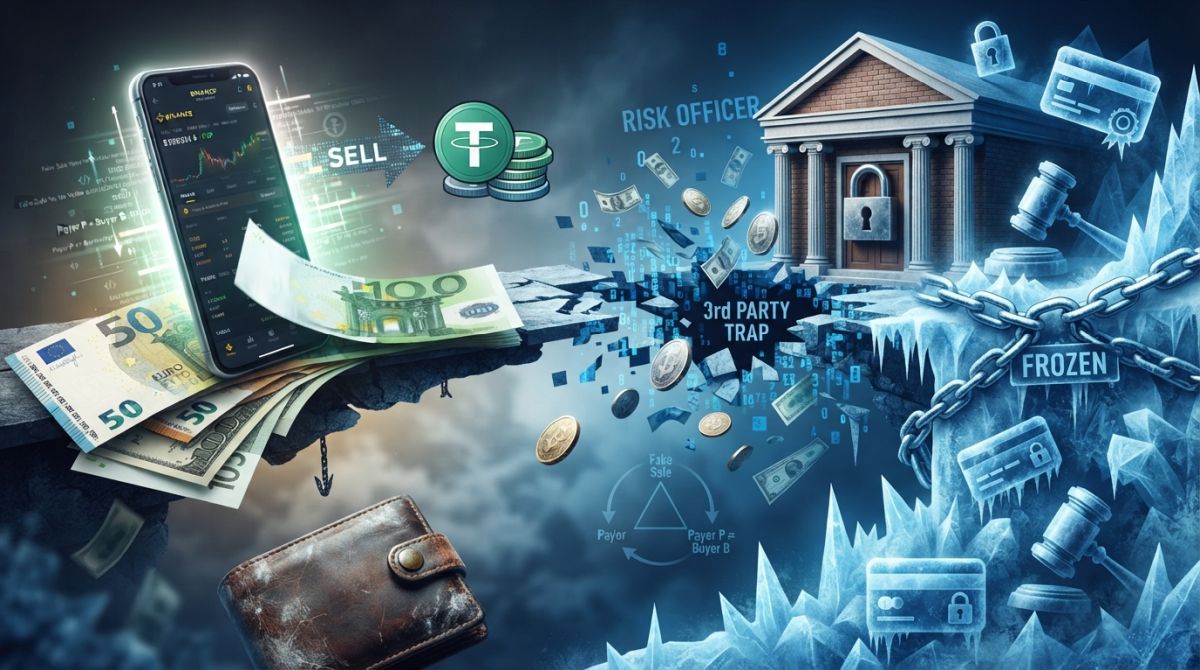
A P2P triangle scam is a fraud in which a criminal uses one honest person’s payment to buy crypto from another honest person, so neither victim ever learns the other exists.
You will also see it called triangulation, a third-party payment scam, or just “the triangle.” Don’t confuse it with e-commerce triangulation fraud, which involves fake storefronts and stolen cards. The P2P version turns the crypto seller into an unwitting cash-out point. Fintech News UAE’s piece on preventing triangle scams, which the site labels a company announcement, describes the structure as two legitimate transactions linked through a single fraudulent intermediary. SPAYZ’s explainer on triangle scams in P2P trading describes the same pattern from a payment provider’s side. Both are vendor content, so I use them for the mechanism, not for neutral statistics.
Who Is in the Triangle
- The fraudster: Advertises something cheap to a victim and, separately, opens a P2P order to buy crypto from you.
- The victim: Believes they are buying the item and pays the bank details they were handed, which are yours.
- You: The honest seller whose payment details appear on the order.
Value moves in a loop. The victim’s fiat goes to you, your crypto goes to the fraudster, and the fraudster’s empty promise goes to the victim.
The Full Lifecycle, Step by Step
The scam unfolds in ten steps, and the first six look completely normal from your side. The sources I reviewed use a laptop and an iPhone as bait. The item doesn’t matter.
1. The fraudster lists a laptop far below market price.
2. A victim agrees to buy it and asks where to send the money.
3. The fraudster opens a P2P order to buy 1,000 USD of USDT from you.
   The order shows the fraudster YOUR bank or payment details.
4. The fraudster gives the victim YOUR details as "the seller's account."
5. The victim pays you 1,000 USD. The amount and timing match the order.
6. You see the credit, mark payment received, and release the USDT.
7. The fraudster moves the USDT onward and disappears.
8. The victim never receives a laptop and reports the fraud.
9. The victim's bank traces the payment to your account and sends a
   recall or fraud notice to your bank.
10. Your bank holds the funds or freezes the account and opens an inquiry.
Look at what you did right in that sequence. You matched the amount, waited for the money, and released through the official flow. That is exactly why the scam works. Fintech News UAE makes the point that the payment can look perfectly healthy: right amount, right account, right time. The only thing wrong is the identity of the payer, and nothing in the standard flow forces you to check it.
The third party doesn’t always have to be a shopper. That same Fintech News UAE article adds that fraudsters can also route payments through compromised accounts, money mules, or people manipulated through impersonation and investment scams. The common thread is that the payer is paying for something other than the crypto trade you think you are in.
Why It Works: Two Ledgers, Three Identities
Every P2P trade touches two ledgers that never talk to each other. The platform’s ledger records who is selling crypto and who is buying it, with know-your-customer (KYC) checks attached. The bank’s ledger records which account sent the fiat and which account received it. A safe trade holds one invariant: the person who bought the crypto on the first ledger is the person who paid on the second.
Ledger A (platform):  Seller S --crypto--> Buyer B   (B is KYC-verified)
Ledger B (bank):      Payer P  --fiat----> Seller S

Safe trade:     P is the same person as B
Triangle scam:  P is a third party, and B is the fraudster
The platform sees B. The bank sees P. The only person who can see both at the same moment is you, and you are the one person in the chain with no tooling beyond your own eyes.
Fraudsters also exploit the clock. The victim has to be kept on the line and the P2P order has a payment countdown, so the script usually includes pressure to release fast. SPAYZ’s list of triangle-scam warning signs names pressure to release crypto quickly as one of the clearest.
How Does P2P Escrow Work, and What Doesn’t It Protect?
P2P escrow locks the seller’s crypto until the seller confirms payment, which protects the crypto leg of the trade and says nothing about who funded the fiat leg.
Platform details differ, but the lifecycle looks like this:
- The seller posts an ad with a price, limits, and accepted payment methods.
- A buyer opens an order, and the platform locks the seller’s crypto in escrow.
- The platform shows the buyer the seller’s payment details, and a payment countdown starts.
- The buyer pays by bank transfer or payment app and marks the order as paid.
- The seller checks their own bank or payment app, then presses release.
- The platform moves the crypto from escrow to the buyer.
- If something is wrong, either side appeals, and support reviews the chat and evidence.
Coin Edition’s walk-through of a USDT sale on Binance P2P in India describes steps 4 and 5 the same way: the seller receives rupees through India’s UPI instant payment system or a bank transfer, confirms the money has arrived, and releases the USDT held in escrow.
Where I come from, this is the point where a settlement veteran raises an eyebrow. In securities settlement we obsess over delivery versus payment: the asset and the cash move together or not at all, linked by infrastructure designed so neither leg settles without the other. P2P escrow looks like delivery versus payment but isn’t. The cash leg lives on a different ledger, and the only connection between the two is a button a human presses. In crypto terms, the seller is acting as an oracle, feeding an off-chain fact (“the fiat arrived, and it came from the right person”) into the escrow with no cryptographic proof. Humans are poor oracles under time pressure, and fraudsters build their scripts around that.
What Escrow Guarantees
- The seller cannot spend the crypto while the order is open.
- The buyer cannot take the crypto without the seller’s release or a platform decision on an appeal.
- The platform keeps chat and order records that can support a dispute.
What Escrow Does Not Guarantee
- That the payer is the verified buyer.
- That the money is clean.
- That the payment won’t be recalled.
- That your bank will react calmly.
Binance doesn’t hide the problem entirely. Its help-center guidance on preventing bank account freezes in P2P transactions, which carries a December 2019 publication date, says several sellers reported freezes after trading with certain buyers. It explains that those buyers had bought crypto to trade on other platforms and were scammed, and that when they reported it to local authorities, both the scammers’ and the innocent sellers’ accounts were frozen.
That is useful guidance, but look at where it puts the burden. Every item on its list is something the seller has to do, and none of them changes how the platform verifies the payer.
| Binance precaution | What it does | What it does not do |
|---|---|---|
| Ask the buyer for extra ID in chat | Surfaces identity mismatches and gives you grounds to cancel | Does not verify the payer’s bank identity |
| Use a separate bank account | Limits the damage a freeze can do | Does not prevent a freeze |
| Reduce frequency and avoid simultaneous trades | Makes each credit easier to tie to one order | Does not screen counterparties |
| Avoid crypto terms in payment references | Likely reduces automated keyword flags (my reading) | Is not a license to mislead your bank |
Why Does My Bank Freeze My Account After a P2P Crypto Sale?
Your bank freezes your account because yours is the account it can reach: the fraudster is anonymous and sitting on crypto, while you are an identified customer whose account received the victim’s money.
What the Bank Actually Sees
The bank doesn’t see a P2P trade. It sees an inbound credit from an individual, and later a fraud notice naming that credit. It can’t see your escrow, your chat, or your platform feedback unless you show it.
The FBI’s guidance on money mules shows what investigators are trained to look for, including complicit mules who operate funnel accounts that collect fraud proceeds from many lower-level mules. A busy P2P seller’s account can resemble that picture on the surface: many credits from unrelated individuals. EMCD’s guide to avoiding bank freezes in P2P trading lists the usual automated triggers as third-party transfers, mismatched names, many small transactions, and payments linked to users already under investigation.
From Fraud Report to Frozen Account
The generic sequence runs like this, though details vary by country and bank:
- The victim reports the fraud to their bank and often to the police.
- The victim’s bank sends a recall or fraud notification to your bank.
- Your bank holds the disputed sum, or sometimes the whole account.
- Its financial crime team investigates under its anti-money-laundering obligations and, in many jurisdictions, may file a suspicious activity report.
- The bank asks you for documents, with short deadlines.
- The outcome is release, return of the disputed amount to the victim, or account closure.
Eichorn Law’s page on frozen accounts after P2P crypto sales lays out this process and adds two points worth knowing: there is usually a police report with your account number in it, and the bank may exit you as a customer even when you are cleared. Don’t expect your bank to tell you whether it filed a suspicious activity report. In most jurisdictions it isn’t allowed to.
Why Banks Freeze Whole Accounts
A bank can’t tell a good-faith seller from a mule by looking at one transaction, and the cheapest way to cap its own exposure is to freeze broadly and ask questions later. In my experience, the first question a fraud desk asks is not “is this person guilty?” but “how much can we lose if we don’t hold this?” Eichorn Law confirms the practical result: sometimes only the disputed sum is frozen, but often the whole account.
Courts are starting to push back in some places. Coin Edition’s report on Binance P2P freezes in India says a June 2026 Kerala High Court case reiterated that banks should, in appropriate circumstances, let account holders operate their accounts while limiting the lien to the amount identified in the cybercrime requisition, provided there is no separate suspicion of money-mule activity.
The Receiving Bank Has Skin in the Game
In the UK, the regulator has made the receiving bank pay part of the victim’s loss. The Payment Systems Regulator’s page on APP scams says sending and receiving payment firms will split reimbursement costs 50:50, that most victims are to be reimbursed within five business days, and that the rules cover payments over Faster Payments and CHAPS. The same page, citing UK Finance, reports GBP 459.7 million lost to APP scams in 2023.
My read: a 50:50 split is one of the smartest mechanism-design choices in modern payments, because it gives the party that sees the incoming money a direct financial reason to scrutinize it. A receiving bank that might owe half of a victim’s refund is not going to be gentle with the account that collected the money. Other countries allocate liability differently, and the PSR page describes the regime as it stood in a 2024 timeframe, so confirm the current rules where you live.
Four Ways Tainted Money Reaches a P2P Seller
Tainted money reaches P2P sellers in four distinct ways, and each calls for a slightly different defense. Most guides lump them all under “triangle scam,” which leaves sellers protected against only one.
| Variant | Who paid you | Name matches buyer? | Best defense |
|---|---|---|---|
| 1. Classic triangle | A deceived third party | No | Reject third-party payments, cancel or appeal |
| 2. Hacked bank account | An account holder who never authorized the payment | Sometimes | Platform risk signals, small first trades, clean evidence trail |
| 3. Victim-buyer | The buyer, using their own money | Yes | Dedicated account, records, ask about purpose |
| 4. Knowing counterparty | A mule or launderer | Often | Refuse premiums, cap volume, stop after any freeze |
1. The Classic Triangle
A deceived third party pays you for something they believe they are buying elsewhere. The payer’s name doesn’t match the buyer’s verified name, which makes this the variant a disciplined seller can catch.
2. The Hacked Bank Account
Kibbo’s UK-focused guide to the mule account trap describes the version most people picture when they hear “hacked bank account”: the buyer pays you using funds from an account they compromised rather than their own money.
If the hacker uses their own platform identity, you will see a name mismatch, which is the easy case. If they have also taken over the victim’s platform account, or built one with stolen ID documents, the names match and your check passes. That is why name matching is necessary but not sufficient, and why your evidence trail matters as much as your check.
3. The Victim-Buyer
Binance’s own guidance describes buyers who purchased crypto on P2P to trade on other platforms and were scammed. Their money was their own, and the name matches. When they reported the loss, authorities froze accounts along the chain, including the seller’s.
You can’t screen for this with name matching. You can reduce the odds by asking what the buyer plans to do with the crypto and declining the order if the answer involves a “manager,” “advisor,” or “platform” telling them what to buy. That is my own rule of thumb, and it protects the buyer as much as it protects you.
4. The Knowing Counterparty
Some buyers know exactly what they are doing. The FBI’s money mule page describes witting and complicit mules who ignore red flags or actively run funnel accounts, and it lists virtual currency among the channels mules use. Eichorn Law’s advice is blunt: treat above-market offers as a red flag, because the premium is the price of dirty money. Someone who pays more than the market rate for no visible reason is paying for something besides the asset, namely your clean banking record.
How Big Is the Problem? What the Data Does and Doesn’t Say
Nobody has published a reliable global count of P2P sellers whose bank accounts were frozen, so any precise percentage you see online is a guess or a sales pitch.
What we can say comes from adjacent data:
- The UK Payment Systems Regulator’s page, citing UK Finance, reports GBP 459.7 million lost to APP scams in 2023.
- Europol’s money muling guide headlines that more than 90 percent of money mule transactions identified through the European Money Mule Actions are linked to cybercrime.
- A company announcement on Fintech News UAE cites FTC figures of roughly 16 billion USD in 2025 fraud losses, up about 25 percent from 2024. It also says consumers reported greater combined losses through bank transfers and crypto than through all other payment methods combined in 2023. The same piece mentions a December 2025 Europol operation against a crypto fraud and laundering network that moved more than 700 million EUR, and a March 2026 FATF report that it says flags illicit-finance risks in stablecoin P2P transactions. I have not verified these against the primary releases, so check them before quoting.
- SPAYZ cites a J.D. Power 2023 finding that 8 percent of banking customers say they were victimized by a P2P scam in the previous 12 months. That figure comes from a Forbes Advisor page on peer-to-peer payment fraud, which suggests it measures payment apps, not crypto marketplaces. Don’t read it as a crypto P2P base rate.
The takeaway: fraud money moves through fast bank transfers at scale, at least one major regulator has decided receiving banks should share the liability, and Binance itself acknowledges freezes. What nobody can tell you is your personal odds.
What Are the Warning Signs of a P2P Triangle Scam?
The clearest warning sign is a payment from an account that doesn’t match the buyer’s verified name, but the full set of red flags is broader, and the best ones show up before money moves.
| Red flag | Why it matters | Where the signal comes from |
|---|---|---|
| Sender name differs from the buyer’s verified name | The core signature of a triangle | Industry and law-firm guidance |
| Buyer says a friend, relative, or company will pay | A pretext for a third-party payment | Law-firm guidance |
| Pressure to release quickly | The victim is on a clock and the fraudster needs speed | Industry guidance |
| Unusual amounts or overpayment | Overpayments set up “refund the difference” requests | Industry and law-firm guidance |
| Reused or edited payment screenshots | Screenshots are not proof of funds | Industry guidance |
| Requests to talk outside the platform | Removes the platform’s records and protections | Industry guidance |
| Refusal to provide extra ID when asked | A legitimate buyer has little reason to refuse | Binance guidance |
| Price above market | The premium is the price of dirty money | Law-firm guidance |
| Several payers or split payments for one order | Suggests money is being gathered from multiple sources | My heuristic |
| Business account or foreign sender on a personal trade | Mismatch with a normal individual buyer | My heuristic |
| Buyer mentions a “manager” or “advisor” directing the purchase | Likely a victim in the middle of a scam | My heuristic |
| Brand-new buyer account placing a large order | No history to judge | My heuristic |
The first eight come from the sources I reviewed (SPAYZ, Eichorn Law, and Binance). The last four are my own judgment from how fraud desks think about incoming payments, not a regulator’s list.
How Do You Verify a P2P Payment Before Releasing Crypto?
Verify a P2P payment by matching three records before you release: your order, the buyer’s verified identity, and the credit in your own bank account. I call it the three-way match, borrowed from accounts payable, where nobody pays an invoice until the purchase order, the receiving report, and the invoice agree.
Think like a bookkeeper. Each P2P order should produce exactly one crypto debit and exactly one fiat credit, and the two must reconcile by amount, name, and timing before the crypto leaves.
RELEASE ONLY IF ALL SIX ARE TRUE
1. I can see the credit in my own bank app or statement, not a screenshot.
2. The credited amount equals the order amount, no more and no less.
3. The sender name on my bank record matches the buyer's verified name.
4. The sender is an individual paying for themselves (no company, no "friend").
5. The payment arrived through the method named in the order.
6. There is no pressure to hurry and no request to move off the platform.

IF ANY ITEM FAILS: do not release. Keep the order open, message the buyer in
the platform chat, and contact platform support.
Why Each Check Exists
- Check 1: SPAYZ advises never releasing on a payment screenshot or confirmation message alone, and checking the funds in the receiving account instead.
- Check 2: Overpayments are a classic setup for a “send back the difference” request, and Eichorn Law says to reject them on the spot.
- Check 3: Eichorn Law’s managing partner says name matching is the fact that most often decides these cases. Sellers who can show every payment came from the verified buyer’s own account almost always resolve as bystanders, while accepted third-party payments turn a bystander file into a suspect file.
- Check 4: Third-party payments are the signature of the scam.
- Check 5: A payment through a different rail than the order names means the buyer isn’t following the trade you agreed to.
- Check 6: SPAYZ lists pressure to release quickly and requests to communicate outside the platform as warning signs.
If your bank or payment method doesn’t show the sender’s full name, you can’t run check 3. Don’t accept that method for P2P.
Binance also tells sellers to ask the buyer for additional identity verification documents in the chat before proceeding. If the buyer refuses, you have the right to ask them to cancel the order. And Binance suggests avoiding multiple simultaneous transactions. My reading of why: when several orders are open, a credit of the right amount can belong to the wrong order, and fraudsters know it.
What the Check Can’t Catch
If a hacker has taken over both the victim’s bank account and a platform account in the victim’s name, every check above passes. You can’t close that gap as a seller. You can shrink it with a dedicated account, small first trades with new counterparties, and a clean evidence trail.
What If You Already Released the Crypto and the Payment Looks Wrong?
If you released crypto and then discover the payment came from someone else, act in the first hour: stop, report, and tell your bank before it tells you.
- Stop. Don’t move or spend the money that came in.
- Report to the platform immediately. Binance says to contact customer service with screenshots and information about the P2P order, and notes that you may submit an appeal after receiving the buyer’s funds so that the team steps in to negotiate a refund. Speed matters because a platform can only restrict what it still custodies.
- Tell your bank. Explain what happened and ask how to return the funds through the bank’s own process. Never send money back to a different account than the one it came from, and never by manual transfer to a new name someone messages you. Eichorn Law warns that silence reads as guilt and response windows are short. Yes, this may trigger a hold sooner. A hold you invited, with documents in hand, is a far better starting position than a hold that arrives with a police reference number and your silence on record.
- Preserve the records the same day. Order ID, chat, timestamps, payment confirmation, and your bank statement.
- Report the crime. US readers can use the FBI’s Internet Crime Complaint Center. Victims of financial cyber fraud in India can dial helpline 1930 through India’s national cybercrime portal. The PSR’s page points UK victims to Action Fraud, the police national fraud reporting centre, and to the Financial Ombudsman Service if you are unhappy with your bank’s response.
If a stranger contacts you afterward offering to recover your crypto or unfreeze your account for an upfront fee, treat that as the next scam.
What Should You Do the Moment Your Bank Freezes Your Account?
In the first 24 hours, do four things: stop moving money, preserve evidence, find out exactly what the freeze covers, and contact the platform and your bank in writing.
The First 24 Hours
- Don’t spend or move the disputed sum. Eichorn Law calls money leaving right after a fraud notification the single worst optic. If it is mixed with your funds, leave at least the disputed amount untouched.
- Preserve the P2P evidence the same day: order ID, timestamps, price, counterparty username, the entire in-app chat, the platform’s payment confirmation, and any appeal history. Export and screenshot everything, because accounts get suspended and chats purge.
- Find out what is being held. Coin Edition suggests getting the details of the freeze or lien: the police or cybercrime authority, the complaint or case reference, and the amount in dispute.
- Contact platform support with screenshots, as Binance’s guidance advises.
- Pause trading. Eichorn Law is direct: continuing high-volume P2P activity during an active fraud inquiry is the pattern that turns a bystander into a suspect.
- Note every deadline in the bank’s letters.
The Evidence Bundle
Coin Edition lists what an affected seller should preserve: the order ID, transaction history, in-platform chat, bank statement, payment reference, payment confirmation, and evidence that the crypto was released only after the payment arrived. I would add three items: your one-line trade ledger (see the rulebook below), your own ID, and your wider P2P history, which Eichorn Law suggests structuring like a source-of-funds file.
Weeks One Through Eight
One law firm’s published estimate, not a rule: a straightforward, well-documented case unfreezes in two to eight weeks, while a case with police involvement runs for months. The disputed sum may be returned to the victim, and the bank may close your account even if you are cleared. Where an account stays frozen without a clear procedural basis, Eichorn Law says a formal letter of claim and, if needed, the banking ombudsman or a court can move things that support tickets cannot. Coin Edition also reports that Indian courts are scrutinizing blanket freezes more closely, and that a March 2026 ruling referred to a CFCFRMS 2026 standard operating procedure with a grievance-redressal mechanism for account holders whose funds are held.
What Not to Do While Frozen
- Don’t move the disputed money or “tidy up” the account.
- Don’t open new accounts to work around the freeze.
- Don’t keep trading.
- Don’t contact the victim yourself. Let your bank or lawyer handle that.
- Don’t send ten angry emails. One organized package beats them all.
What Should I Tell My Bank If I Received Funds Linked to Fraud?
Tell your bank the truth, in order, with documents: who you are, what P2P trading is, exactly what happened on this order, what you checked before releasing, and what you need from them. Eichorn Law’s managing partner puts it well: banks move on documents, not on indignation, and the seller who sends one organized bundle in week one is usually unfrozen before the seller who sends ten angry emails has received a substantive reply.
Step 1: Explain P2P in Plain English
Many fraud analysts have never seen a matched P2P order. Give them three sentences:
“A P2P marketplace matches me with a buyer, holds my crypto in escrow, and releases it only when I confirm payment. The platform verifies both parties’ identities, and I can show you the order, chat, and timestamps. I have no way to see where a buyer’s money came from beyond the sender’s name on my bank record and the platform’s verification.”
Step 2: Gather the Bundle
- Order details: order ID, timestamps, price, counterparty username.
- The full chat export.
- The platform’s payment confirmation and any appeal or ticket history.
- Your bank statement for the period, showing the sender name and reference on the credit.
- Your trade ledger and wider P2P history.
- The bank’s letters, with deadlines.
- Your own ID.
Step 3: The First Phone Call
"I'm calling about a hold on my account ending in [1234].
I sold cryptocurrency through a regulated peer-to-peer marketplace, and I
understand a payment I received may be the subject of a fraud recall.
I want to cooperate fully. Can you tell me:
1. Exactly what amount is on hold, and is the hold limited to that amount?
2. Is there a reference number, and which authority or bank raised it?
3. What documents do you need from me, and by what date?
4. Who is my named contact, and how do I send documents securely?
5. Can you confirm in writing what you tell me today?"
Step 4: The Written Response
Subject: Account ending [1234], documents for a peer-to-peer crypto sale

Dear Financial Crime Team,

I am writing about the hold placed on my account on [date], reference
[number]. I want to cooperate fully, and I am attaching documents so you
can verify what happened.

1. Who I am. [One sentence: occasional or regular seller of cryptocurrency
   on [platform], using my own verified account in my own name.]

2. The transaction. On [date and time] I sold [crypto amount] for [fiat
   amount] under order ID [ID]. The platform held my crypto in escrow. I
   received [fiat amount] by [method] from [sender name on my statement] at
   [time]. I confirmed the credit in my own banking app before releasing the
   crypto at [time].

3. What I checked. [State factually whether the sender name matched the
   buyer's verified name, and what verification you did.]

4. What I did not know. I had no knowledge that these funds were connected
   to fraud. When I learned of the recall on [date], I stopped trading and
   have not moved the disputed amount.

5. Attached. Order details and timestamps, full chat export, platform
   payment confirmation, appeal history, bank statement, and my ID.

6. My requests. (a) Please confirm the amount held and whether the hold can
   be limited to that amount while you review. (b) Please confirm which
   documents you still need and by when. (c) Please name a point of contact.
   (d) Please tell me the review process and expected timeline.

Sincerely,
[Name, phone, email]
If your honest answer to item 3 is unflattering, for example you released despite a name mismatch, write it plainly anyway. Banks verify, and an inconsistent story is worse than a mistake. Asking the bank to confine the hold to the disputed amount mirrors the logic of the Kerala High Court case Coin Edition reports, though whether any court decision helps you is a question for your lawyer.
Step 5: What Not to Say
- Don’t hide that it was crypto, and don’t minimize volume.
- Don’t claim you “didn’t know” if you saw a mismatch and moved on.
- Don’t speculate about who the fraudster was.
- Don’t threaten the bank.
I would take a closed account over a false statement to a bank every time. A closed account is an inconvenience. A false statement is evidence.
Can You Get in Legal Trouble for a P2P Sale to a Fraudster?
Selling crypto in good faith at market price to a verified counterparty is not a crime, but the law has a doctrine for people who see red flags and look away, and prosecutors know how to use it. This section is general information, not legal advice.
The FBI’s Three Kinds of Mules
The FBI’s money mule page defines a mule as someone who transfers or moves illegally acquired money on behalf of someone else. It sorts mules into three groups: unwitting (unaware they are part of a scheme), witting (they ignore obvious red flags or act willfully blind), and complicit (aware and actively participating). The page says acting as a money mule is illegal and punishable even for people who don’t realize they are committing a crime, and it lists possible federal charges including mail fraud, wire fraud, bank fraud, money laundering, and aggravated identity theft.
I read that as a deterrence message aimed at people who move money for strangers at someone else’s direction, not a statement that every P2P seller is automatically guilty. The statutes it lists generally require proof of knowledge or intent. But notice how the categories shift: a witting mule may have been unwitting at first and then kept participating, and may have been warned by bank employees. Translate that to P2P. Once your bank has frozen or warned you, repeating the same behavior can move you from the first category toward the second.
Willful Blindness in Plain English
The Supreme Court’s opinion in Global-Tech Appliances v. SEB is a patent case, but it is a leading modern statement of willful blindness, and the Court described the doctrine as well established in criminal law. It requires two things: the person must subjectively believe there is a high probability that a fact exists, and must take deliberate actions to avoid learning of it. The Court said this sets a higher bar than recklessness or negligence, and that people who behave this way are treated as just as culpable as those with actual knowledge.
Map that onto a P2P seller. Seeing a payer name that doesn’t match the buyer, then releasing because the amount is right, is the kind of fact a prosecutor points to. So is accepting a payment from a stranger you were told would come from a friend, or continuing to trade after a freeze. Not looking at the name at all can be argued as deliberate avoidance if you had reason to believe the risk was high. That is why your verification routine is both a financial control and a legal exhibit: it creates a record that you looked.
Where Eichorn Law Draws the Line
Eichorn Law’s practical boundary is a pattern, not a single act. A one-off sale at market price to a verified counterparty is the classic good-faith position. High-volume selling at above-market premiums, accepting third-party payments anyway, or continuing to trade after a previous freeze is what prosecutors read as willful blindness. The firm says money-laundering statutes reach people who “ought to have known.” The exact standard differs by country, so I’d rather you think in terms of what you can show you checked.
When to Hire a Lawyer
Bring in a criminal defense lawyer before you give any account to the police, and certainly before an interview under caution if you are in the UK. A civil strategy to unfreeze the account and a criminal defense must be coordinated, which Eichorn Law stresses. Binance’s own guidance ends the same way: consult legal advice if necessary.
Country Notes: India, the UK, and the US
The same mechanism plays out differently in each country, and the protections you can invoke depend on where your bank and the victim’s bank sit.
India
In India, P2P freezes usually arrive as a bank lien after someone files a cybercrime complaint, and the framework for challenging them is still taking shape.
- Coin Edition’s reporting cites Reddit complaints, including an August 2026 post from a verified Binance P2P merchant whose bank placed a lien weeks after a USDT sale paid through UPI. The buyer was allegedly linked to a cybercrime complaint, and the seller had kept the Binance order details, bank statement, and UPI proof. Another post asked how long it takes before funds from a P2P buyer can be considered “safe.”
- India has brought virtual digital asset (VDA) activity into its anti-money-laundering framework, and VDA service providers must register with the Financial Intelligence Unit-India. As Coin Edition frames it, registration and KYC don’t mean every rupee reaching your account has been cleared by India’s banking and cybercrime systems.
- The same report describes the June 2026 Kerala High Court case and a March 2026 ruling referencing the CFCFRMS 2026 standard operating procedure, both discussed above.
- India’s cybercrime portal says any victim of financial cyber fraud can dial helpline 1930.
- Notices vary. BuyUcoin’s guide cites the Bharatiya Nyaya Sanhita (BNS 2023) as the basis for police freezing powers, while JuriGram’s legal guide discusses replying to Section 91 CrPC notices. The law is in transition, so read the notice you actually received to see which provision it cites. The Economic Times has also run a warning that traders on international P2P exchanges risk frozen bank accounts.
United Kingdom
In the UK, the receiving bank shares the cost of reimbursing scam victims, so expect fast, firm holds and detailed questions.
- The PSR’s page describes the 50:50 reimbursement split, and the Confirmation of Payee name-checking service designed to help prevent APP scams and misdirected payments.
- Unresolved complaints about a bank can go to the Financial Ombudsman Service. The PSR describes that route for scam victims, so ask the ombudsman what it can review in a freeze case.
- On the criminal side, offenses sit in Part 7 of the Proceeds of Crime Act 2002. Section 329 covers acquiring, using, or possessing criminal property, section 340 supplies the definitions, and the consent provisions starting at section 335 let a person who suspects they are handling criminal property seek consent before proceeding. As I read it, the mental element can be met by suspicion, not only knowledge, which is a lower bar than most Americans assume. The site shows the text current to October 21, 2026 and flags pending amendments from a 2026 Act. Have a UK solicitor read the current text before you rely on my summary.
United States
In the US, exposure turns on knowledge, willful blindness, and the specific statute, and government seizures follow fixed procedural clocks.
- Report fraud to the FBI’s IC3, and use the willful blindness test above to judge your own habits.
- A bank’s internal hold is a private action. If the government actually seizes funds, 18 U.S.C. § 983 sets the rules for nonjudicial civil forfeiture, and as I read it the clocks start with the seizure, not the bank hold. The government must generally send notice within 60 days of the seizure (90 days if a state or local agency seized the property and turned it over to a federal agency). The deadline to file a claim is stated in the notice letter and can’t be earlier than 35 days after mailing. A claim must identify the property, state your interest, and be made under oath, with no bond required. After a claim is filed, the government has 90 days to file a forfeiture complaint or return the property, unless a court extends the time.
- Subsection (d) of that statute is where the innocent-owner defense lives. Read it with a forfeiture attorney before assuming it fits your facts.
Is the P2P Premium Worth the Freeze Risk?
A P2P premium pays off only if a tiny fraction of your trades is ever recalled, because a recalled trade can cost you the entire trade value, not just the premium.
Here is why. When a victim’s bank recalls funds, the disputed sum may be returned to the victim, as Eichorn Law notes, while the crypto you released is already gone. You have effectively given the crypto away. Add frozen liquidity, legal fees, and the chance your bank closes the account, and the math turns ugly fast.
Expected profit per trade = (1 – p) x (premium x V) – p x (V + F)
Break-even recall probability p = (premium x V) / ((premium x V) + V + F)
Here p is the probability a trade is later recalled, V is the trade value, and F is the friction cost of a recall (time, fees, and so on).
Illustrative numbers, not market data: a 0.5 percent premium on a 1,000 USD trade earns 5 USD. If a recall costs the full 1,000 USD plus 200 USD in friction, break-even is 5 / 1,205, or about 0.41 percent, roughly one recalled trade in 240.
SuperCash, a company selling an alternative off-ramp, argues in its comparison of P2P premiums and freeze risk that a half-percent rate gap in its Vietnamese dong example isn’t worth the risk. Vendors have incentives, but the arithmetic points the same way no matter who writes it.
You can’t know your true recall probability, but you do control the inputs. Name matching and verification lower p. A dedicated account and a liquidity buffer lower F.
What Should Exchanges and Banks Fix?
The root cause is an identity gap between the platform’s ledger and the bank’s ledger, and the fix is to bind the payer’s identity to the buyer’s identity before the crypto is released, not after a victim files a report.
Platforms
- Block third-party payments by design. SPAYZ’s guidance, as summarized by Fintech News UAE, recommends blocking unauthorized third-party payments rather than relying on traders to notice them manually. It sells payment tooling, so weigh that, but the design principle is sound.
- Bind payment methods to KYC identity so a seller sees a verified payer name, not just an account number.
- Add release delays and velocity limits for new buyers (my suggestion).
- Give sellers an evidence export and clear appeal outcomes (my suggestion).
- Allocate liability honestly. Binance’s help-center guidance describes the platform as mediating refunds and points sellers to local authorities and legal advice. The UK’s 50:50 rule shows that sharing liability with the parties best placed to prevent harm can work.
Banks
- Confine holds to the disputed amount where there is no wider suspicion, as the Kerala High Court case Coin Edition describes.
- Train analysts to read P2P evidence. Eichorn Law notes that many fraud analysts have never seen a matched order.
- Review faster for customers who produce complete documents.
Regulators
The payments industry solved a similar identity-binding problem for cards with tools like 3-D Secure and address verification. The UK’s Confirmation of Payee shows name checking can work on bank transfers. A receiver-side equivalent for P2P sellers is the obvious next step. The Fintech News UAE piece also says FATF’s March 2026 report on stablecoins and unhosted wallets flags illicit-finance risks in stablecoin P2P transactions. I haven’t read the FATF report, so treat that as a pointer, not a citation.
What You Can Demand Before You Trade
- Does the platform show me the sender’s full name?
- Does it block third-party payments?
- What evidence can I export?
- What does the appeal process cover?
- Does the help center say anything about frozen bank accounts?
Binance is the only exchange in this guide whose published guidance I could cite directly. If you trade on Bybit, Paxful, or anywhere else, look for the equivalent page in that platform’s help center, and treat its absence as information.
The P2P Seller’s Rulebook: Ten Habits That Protect Your Account
Ten habits cover most of the risk, and every one is cheap compared to a frozen account.
- Accept payment only from an account in the buyer’s verified name. This is the single most decisive fact in these cases.
- Confirm the credit in your own banking app. Never release on a screenshot.
- Run one order at a time so each credit ties to exactly one order.
- Use a dedicated bank account for P2P, and keep salary and family money elsewhere. In risk terms, it is a bulkhead.
- Keep a liquidity buffer outside that account, because a freeze can last weeks.
- Keep payment references neutral, as Binance advises, but never lie to your bank about what you do.
- Keep a one-line ledger entry per trade: order ID, time, crypto amount, fiat amount, sender name, buyer’s verified name, match yes or no. This is double-entry bookkeeping for a P2P seller.
- Walk away from above-market premiums and overpayments.
- Ask for extra ID when anything feels off, and cancel if the buyer refuses.
- After any freeze, stop and reset before you trade again.
Safer Alternatives to P2P Selling
If the premium isn’t worth the risk, sell through a regulated exchange and withdraw to your own bank account in your own name. The counterparty is then the exchange, not an anonymous individual, and your statement shows one recognizable source. You will pay fees and may hit limits. Some banks also restrict crypto-related transfers altogether, as Eichorn Law notes, so ask yours. Over-the-counter desks that run their own source-of-funds checks are another option for larger amounts. I am not endorsing any provider. The point is to move the identity check to a party equipped to perform it.
Frequently Asked Questions
What is a P2P triangle scam in simple terms?
It is a scam where a fraudster makes a stranger pay you for crypto the fraudster is buying. The stranger thinks they are paying for something else, like a laptop. You release the crypto, the fraudster disappears, and the stranger’s bank traces the stolen payment to your account.
Why was my bank account frozen after I sold crypto P2P?
Almost certainly because the money that paid you was reported as fraud proceeds. As Eichorn Law explains, the victim’s bank sends a recall or fraud notice and your bank freezes the disputed sum or the whole account to investigate. The freeze targets the payment’s origin, not crypto as such. Binance’s guidance says freezes also happen when your buyer was scammed and reported it to the police.
How do I know if a P2P payment came from a third party?
Compare the sender name on your own bank record with the buyer’s verified name on the platform. If they differ, or if you can’t see the sender’s name at all, treat it as a third-party payment and don’t release. A screenshot is not proof of anything.
What should I tell my bank if I received money linked to fraud?
Give a factual timeline with documents: who you are, how P2P escrow works, the order details, what you checked, what you did not know, and what you are asking for. Don’t hide that it was crypto, and ask the bank to limit the hold to the disputed amount. The template above shows the structure.
How long does it take to unfreeze a bank account after a P2P sale?
One law firm’s published estimate is two to eight weeks for a straightforward, well-documented case and months when police are involved. The disputed sum may be returned to the victim and the bank may close the account afterward. No honest adviser can promise a date.
Can I get in legal trouble for receiving a third-party payment?
Selling in good faith at market price to a verified counterparty is not a crime, according to Eichorn Law. Risk rises with third-party payments accepted anyway, above-market premiums, high volume, and trading after a freeze. In the US, willful blindness is the key doctrine. If police want an interview, call a criminal defense lawyer first.
Does Binance P2P protect sellers from bank freezes?
Not from your bank’s reaction. Binance’s help-center guidance acknowledges the problem and lists precautions, and Coin Edition notes that Binance allows appeals for completed P2P orders involving frozen bank accounts or chargebacks. But escrow, KYC, and appeals can’t control what happened to the fiat before it reached you.
Can I get my crypto back if I released it to a scammer?
Rarely. Gate’s glossary entry on triangle scams notes that on-chain transfers are irreversible, so sellers seldom recover released crypto. Speed gives you the best chance: report to the platform immediately, because a platform can only restrict what it still custodies. Ignore strangers offering recovery for an upfront fee.
Is P2P crypto trading safe?
It can be, if you treat the fiat leg like a banker would. Escrow protects the crypto leg. Nothing protects the fiat leg except your own verification. The risk is manageable with name matching, a dedicated account, and records, but it never reaches zero.
How common are P2P bank freezes?
Nobody knows. I found no authoritative global statistic. The evidence is anecdotal but consistent: Binance acknowledges that several sellers were frozen, and Coin Edition describes repeated complaints from Indian traders.
The Bottom Line
P2P trading isn’t the problem. Pretending the fiat leg is risk-free is. After 25 years in banking, the lesson I’d hand every seller is simple: a credit on your statement is a claim on value, not proof that the money is clean. Treat every incoming payment the way a banker would. Check who sent it, keep the paperwork, and never let a countdown timer make the decision for you. Do that, and the triangle scam goes from a threat to a nuisance you can see coming.
Sponsored Partner: Volet.com
Looking for a simple, everyday way to buy, hold, and sell cryptocurrencies alongside your traditional currencies and payment cards?
- Read my full breakdown: Complete Volet Review on DoraMilen.com
- Get started right away: Open your free Volet account using my referral link