BNB Smart Chain is often described in one sentence: an EVM-compatible Layer 1 blockchain with faster blocks and lower transaction fees than Ethereum Mainnet.
That description is broadly accurate. As a developer brief, it is nowhere near enough.
It does not explain what EVM compatibility actually guarantees, how Parlia consensus changes the way an application should handle transaction confirmations, why latest is not the same as finalized, or why the RPC layer can become a bigger operational headache than the smart contract itself.
After 25 years in traditional finance, I tend to ask the less glamorous questions first: When has a payment actually settled? Which record is authoritative? What happens when the infrastructure feeding an application falls behind?
Those questions matter on BSC, too.
Formerly known as Binance Smart Chain, BNB Smart Chain is a standalone EVM network within the broader BNB Chain ecosystem. BNB is its native asset, used for gas and staking. Its smart contracts use the same foundational concepts Ethereum developers already know: addresses, ABIs, bytecode, logs, storage slots, gas, and JSON-RPC.
That means Solidity, Foundry, Hardhat, OpenZeppelin Contracts, Viem, Ethers, and much of the Ethereum development stack can be used on BSC.
It does not mean BSC is simply Ethereum with a different RPC URL.
Configuration note: The network timings, validator counts, fee baselines, provider policies, and hardware recommendations below reflect documentation reviewed on October 18, 2026. Check the current configuration before deploying.
What Is BNB Smart Chain?
BNB Smart Chain is an EVM-compatible Layer 1 blockchain with its own validators, consensus mechanism, fork-choice rules, fee market, and finality model.
The basic network parameters are:
| Network | Chain ID | Hex Chain ID | Native asset |
|---|---|---|---|
| BSC Mainnet | 56 | 0x38 | BNB |
| BSC Testnet | 97 | 0x61 | tBNB |
Both mainnet and testnet expose Geth-compatible JSON-RPC interfaces. Familiar Ethereum methods are available, including:
eth_calleth_estimateGaseth_getBlockByNumbereth_getTransactionReceipteth_sendRawTransactioneth_getLogs, where the endpoint permits it
BSC also has network-specific behavior, particularly around finality, validator operations, blob data, and additional RPC methods.
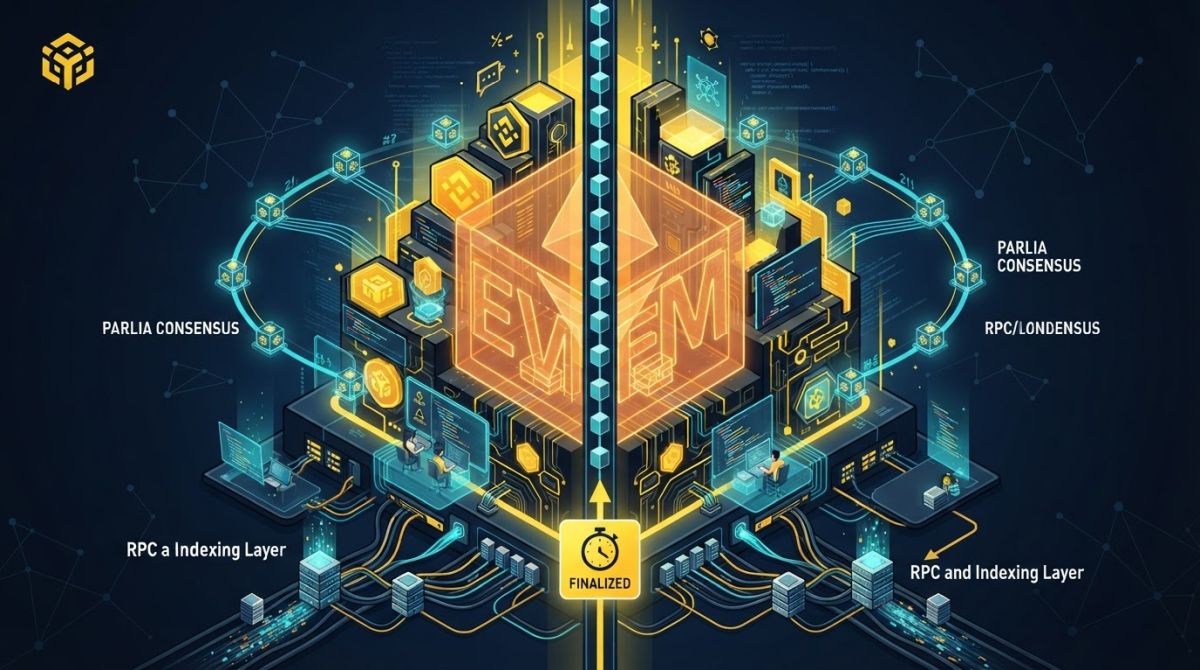
I find it useful to evaluate a BSC application as three separate layers:
- EVM execution: How smart contracts execute and update state.
- Parlia consensus and block finality: How blocks are produced, selected, and finalized.
- RPC and indexing infrastructure: How the application submits transactions, reads data, and maintains its own usable view of the chain.
A simple integration may expose only the first layer. Production reliability depends heavily on the other two.
What EVM Compatibility Does and Does Not Guarantee
EVM compatibility means a Solidity contract can execute on BSC if its compiled bytecode uses instructions supported by the network’s active hard fork.
That gives developers several practical advantages:
- ABI encoding works the same way as on Ethereum.
- Addresses use the standard 20-byte format.
- Contracts use the familiar EVM storage model.
msg.sender,msg.value,block.number, andblock.timestampretain their familiar roles.- Event logs use topics and data fields.
- ERC-20 interfaces provide the foundation for BEP-20 tokens.
- Ethereum tooling can connect to BSC through the appropriate RPC endpoint and chain ID.
Over time, BSC has adopted Ethereum features including typed transactions, EIP-1559 transaction structures with a zero base fee, PUSH0, transient storage, MCOPY, blob transactions, and EIP-7702.
I check the BNB Evolution Proposals and their implementation status when evaluating these features. A proposal’s existence is not enough, however. What matters for a deployment is whether the relevant change is active on the specific network and supported by the client version being used.
The distinction I keep coming back to is simple:
Compatibility is not identity.
Differences That Become Visible in Production
A contract can be bytecode-compatible while the application around it behaves differently because of:
- Shorter block intervals.
- Different finality rules.
- A different fee market.
- A different validator set.
- A different MEV environment.
- RPC provider restrictions.
- Different hard-fork schedules.
- Different token availability and liquidity.
Moving a contract from Ethereum to BSC is therefore not a complete migration until the team has checked the backend, indexer, wallet configuration, token addresses, oracle sources, bridge assumptions, and monitoring.
Suppose a contract expects a particular Chainlink feed, DEX router, or stablecoin deployment. The same address on BSC usually does not identify the same contract.
There may be no code at that address. Worse, there may be an entirely unrelated contract.
Bridged assets and issuer-native assets also need to be evaluated separately. A familiar token symbol does not establish the issuer, redemption arrangement, or bridge security model.
My rule is straightforward: Chain-specific addresses belong in validated configuration, not in constants copied from another network’s deployment.
How Parlia and Proof of Staked Authority Produce Blocks
BSC uses the Parlia consensus engine, which is built around Proof of Staked Authority, or PoSA.
PoSA combines two ideas:
- Staking helps determine which validator candidates are eligible to participate.
- A limited set of validators produces blocks according to a schedule resembling a Proof of Authority system.
The BSC validator selection and rotation rules describe an active validator set of 45:
- The 21 validators with the most stake are classified as Cabinet validators.
- The remaining 24 are classified as Candidate validators.
For each epoch, a consensus set of 21 validators is selected:
- 18 from the Cabinet group.
- 3 from the Candidate group.
The documentation describes a daily election after 00:00 UTC that selects the active validators according to staking rankings. The epoch-level selection then determines which validators participate in block production for that epoch.
This is an important distinction from Ethereum’s Proof of Stake architecture. BSC deliberately concentrates direct block production in a smaller consensus set to support shorter propagation times and more frequent blocks.
The trade-off is a greater concentration of consensus responsibility.
A simplified transaction-to-finality flow looks like this:
- A wallet or backend signs a transaction.
- An RPC node receives the signed transaction and applies its transaction-admission checks.
- The transaction enters a transaction pool, which may be public or part of a private submission route.
- A validator or block builder selects and orders transactions.
- The EVM executes the transactions and calculates the resulting state changes.
- A new block is proposed and propagated.
- Validators exchange finality votes according to the protocol’s voting rules.
- The block becomes finalized when the required voting and attestation conditions are satisfied.
For application design, block production and block finalization are related processes, not interchangeable events.
Why BSC Blocks Are No Longer Three Seconds Apart
BSC Mainnet’s documented block interval is approximately 0.45 seconds, not the three seconds still quoted in many older articles and integrations.
The Lorentz, Maxwell, and Fermi upgrades progressively reduced the interval from three seconds to roughly 0.45 seconds.
This change usually matters more to backend infrastructure than to Solidity code.
A service that checks for a new block every three seconds can now have several blocks arrive between checks. An indexer that processes logs slowly and sequentially can accumulate a backlog much faster. A frontend that refreshes every data source on every block can generate an unnecessary volume of RPC requests.
Shorter blocks do not mean every user request should trigger a fresh blockchain read.
I would still build the frontend and backend around:
- Caching.
- Request deduplication.
- Batched RPC requests.
- Multicall where appropriate.
- Indexed data for lists, histories, and aggregates.
- Direct RPC reads for critical or time-sensitive state.
I would also avoid treating a fixed number of blocks as a permanent measure of elapsed time. Network upgrades can change the block interval without changing the business meaning of an order deadline.
Transaction Inclusion vs. Finality on BSC
A transaction receipt proves that a transaction was included in a block observed by the RPC node. It does not, by itself, prove that the block is finalized.
This is the distinction I would never blur in a financial application.
In banking, “received,” “processed,” and “settled” are not interchangeable entries. The blockchain equivalents also deserve separate states.
| State | Meaning |
|---|---|
| Submitted | The submission interface returned a transaction hash. The transaction has not necessarily been included. |
| Included | The transaction appears in a block and has a receipt. Its execution may have succeeded or reverted. |
| Finalized | The containing block is finalized under the network’s consensus assumptions and should not be removed by a normal chain reorganization. |
BSC’s Fast Finality mechanism was introduced through BEP-126. Validators sign BLS votes, and those votes are aggregated into attestations used by the protocol’s justification and finalization rules.
Under normal operating conditions, the documentation describes finalization within approximately two blocks, with timing around a second at the current block interval.
That is an operating expectation, not a wall-clock guarantee.
If there are not enough finality votes, the chain can continue producing blocks while relying on probabilistic finality. In that situation, more confirmations can increase confidence, but an application cannot honestly conclude that every block becomes finalized after a fixed number of milliseconds.
For critical decisions, read the finalized block tag.
A direct JSON-RPC request looks like this:
{
  "jsonrpc": "2.0",
  "id": 1,
  "method": "eth_getBlockByNumber",
  "params": ["finalized", false]
}
That is a better settlement signal than a hardcoded instruction such as “wait three blocks.”
How I Model Transaction Status in an Application
For an escrow deposit, payout, or withdrawal, I would use a workflow along these lines:
- Submitted: Record the transaction hash and its relationship to the business operation.
- Pending: No receipt is available yet. Distinguish this from an actual RPC failure.
- Reverted: A receipt exists, but execution failed. Raw JSON-RPC represents a failed receipt status as
0x0; Viem exposes it as'reverted'. - Included: A successful receipt exists, but its block is ahead of the finalized head.
- Finalized: The successful receipt belongs to the canonical chain, and the finalized head has reached or passed its block.
- Needs investigation: The transaction remains unlocated beyond the expected period. Check for replacement transactions, cancellation, nonce conflicts, and differences between providers’ transaction-pool views.
Execution outcome and finality are separate dimensions. A reverted transaction can also become finalized. Finalization does not turn a failed contract call into a successful payment.
Viem lets an application request the finalized block explicitly:
import { createPublicClient, http } from 'viem';
import { bsc } from 'viem/chains';

const publicClient = createPublicClient({
  chain: bsc,
  transport: http(process.env.BSC_RPC_URL),
});

export async function isTransactionFinalized(hash: `0x${string}`) {
  const [receipt, finalizedBlock] = await Promise.all([
    publicClient.getTransactionReceipt({ hash }),
    publicClient.getBlock({ blockTag: 'finalized' }),
  ]);

  const receiptBlock = await publicClient.getBlock({
    blockNumber: receipt.blockNumber,
  });

  return {
    receipt,
    finalized:
      receiptBlock.hash === receipt.blockHash &&
      finalizedBlock.number >= receipt.blockNumber,
  };
}
The block-hash check matters. Comparing heights alone is not sufficient if a receipt came from a block that was subsequently removed from the canonical chain.
This example is intentionally small. A production implementation should also:
- Treat a missing receipt differently from a failed RPC request.
- Check
receipt.statusbefore recognizing a successful business operation. - Validate the RPC network’s chain ID.
- Fail fast if the required RPC configuration is missing.
- Avoid combining inconsistent responses from different providers without checking canonicality.
The Viem block-querying API accepts tags including latest, pending, safe, and finalized, as well as earliest. Actual availability and behavior still depend on the RPC server.
A library accepting a parameter does not guarantee that every provider implements it correctly.
BSC Gas Fees: How Transaction Costs Actually Work
A standard BSC transaction’s execution fee is the gas actually used multiplied by the effective price paid per unit of gas.
The amount of gas used depends on the EVM operations executed. The gas price is expressed in wei per unit of gas, and the resulting fee is paid in BNB.
The unit relationships are:
- One gwei contains 1,000,000,000 wei.
- One BNB contains 1,000,000,000,000,000,000 wei.
BSC supports EIP-1559 transaction structures, but BEP-226 introduced them with the base fee set to zero. That is not the same fee mechanism Ethereum Mainnet uses.
The published BNB Chain gas and fee configuration lists a standard minimum priority price of:
- 0.05 gwei for BSC Mainnet.
- 0.1 gwei for BSC Testnet.
I would not present those values as a promise that any transaction submitted at that price will immediately enter a block. They describe the documented standard configuration, while actual inclusion depends on current conditions, validator policies, transaction validity, and the submission route.
Do not hardcode a gas price in production merely because a documentation table or an article lists it.
Use current RPC estimates, such as:
eth_gasPriceeth_maxPriorityFeePerGas- Your client library’s fee-estimation functionality
Then apply a deliberate application policy for fee caps, retries, and replacement transactions.
Illustrative Transaction Costs at 0.05 Gwei
If the effective gas price were exactly 0.05 gwei, the execution fees would be:
| Operation | Gas used | Cost in BNB |
|---|---|---|
| Plain native BNB transfer | 21,000 | 0.00000105 BNB |
| Illustrative simple contract call | 100,000 | 0.000005 BNB |
| Illustrative more complex transaction | 250,000 | 0.0000125 BNB |
| Deployment using 1,000,000 gas | 1,000,000 | 0.00005 BNB |
The 21,000-gas example assumes a plain transfer without additional execution. Transfers involving contract execution or other transaction features can consume more gas.
The contract-call and deployment figures are examples, not fixed gas requirements for those categories.
To estimate the fiat cost, multiply the BNB fee by the current BNB price. Both the asset price and fee conditions can change, so neither an article nor an application interface should present a fixed USD amount as a permanent property of the network.
Gas Limit and Gas Price Are Different Things
The gas limit controls how much computational work a transaction may consume. The gas price controls what the sender pays for each unit consumed.
The relevant fields are:
gasorgasLimit: The maximum amount of gas the transaction may use.gasPrice: The price per unit of gas for a legacy transaction.maxFeePerGas: The maximum total price per unit of gas for a dynamic-fee transaction.maxPriorityFeePerGas: The maximum priority-fee component per unit of gas.
If a transaction uses less gas than its limit, the unused portion is not charged.
If it exhausts its gas limit, execution fails with an out-of-gas condition. The state changes from that failed execution are reverted, but the gas consumed is not returned to the sender.
That is why eth_estimateGas belongs in transaction preparation. It is not an optional optimization to skip because the network is inexpensive.
A Practical BSC Use Case: Escrow for a Digital Marketplace
An escrow contract can hold a buyer’s payment and release it to a seller when the application’s delivery conditions are met.
To make the infrastructure discussion concrete, I will use a marketplace for digital products or services.
The underlying transaction could involve:
- Purchasing a software license.
- Buying API credits.
- Ordering digital content.
- Paying for a freelance task.
- Settling an obligation between two applications.
- Purchasing a tokenized digital good.
BSC can make sense when individual payments are relatively small, users value short confirmation times, and the development team wants a standard EVM stack.
The important question is not simply whether the payment is cheap. It is whether the application can reliably connect payment, delivery, refunds, and its own records.
What Belongs On-Chain?
The contract should store the information needed to enforce custody and state transitions, not the entire business record.
For an escrow order, that may include:
- The order identifier.
- The buyer.
- The seller.
- The payment-token address.
- The locked amount.
- The deadline.
- The order status.
- The parties authorized to release or refund the funds.
I would keep the following off-chain:
- Private buyer information.
- The complete order contents.
- Large files.
- API results.
- Internal comments.
- Information that legal requirements or business rules may require the application to delete.
Instead of storing a full document, the contract can store a bytes32 hash of a canonically serialized version.
That hash can establish whether a later document matches the committed document. It does not prove that the document is truthful, complete, lawful, or commercially valid.
A hash is also not automatically a privacy mechanism. Predictable underlying data may still be guessable.
A Practical Application Architecture
The contract should be authoritative for custody of funds, while the application database combines indexed on-chain facts with off-chain business information.
A clean architecture can follow this flow:
- The web application connects to the user’s wallet for account access and transaction signing.
- The web application also communicates with the backend API for order preparation and business data.
- The wallet submits signed transactions through an RPC provider to the escrow contract.
- The escrow contract emits events when orders are created, released, or refunded.
- An indexer reads those events and updates the application database.
- The backend API reads and writes application records in that database.
- A delivery worker handles off-chain fulfillment, using a separate storage service for files or other deliverables.
This separation matters.
If the database says an order is funded but the contract says it is not, the contract is the authority for the funds.
If the contract stores only a content hash, the database or storage service still holds the actual content.
My finance background makes me particularly cautious here: A convenient internal record is not a substitute for reconciling against the system that actually controls the money.
A Minimal Escrow Smart Contract Interface
A useful escrow interface needs a clear state machine and indexable events more than it needs a long list of functions.
A minimal starting point could look like this:
interface IOrderEscrow {
    event OrderCreated(
        bytes32 indexed orderId,
        address indexed buyer,
        address indexed seller,
        address token,
        uint256 amount,
        uint64 deadline
    );

    event OrderReleased(bytes32 indexed orderId);
    event OrderRefunded(bytes32 indexed orderId);

    function createOrder(
        bytes32 orderId,
        address seller,
        address token,
        uint256 amount,
        uint64 deadline
    ) external;

    function release(bytes32 orderId) external;
    function refund(bytes32 orderId) external;
}
This is an interface, not a complete or audited escrow implementation. The implementation still needs to define custody, authorization, deadlines, and every valid state transition.
At a minimum, it should verify that:
- The
orderIddoes not already exist. - The seller is not the zero address.
- The payment token is allowed.
- The amount is greater than zero.
- The deadline is not in the past.
- Only an authorized party can call
release. - A refund is possible only in explicitly defined states.
- Internal accounting is updated before outbound token transfers.
- Reentrancy protection covers all relevant external-call paths.
- Events are emitted only as part of a successful state transition.
For token transfers, I would use OpenZeppelin’s SafeERC20 wrappers rather than assume that every token perfectly implements the expected IERC20 return behavior.
A transfer fragment might look like this:
using SafeERC20 for IERC20;

IERC20(order.token).safeTransfer(order.seller, order.amount);
The BEP-20 token interface specification derives from ERC-20 and uses familiar functions such as transfer, approve, transferFrom, balanceOf, and allowance.
But “BEP-20” is an interface label, not a guarantee that every deployed token behaves identically.
BEP-20 Token Risks an Escrow Must Handle
An escrow that accepts arbitrary tokens inherits the behavioral risks of those tokens.
I would not accept “it is a BEP-20 token” as sufficient integration due diligence. Several common token behaviors can break otherwise reasonable accounting.
Tokens That Return false
Some tokens return false when a transfer fails instead of reverting.
If the escrow ignores the return value, it may record a payment even though no funds were transferred.
SafeERC20.safeTransferFrom handles this class of failure by rejecting a transfer that explicitly signals failure.
It does not make an arbitrary or malicious token trustworthy. It solves a specific interface-handling problem.
Tokens That Return No Value
Some deployed tokens do not return the standard Boolean value from transfer or transferFrom.
A direct ABI interaction that expects a Boolean can fail when the token returns no data. SafeERC20 supports these nonstandard implementations while still checking for call failure.
Fee-on-Transfer Tokens
A user can request a transfer of 100 token units while the escrow receives only 98.
If the contract simply records the requested amount, its accounting no longer matches the funds it holds.
An implementation that intentionally supports these tokens can measure the actual balance change:
uint256 beforeBalance = token.balanceOf(address(this));
token.safeTransferFrom(msg.sender, address(this), amount);
uint256 received = token.balanceOf(address(this)) - beforeBalance;
The contract must then account for the amount actually received, not blindly use the requested amount.
Even this does not solve every rebasing or nonstandard-token case. An outgoing transfer fee can also mean the seller receives less than the escrow sends.
For an escrow product, my conservative preference is an explicit allowlist of supported payment tokens. Support unusual token behavior only when the business actually needs it and the accounting has been designed for it.
Tokens With Unexpected Decimals
Never assume every token uses 18 decimals.
The frontend can read decimals(), but the backend should treat amounts as integers in the token’s smallest units. A decimal string entered by the user must be converted before the transaction is signed.
In JavaScript and TypeScript, monetary calculations should use integer-safe types such as bigint, not floating-point Number arithmetic. At API boundaries, integer strings are often the practical serialization format.
Token metadata should also be validated against the application’s supported-token configuration rather than treated as an unlimited source of trust.
Fake Tokens With Familiar Symbols
symbol() and name() do not establish token identity.
Anyone can deploy a token called USDT, USDC, or another recognizable name.
At a minimum, token identity is a composite identifier:
chain ID + contract addressA production application should maintain a verified list of token addresses for each supported network.
The symbol is a display label. The address and network identify the contract.
From Wallet Click to Finalized Order: The Complete Workflow
A reliable escrow integration is a coordinated workflow across the frontend, wallet, contract, backend, and indexer.
It is not just a call to writeContract.
1. Build a Deterministic orderId
An orderId can be derived from the order’s identifying parameters:
orderId = keccak256(
    appDomain,
    internalOrderId,
    buyer,
    seller,
    token,
    amount
)
This is pseudocode. In an implementation, the fields must be encoded unambiguously before hashing, for example with a defined ABI encoding scheme.
The domain or namespace separates identifiers belonging to different applications that otherwise use the same format. For cross-chain or multi-contract deployments, I would also bind the domain to the intended chain and escrow contract.
The backend should not accept an arbitrary orderId without verifying that it belongs to the specified order and user.
The contract must enforce the relevant sender and parameter binding as well. A hash generated by the frontend does not enforce authorization on its own.
2. Have the Backend Prepare Unsigned Parameters
The backend can return the transaction parameters the user needs:
- The escrow address.
- The payment-token address.
- The amount in the token’s smallest units.
- The
orderId. - The seller’s address.
- The deadline.
- The expected chain ID.
The user’s private key stays in the wallet.
This keeps order preparation separate from transaction authorization. The backend can define the proposed operation without gaining custody of the user’s signing key.
3. Check Both the RPC Network and the Wallet Network
Before simulation, verify that the public client is connected to the expected network:
const chainId = await publicClient.getChainId();

if (chainId !== 56) {
  throw new Error(
    `Wrong RPC network: expected chain ID 56, received ${chainId}`,
  );
}
That check validates the RPC connection, not necessarily the user’s wallet. Check the wallet separately:
const walletChainId = await walletClient.getChainId();

if (walletChainId !== chainId) {
  throw new Error(
    `Wrong wallet network: expected chain ID ${chainId}, ` +
      `received ${walletChainId}`,
  );
}
On BSC Testnet, the expected chain ID is 97.
I would keep explicit network checks even when the wallet interface displays a friendly network name. The name is presentation data. For replay-protected transactions, the chain ID is part of the signed transaction’s network binding.
The signing request should also specify the intended chain, so a network change between the initial check and submission does not silently redirect the operation.
4. Check the Token Allowance
If the escrow collects funds with transferFrom, the user must authorize it to spend the payment token.
The conventional workflow requires two transactions:
approve(escrow, amount)createOrder(...)
This has both usability and security consequences.
An unlimited approval reduces the need for future approval transactions, but increases the potential loss if the escrow contract or its upgrade authority is compromised.
A more conservative approach is to approve the exact amount or a clearly bounded spending limit.
Some tokens also require allowance changes to pass through zero, so the approval flow needs to accommodate the actual supported token behavior.
A permit mechanism may reduce the number of on-chain steps when the token and escrow integration support the appropriate standard. Do not assume every BEP-20 token implements permit.
5. Simulate the Contract Call
Viem separates transaction simulation from transaction submission:
const { request } = await publicClient.simulateContract({
  account,
  address: escrowAddress,
  abi: escrowAbi,
  functionName: 'createOrder',
  args: [
    orderId,
    sellerAddress,
    tokenAddress,
    amount,
    deadline,
  ],
});
These variables should already be validated, with token amounts and other large integer arguments represented using the appropriate integer-safe types.
Simulation can catch many problems before the user signs:
- Insufficient allowance.
- An unsupported payment token.
- A duplicate
orderId. - An expired deadline.
- An unauthorized caller.
- Another contract condition that would cause a revert.
If an approval transaction is required first, the allowance must be available in the state being simulated.
Simulation is still not a guarantee of success. State can change between the eth_call simulation and the transaction’s actual execution.
6. Ask the Wallet to Submit the Simulated Request
The wallet can submit the request returned by the simulation:
const hash = await walletClient.writeContract(request);The returned hash identifies the submitted transaction. It does not prove that the transaction executed or that the escrow received funds.
The interface should display at least:
- The transaction hash.
- The network.
- A pending status.
- A way for the user to close the screen without losing transaction tracking.
Persist the hash immediately, either locally or through the backend.
I would not make transaction tracking depend on a browser tab remaining open.
7. Wait for the Transaction Receipt
The frontend or backend can wait for inclusion:
const receipt = await publicClient.waitForTransactionReceipt({
  hash,
});
Then inspect the execution outcome:
if (receipt.status !== 'success') {
  throw new Error('The escrow transaction reverted');
}
Do not accept a receipt simply because it exists. Reverted transactions also have receipts and consume gas.
If the user speeds up or cancels a transaction, track the replacement. Do not assume the original hash will eventually produce the intended escrow event.
8. Have the Backend Verify the Event
The backend must not trust a transaction hash merely because the frontend submitted it.
It should independently verify:
- The chain ID.
- The escrow contract address.
receipt.status.- The emitted event.
- The
orderId. - The buyer’s address.
- The seller’s address.
- The payment token.
- The amount.
- The block number.
- The containing block’s identity where canonicality needs to be checked.
Only after those checks should the internal order move from awaiting_payment to included.
A successful transaction to the wrong contract is not payment for the intended order.
9. Wait for Finality Before Irreversible Fulfillment
Once the finalized head reaches the canonical block containing the verified OrderCreated event, the order can move to funded.
This separation lets the application show progress quickly without starting an irreversible off-chain operation too early.
If access to a digital resource can be revoked, the application might deliberately grant provisional access after inclusion.
If fulfillment creates an irreversible cost, such as purchasing a third-party license or releasing a nonrecoverable asset, I would normally wait for finality.
That should be an explicit business-risk decision, not an accidental consequence of whichever receipt helper the developer used first.
How to Build a Reliable BSC Event Indexer
A BSC event indexer needs an RPC service that supports historical log retrieval, a durable processing cursor, and idempotent database writes.
One important operational limitation appears in the documented BSC public RPC endpoints: eth_getLogs is disabled on the listed public mainnet endpoints.
The documentation recommends third-party endpoints for log retrieval and WebSocket delivery when logs are needed frequently.
A public endpoint that works for eth_call is therefore not automatically suitable for an indexer.
Use a Durable Cursor
For event-level processing and partial-block recovery, a useful cursor contains:
blockNumber
transactionIndex
logIndex
blockHash
A block can contain multiple relevant transactions, and a single transaction can emit multiple relevant logs. An event-level cursor therefore needs more detail than blockNumber alone.
A block-only high-water mark can work if the indexer processes and commits complete blocks atomically. The important point is to make the checkpoint model match the actual transaction boundaries in the database.
A typical finalized-event indexing workflow is:
- Load the last successfully processed finalized checkpoint.
- Read the current finalized head.
- Divide the unprocessed interval into manageable block ranges.
- Call
eth_getLogsfor known contract addresses and topics. - Sort the results by
blockNumber,transactionIndex, andlogIndex. - Write the events and their projections idempotently.
- Advance the cursor only after the database commit succeeds.
Provider limits may require the worker to shrink a range and retry. That should be normal control flow, not an emergency procedure.
For finalized events, a useful deduplication key is:
chainId + transactionHash + logIndexThis prevents duplicate processing when a worker retries the same range after a restart.
An optimistic indexer also needs block identity and rollback handling. A deduplication key alone does not solve reorganizations.
WebSockets Do Not Replace Backfill
A WebSocket subscription is a low-latency notification mechanism, not a complete indexing strategy.
Connections drop. Processes restart. Providers can miss or delay notifications.
After every reconnect, run an HTTP backfill from the last reliably processed checkpoint using an endpoint that supports the required historical log queries.
A practical pattern is:
- WebSockets notify the application that new blocks or logs are available.
- HTTP JSON-RPC retrieves logs deterministically.
- A database cursor provides durable recovery.
I treat a subscription as a prompt to check the ledger, not as the ledger itself.
Choosing Between latest and finalized
An indexer can prioritize simplicity and settlement confidence, or prioritize the earliest possible interface update.
The two common approaches have different operational costs.
Finalized-Only Event Indexing
A finalized-only indexer reads only blocks at or below the finalized head.
Its advantages include:
- Simpler database logic.
- No normal unfinalized-reorg rollback path.
- No events appearing in the interface and then disappearing because their blocks were reorganized.
Its main disadvantage is:
- A small amount of additional application latency.
This does not eliminate the need for incident recovery, provider validation, or backups. It removes a common category of ordinary unfinalized-chain handling.
Optimistic Event Indexing
An optimistic indexer reads latest blocks and updates the interface immediately.
Its main advantage is:
- The fastest possible visible response to inclusion.
Its requirements include:
- Storing block hashes.
- Detecting reorganizations.
- Reversing previously applied event projections.
- Separating
includedfromfinalizedstatus.
On a network where normal finality is around a second, I think finalized-only indexing is often a sensible starting point for business applications.
The extra complexity of optimistic indexing should buy something the product genuinely needs.
Backend Wallets and Nonce Management
A backend that submits transactions needs durable coordination for each sender account, not just access to a private key.
This applies when the backend handles releases, refunds, batch settlement, or other administrative transactions.
One of the easiest ways to break such a system is concurrent nonce assignment.
Two workers can read the same transaction count and attempt to submit different transactions with the same nonce. One may replace the other if replacement conditions are met, or one may be rejected. Missing or unresolved nonces can also block later transactions from the account.
I would give each sender account a serialized transaction pipeline:
- API requests enter a durable queue.
- The queue organizes work by sender account.
- A nonce manager reserves the next nonce durably.
- An isolated signer authorizes and signs the transaction.
- A write RPC endpoint broadcasts the signed transaction.
- A receipt monitor tracks inclusion, replacement, failure, and finality.
The practical rules are:
- One logical writer controls nonce assignment for each sender account.
- Nonces are reserved through a database transaction or durable queue mechanism.
- Startup recovery reconciles local transaction records with the RPC’s
pendingtransaction count. - Every business operation has an idempotency key.
- Replacement transactions use the same nonce and an appropriate fee policy.
submittedis never treated as business success.- The signer is not exposed to an ordinary web process unless that access is genuinely necessary.
The RPC’s pending transaction count is only that node’s view. A fallback provider may not have seen a transaction that the application already signed and broadcast.
Do not discard durable local records just because one provider reports a lower pending count.
For higher-value treasury accounts, I would consider multisignature controls or hardware-backed key management instead of relying on a single hot private key.
Why the RPC Layer Is Part of the Security Model
An RPC provider influences what an application sees, when it sees it, and whether its transactions reach the network.
The provider can observe the application’s reads and submissions. It can also be unavailable, slow, misconfigured, or several blocks behind.
For a prototype, one endpoint may be enough. For production, I would consider separating these roles:
- Read RPC.
- Write RPC.
- WebSocket RPC.
- Archive RPC.
- Fallback provider.
The read and write endpoints do not have to be the same.
A dedicated write route can make rate-limit management, transaction rebroadcasting, and submission-policy control easier.
However, rebroadcasting should not accidentally become a second business operation. Retrying the same signed transaction is different from creating a new transaction with a new nonce.
RPC Metrics Worth Monitoring
RPC monitoring should measure application-relevant behavior, including:
- Latency by method.
- Error rate.
- Timeout rate.
- Current block number.
- Finalized block number.
- The gap between the latest and finalized heads.
- Height differences between providers.
- The success rate of
eth_estimateGas. - Time from submission to receipt.
- Time from receipt to finality.
HTTP 200 is not a meaningful blockchain health check on its own.
An RPC server can return an HTTP success response containing a JSON-RPC error. It can also return perfectly formatted but stale data.
For high-value decisions, I would want a plan for cross-checking critical observations through an independent provider or an appropriately configured node.
A Public Endpoint Is Not a Production SLA
The documented public BSC endpoints list a rate limit of 10,000 requests per five minutes for mainnet and testnet, alongside the mainnet eth_getLogs restriction.
That is a policy for those endpoints, not a network-wide capacity promise.
Even when average traffic fits comfortably within a limit, bursts can still cause failures.
Per-user frontend polling is particularly good at turning a modest user base into a surprisingly large RPC bill or a wave of throttled requests.
Caching, shared backend reads, deduplication, and sensible refresh policies matter even when individual transactions are cheap.
When Running Your Own BSC Node Makes Sense
Running a BSC node gives a team more control over data access and operating policies, but it creates a substantial infrastructure responsibility.
The benefits can include control over:
- Retention policies.
- Available RPC methods.
- Log-query ranges.
- Tracing.
- Rate limits.
- Read privacy.
- Dependence on an outside provider.
A BSC node is not a small service to start occasionally on an inexpensive virtual machine.
The BSC node configuration best practices distinguish fast, full, and archive configurations.
| Node type | CPU | RAM | Storage |
|---|---|---|---|
| Fast node | At least 16 cores | At least 32 GB | At least 2 TB SSD |
| Full node | At least 16 cores | At least 64 GB | At least 3 TB SSD |
| Archive node | At least 16 cores | At least 128 GB under the general guidance | At least 10 TB SSD under the general guidance |
These figures are documented provisioning baselines, not permanent capacity guarantees.
Archive requirements depend on the client, database design, retention policy, snapshot age, and the amount of operational headroom required.
The separate BSC Erigon archive-node deployment guide gives a different baseline, including at least 64 GB of RAM and 5 TB of storage for archive mode.
That is not necessarily a contradiction. Different clients, storage engines, pruning strategies, and documentation snapshots can produce different requirements.
I would size an archive deployment against the current client release and current data footprint, not simply choose the smallest number mentioned on any documentation page.
The BSC node maintenance recommendations also emphasize disk performance: SSD or NVMe storage, thousands of IOPS, high throughput, and low read latency.
Full-node storage needs an appropriate maintenance and pruning strategy. The procedure must match the actual client version and storage scheme.
For many teams, a hybrid setup is more practical:
- A commercial RPC provider as the primary endpoint.
- A second provider as a fallback.
- A self-operated pruned node for critical reads.
- An archive provider for historical-state queries and tracing.
Owning a node can reduce one category of dependency. It does not remove the need for monitoring, upgrades, backups, and operational expertise.
A Reliable BSC Smart Contract Deployment Workflow
Deploying on BSC uses familiar EVM tools, but a reliable release process includes much more than forge script --broadcast.
I want a deployment to be reproducible, reviewable, and recoverable. A transaction hash alone does not meet that standard.
1. Pin the Compiler and Dependencies
Do not let CI silently move to a new Solidity or OpenZeppelin version without reviewing the changes.
Pin or version-control:
- The Solidity compiler version.
evmVersion.- The OpenZeppelin Contracts version.
- The Foundry or Hardhat version.
- The npm lockfile.
- The deployment scripts.
BSC implements many Ethereum EIPs, but a new Solidity default can emit instructions that are not active on every target network, private chain, or local fork environment.
Compiler compatibility should be an explicit deployment decision.
2. Test the State Machine, Not Just Individual Functions
An escrow test suite needs to cover invalid transitions as thoroughly as the happy path.
I would include:
- A duplicate
orderId. - A zero amount.
- A zero address.
- An expired deadline.
- Release by an unauthorized address.
- A refund before the permitted time.
- A refund after release.
- A token transfer that returns
false. - A token transfer that reverts.
- A fee-on-transfer token.
- A reentrancy attempt.
- A paused contract, if a pause mechanism exists.
- Boundary timestamp values.
The goal is to prove that an order cannot move into an invalid financial state, not merely that each function can be called successfully once.
3. Fork-Test Against Real Token Deployments
Local mock ERC-20 contracts are usually better behaved than real tokens.
Fork tests can expose differences in:
- Decimals.
- Allowance handling.
- Return values.
- Transfer restrictions.
- Other deployment-specific behavior.
Pin the fork block number.
Otherwise, a test can pass today and fail tomorrow because external state changed, even though the application code did not.
A reproducible failure is much more useful than a test suite that depends on whatever the live chain happens to look like that morning.
4. Deploy to BSC Testnet
BSC Testnet uses chain ID 97 and tBNB for gas.
The testnet exercise should validate more than the deployment transaction. Check:
- Wallet network switching.
- The deployment script.
- Contract verification.
- The approval workflow.
- Event indexing.
- Reading the finalized block.
- Indexer restarts.
- RPC failover.
- The backend nonce queue.
- Alerting.
Testnet is also the place to discover that the application cannot recover cleanly from a disconnected WebSocket or a restarted worker.
5. Verify the Deployed Runtime Bytecode
After deployment, compare the expected runtime code with the code returned for the deployed address.
That comparison must account for the artifact’s actual deployment details, including linked libraries, immutable values, and relevant compiler metadata.
A transaction hash does not establish that the correct artifact was deployed to the correct network with the correct constructor arguments.
For proxy deployments, verify the proxy configuration and implementation address as well.
6. Separate Addresses by Environment
A network configuration might look like this:
type ChainConfig = {
  chainId: number;
  escrow: `0x${string}`;
  paymentTokens: Record<string, `0x${string}`>;
};

export const chains: Record<
  'bscTestnet' | 'bscMainnet',
  ChainConfig
> = {
  bscTestnet: {
    chainId: 97,
    escrow: process.env.BSC_TESTNET_ESCROW as `0x${string}`,
    paymentTokens: {},
  },
  bscMainnet: {
    chainId: 56,
    escrow: process.env.BSC_MAINNET_ESCROW as `0x${string}`,
    paymentTokens: {},
  },
};
The type assertions do not validate environment variables at runtime. Add startup checks for missing values, malformed addresses, the intended chain, and expected contract code.
An empty token allowlist is safer than automatically filling it with unverified addresses from a blog post or a random repository.
Smart Contract Optimization Is Not Just About Lower Gas Bills
Gas optimization matters on BSC because gas limits computational work and network capacity, even when the fee paid in BNB is small.
Low gas prices can encourage a misleading conclusion: If the transaction is cheap, inefficient code does not matter.
Gas still serves at least two important roles:
- It limits the work a transaction can perform.
- It affects the scalability of both the application and the network.
Storage Writes Are Still Expensive Operations
Every permanent storage field adds to the chain’s state.
An application often needs only the current state on-chain, with events providing the history for an indexer.
A potentially troublesome pattern is:
mapping(address => Order[]) public allOrdersByUser;This can become expensive to update, awkward to paginate, and impractical for other contracts to consume as a complete history.
A more manageable pattern is often:
mapping(bytes32 => Order) public orders;Paired with events such as:
event OrderCreated(bytes32 indexed orderId, address indexed buyer);The contract maintains the state it needs to enforce. The indexer handles lists, search, filtering, and historical views.
That is a division of responsibility, not a loss of functionality.
Avoid Iterating Over Unbounded Sets
A function that processes every user or every order can eventually become impossible to execute within the applicable gas limits.
Use bounded alternatives such as:
- User-initiated claim functions.
- Limited-size batches.
- Merkle claim mechanisms.
- Cursor-based processing.
- Off-chain computation with on-chain verification.
A low gas price does not remove the block gas limit or any transaction-level limits imposed by the network.
Events Do Not Replace Contract State
Events are useful for indexing, but contracts cannot directly read historical event logs.
Anything that future contract logic must verify needs to exist in state or be supplied through an explicit verification mechanism.
I would not remove a necessary state field simply because the same information appears in an event. The contract and the indexer have different access models.
MEV, Front-Running, and Transaction Ordering on BSC
Faster blocks do not eliminate front-running, sandwich attacks, or other forms of transaction-ordering risk.
If an application sends a DEX swap through a public mempool, other participants can attempt to act on that information before inclusion.
The BSC guide to private transaction routing and MEV protection describes Proposer-Builder Separation and private RPC options that can reduce public exposure before a transaction reaches a block.
Private routing is a mitigation, not a universal guarantee. Builders or other parties involved in the private route may still see the transaction, and inclusion behavior can differ from the public path.
A private RPC also cannot repair unsafe swap parameters.
A swap still needs:
- A reasonable
amountOutMin. - A deadline.
- A verified router address.
- A bounded allowance.
- Protection against an incorrect token path.
For an escrow’s createOrder, ordering is usually less sensitive if the identifier is bound to the actual buyer and verified order parameters.
But if anyone can register an arbitrary orderId, an attacker may front-run the legitimate user and claim that identifier first.
The fix is not simply “send a faster transaction.”
The contract needs appropriate domain separation and sender validation. It must enforce the relationship between the identifier, the caller, and the order parameters rather than trusting a supplied hash.
Should an Escrow Contract Be Upgradeable or Immutable?
BSC does not change the fundamental trade-off between upgradeability and predictable contract behavior.
An upgradeable contract can support:
- Bug fixes.
- New features.
- Changes to business rules.
- Responses to changes in integrated protocols.
It also introduces:
- Administrative-key risk.
- Storage-layout risk.
- Additional architectural complexity.
- The possibility of changing rules after users deposit funds.
- A need for transparent governance and upgrade procedures.
For an escrow with a short order lifecycle, I would seriously consider an immutable version followed by a new deployment when changes are needed.
The frontend can direct new orders to the new contract. Existing orders remain on the old contract until they close.
That can be easier to reason about than changing the implementation beneath active orders.
“Immutable” does not automatically mean “no privileged controls,” however. Any pause, allowlist, or fund-management permissions still need to be reviewed.
If a proxy is used, users should be able to determine:
- Who controls upgrades.
- Whether a timelock exists.
- Whether a pause mechanism exists.
- Who can modify the payment-token allowlist.
- Whether an administrator can redirect funds.
Lower gas costs are not a reason to skip the threat model.
BSC vs. opBNB: Should You Use Layer 1 or Layer 2?
BSC and opBNB are separate networks with different settlement architectures, even though both use BNB as their native asset.
The choice is not simply a contest over which transaction fee is smaller.
opBNB is a Layer 2 network that uses BSC as part of its Layer 1 infrastructure for data submission and settlement.
BSC can be the better fit when the application needs:
- Direct access to BSC liquidity.
- Existing BSC users and token deployments.
- A more direct Layer 1 settlement model.
- Short finality.
- A standard EVM stack.
- Transaction costs that BSC already makes acceptable.
opBNB may be more attractive when the application requires:
- Even cheaper microtransactions.
- Large numbers of frequent user actions.
- Gaming or social workloads.
- A Layer 2 architecture as an acceptable trade-off.
Moving to Layer 2 adds questions that do not disappear because the development tools look familiar:
- What is the sequencer model?
- How are Layer 1 data costs calculated?
- How do bridge deposits and withdrawals work?
- How does Layer 2 confirmation differ from Layer 1 settlement?
- Which tokens are actually available on the Layer 2 network?
- Which chain ID and RPC configuration does the application require?
Fast Layer 2 inclusion also does not mean every withdrawal back to Layer 1 is immediately settled and available.
BSC Mainnet uses chain ID 56. The opBNB mainnet network configuration specifies chain ID 204.
Those are different networks. Sharing BNB as the native asset does not make their contract addresses, balances, transactions, or finality assumptions interchangeable.
BSC’s Core Trade-Off: Performance and a Smaller Consensus Set
BSC’s most important architectural trade-off is its consensus design, not its Solidity syntax or choice of client library.
A limited consensus set supports:
- Faster block propagation.
- Short block intervals.
- Short normal finality.
- Simpler coordination among block producers.
- A high-throughput design that can keep fee pressure low.
It does not independently guarantee a fixed transaction price.
The same architecture also means:
- Fewer direct consensus participants.
- Greater importance placed on validator infrastructure.
- A different censorship-resistance profile.
- Greater reliance on the network’s staking and governance model.
For a rewards system, marketplace, gaming economy, loyalty program, or settlement service handling smaller amounts, that trade-off may be entirely acceptable.
For a system whose primary objective is maximum neutrality and resistance to coordinated censorship, I would explicitly compare BSC with other Layer 1 and Layer 2 options.
That comparison should examine the alternatives’ real validator, sequencer, governance, and settlement arrangements, not just their marketing categories.
EVM compatibility is not a security model.
What BNB Smart Chain Cannot Fix for Your Application
BSC can execute bytecode quickly and inexpensively. It cannot determine whether the application’s business logic is correct.
The network does not automatically solve:
- Smart contract bugs.
- A compromised administrative key.
- An incorrect token address.
- False oracle data.
- An insecure or unreliable bridge.
- Unlimited-approval risk.
- A lost private key.
- Duplicate event processing.
- Incorrect nonce management.
- An RPC provider that has fallen behind.
- Disagreement between database records and on-chain state.
- The application’s legal obligations.
Low fees can also make spam and automated attack attempts cheaper.
Rate limits, signature nonces, idempotency keys, and access controls remain necessary.
This is where I think the banking comparison is useful without taking it too far: A faster payment rail does not automatically produce better controls around the payment.
BSC Mainnet Production Checklist
A production-ready BSC application needs verified contracts, reproducible deployments, finality-aware accounting, and monitored infrastructure.
Before broadcasting a mainnet deployment, I would work through the following checklist.
Smart Contract
- The state machine is explicitly documented.
- Every invalid state transition has a test.
- BEP-20 transfers use
SafeERC20. - Supported payment tokens are allowlisted.
- No function relies on an unbounded loop.
- External calls cannot observe unsafe intermediate accounting, and outbound transfers follow the reviewed checks-effects-interactions design.
- Administrative permissions are minimized.
- The upgrade or immutability model is documented.
- Events are sufficient to reconstruct the intended application projection from the deployment block.
Deployment
- The chain ID is checked before broadcasting.
- Compiler and dependency versions are pinned.
- Constructor and initializer parameters are verified.
- Deployed runtime bytecode is validated.
- Source code is verified on the block explorer.
- Deployment artifacts and addresses are stored in version control.
Frontend
- The correct network is clearly displayed.
- Tokens are identified by contract address and network, not symbol alone.
- Amounts are converted using the correct, validated decimals.
- Transactions are simulated before submission.
- Pending, included, finalized, and reverted states are distinguished.
- The approval amount is visible to the user.
Backend
- Frontend-submitted data is independently checked against on-chain evidence.
- Event processing is idempotent.
- Processing cursors are durably stored.
- WebSocket reconnection triggers backfill.
- Financial decisions use finalized, canonical chain data.
- Each backend sender has a serialized nonce-management pipeline.
- Private keys do not appear in source code or logs.
Infrastructure
- At least one fallback RPC provider is available.
- Both latest and finalized heads are monitored.
- Alerts exist for RPC lag and indexer lag.
- The team knows whether each provider supports
eth_getLogs, tracing, and historical state. - Rate-limit behavior has been tested under burst load.
- The incident procedure covers pausing or migration where the architecture supports those actions.
A checklist does not replace an audit or a threat model. It helps prevent ordinary operational omissions from undermining otherwise sound contract code.
When Is BNB Smart Chain the Right Choice?
BNB Smart Chain is a reasonable candidate when an application needs an EVM environment but Ethereum Layer 1 fees or confirmation latency do not fit its operating model.
I would give BSC serious consideration when the application has:
- Many moderately complex contract interactions.
- Tokens or liquidity already established on BSC.
- Users who already hold BNB and use BSC-compatible wallets.
- A need for a short normal time to finality.
- A backend capable of reliable event indexing.
- A security model that explicitly accepts the PoSA validator trade-off.
I would be less convinced when:
- The application has no meaningful reason to use a blockchain.
- All rights and data ultimately depend on one centralized backend anyway.
- The product assumes effectively free, unlimited microtransactions.
- The team cannot maintain key management and RPC monitoring.
- The most important requirement is the broadest possible direct validator participation.
- The business logic depends on information the contract cannot obtain reliably.
My preferred first experiment would not be launching another token.
I would build a small contract with a clear state machine, a handful of useful events, and a complete backend workflow from simulation through finality.
That exercise reveals where BSC actually helps: It makes a familiar EVM workflow practical for a larger number of transactions without requiring a completely different approach to writing Solidity.
It also reveals where there are no shortcuts.
A reliable indexer, correct nonce management, verified token addresses, a finality-aware backend, and an explicit security model remain the application’s responsibility.
That is the standard I bring from finance: Know when value has settled, keep records that can be reconciled, and never confuse a fast interface with a reliable financial system.
Sponsored Partner: Volet.com
Looking for a simple, everyday way to buy, hold, and sell BNB and Bitcoin alongside your traditional currencies and payment cards?
- Read my full breakdown: Complete Volet Review on DoraMilen.com
- Get started right away: Open your free Volet account using my referral link