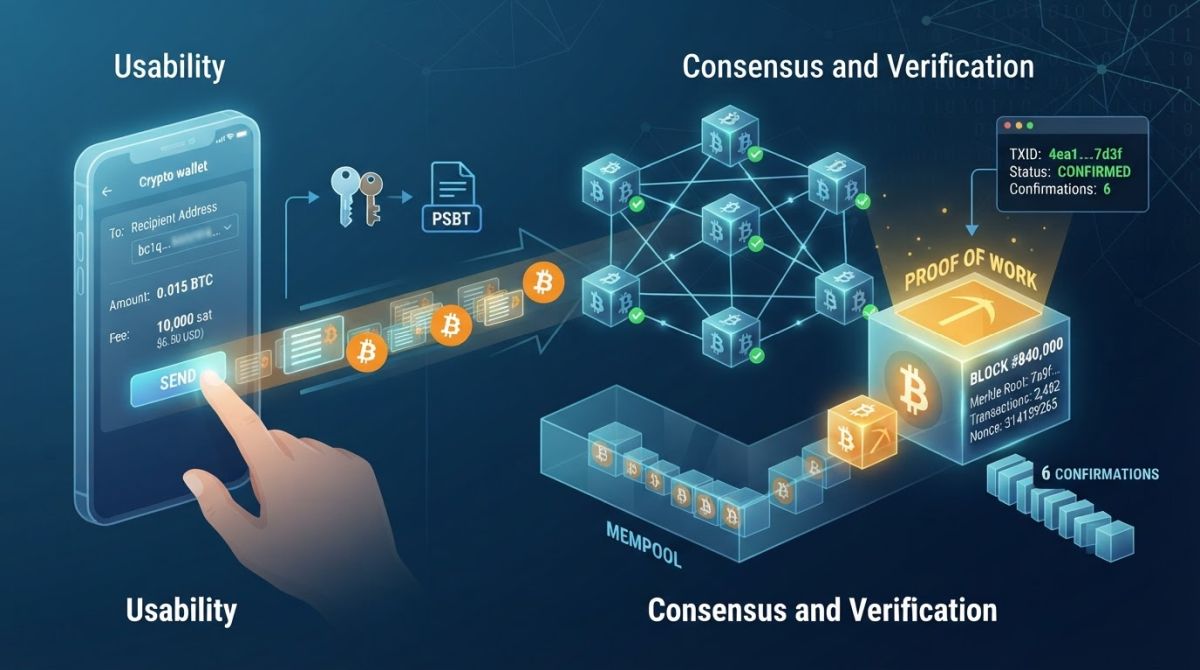
Most people know Bitcoin as a digital asset. Far fewer understand what happens between the moment a wallet displays the “Send” button and the moment the recipient sees a transaction with several confirmations.
After 25 years in traditional finance, I tend to look past the payment screen and ask a different question: Who maintains the ledger, and who gets to verify it? That question is where Bitcoin becomes genuinely interesting.
Underneath its simple interfaces sits a distributed system built from cryptographic keys, transactions, a deliberately limited programming language, a peer-to-peer network, local databases, a fee market, and proof-of-work consensus. None of those components, on its own, is Bitcoin. Bitcoin emerges when they work together as a system whose rules participants can independently verify.
For a developer, that matters more than the daily price of BTC. Bitcoin is a protocol for transferring and verifying digital value without a central server deciding the authoritative state. Its database is not as fast as PostgreSQL. Its programming model is not as flexible as the Ethereum Virtual Machine. Its transactions are not free. In return, you get a system you can validate yourself, without permission from a payment processor, infrastructure provider, or database administrator.
In this guide, I’ll explain what Bitcoin actually is, how transactions work, how consensus forms, where wallets and Lightning fit, what a real integration looks like, and which trade-offs deserve attention before anything reaches production.
What Bitcoin Is, Precisely
Bitcoin is several things at once:
- A protocol with rules for validating transactions and blocks.
- A peer-to-peer network for exchanging that data.
- A distributed record of previously confirmed transactions.
- A digital unit of account, represented by the ticker BTC.
- A collection of software implementations that enforce compatible rules.
Bitcoin is not a company, an API service, or one particular application. There is no central Bitcoin server that can edit a user’s balance. Instead, independent nodes receive data from their peers, verify it, and relay it according to their locally implemented validation and relay rules.
Bitcoin Core is the most widely used full-node implementation, but Bitcoin Core and the Bitcoin protocol are not the same thing. Another implementation can participate as long as it validates the consensus rules compatibly.
In practice, that compatibility is demanding. Even a small difference in how two implementations interpret a transaction can split them into incompatible views of the ledger.
This is why I don’t describe Bitcoin as a system where nodes vote on whether a transaction is valid. Each node independently reaches a yes-or-no conclusion: A block either satisfies its consensus rules or it does not.
The Problem Bitcoin Tries to Solve
Digital information is easy to copy. If I send you a photograph, we can both keep the same photograph.
Money cannot work that way. If I can send the same digital coin to two different people and both payments remain valid, the system has no reliable way to establish who can spend what.
Traditional payment systems solve this double-spending problem through a central ledger. A bank or payment processor maintains account records and determines which transactions are authorized, how they are ordered, and when they are considered final.
That centralized responsibility was a familiar part of my banking career. Bitcoin attempts to solve the same underlying coordination problem without appointing a central operator.
The network must establish a usable transaction history even when:
- Participants do not trust one another.
- Nodes disappear and later reconnect.
- Network messages arrive in different orders.
- Someone tries to spend the same output more than once.
- An attacker actively produces an alternative history.
Bitcoin addresses this through a combination of digital signatures, hash functions, a public transaction history, and proof of work that makes rewriting confirmed history costly. This is the central problem Satoshi Nakamoto addressed in the original Bitcoin whitepaper.
But the boundary of that solution matters.
Bitcoin does not prove that merchandise was delivered, that a customer is old enough to make a purchase, or that an external event actually happened. It establishes that a transaction satisfied the spending conditions attached to existing outputs and was included in a valid chain with a particular amount of accumulated work.
That is a powerful capability. It is not a substitute for every other form of verification a business needs.
The Right Mental Model: Bitcoin Is Not an Account Table
One of the most common beginner mistakes is imagining the blockchain as a table like this:
alice: 1.2 BTC
bob: 0.7 BTC
The Bitcoin protocol does not maintain accounts in that form. It uses the UTXO model: a set of unspent transaction outputs.
A UTXO is an output from an earlier transaction that has not yet been spent. Each output contains:
- An amount denominated in satoshis.
- A locking script that establishes the conditions for spending it.
The Bitcoin Developer Guide’s explanation of transactions provides the foundation for this input-and-output model.
One BTC contains 100,000,000 satoshis. At the protocol level, amounts are represented as integer satoshis, not floating-point BTC values.
If a wallet displays a balance of 0.08 BTC, that balance does not necessarily correspond to one record. It could be the sum of several UTXOs:
UTXO A: 2,000,000 sat
UTXO B: 1,500,000 sat
UTXO C: 4,500,000 sat
Total: 8,000,000 sat
To send 5,000,000 satoshis, the wallet must select enough UTXOs to cover:
- The amount going to the recipient.
- The transaction fee.
If it selects all three outputs, the transaction might allocate the value as follows:
Recipient: 5,000,000 sat
Change: 2,990,000 sat
Fee: 10,000 sat
Only the recipient payment and change become transaction outputs. The fee is not a separate output addressed to the miner. It is the difference between the total input value and the total output value:
First, the formula:
Fee = Total input value - Total output valueIn this example:
8,000,000 – 7,990,000 = 10,000 sat
The miner that includes the transaction in a block may collect that difference through the block’s coinbase transaction.
When I explain Bitcoin to someone with a banking background, this is the first mental adjustment I emphasize: The wallet’s balance is a calculated view of spendable outputs, not an account balance stored directly in the protocol.
What a Bitcoin Transaction Looks Like
A Bitcoin transaction is a serialized data structure. In simplified form, it contains:
- A transaction version.
- A list of inputs.
- A list of outputs.
- SegWit witness data, when applicable.
- A
locktimefield.
Each ordinary input references a specific output from a previous transaction using:
- The previous transaction’s identifier, or
txid. - The output’s position within that transaction, or
vout.
The combination txid:vout is called an outpoint.
The byte-level structure is documented in the Bitcoin transaction reference. A simplified, decoded RPC-style representation might look like this:
{
  "txid": "7d3f...",
  "version": 2,
  "vin": [
    {
      "txid": "98ab...",
      "vout": 1,
      "sequence": 4294967293
    }
  ],
  "vout": [
    {
      "value": 0.0015,
      "n": 0,
      "scriptPubKey": {
        "type": "witness_v1_taproot",
        "address": "bc1p..."
      }
    },
    {
      "value": 0.00047,
      "n": 1,
      "scriptPubKey": {
        "type": "witness_v1_taproot",
        "address": "bc1p..."
      }
    }
  ],
  "locktime": 0
}
The identifiers and addresses are shortened placeholders, and signature data has been omitted. This is an illustration, not a transaction you can broadcast.
The decimal BTC amounts also reflect a decoded display convention. The serialized transaction stores output values as integer satoshis. An application consuming decimal BTC fields should parse them exactly rather than routing them through binary floating-point arithmetic.
The first output could be the recipient’s payment, while the second could be change returning to the sender’s wallet. The blockchain does not attach an explicit “payment” or “change” label to either one. The wallet identifies its own change using its derivation information and internal records.
Notice that the input does not contain its previous output’s amount. To calculate the transaction fee, you need the values of the outputs being spent.
When a transaction spends a UTXO, it spends that output in full. There is no partial spending of an existing output. If the UTXO is worth more than the required payment and fee, the difference must become a new change output or it becomes additional transaction fee.
That design affects:
- Coin selection.
- User privacy.
- Transaction size.
- Future spending fees.
- Accounting and deposit tracking.
Where the txid Comes From
For a legacy transaction, the transaction identifier is derived by applying SHA-256 twice to its serialized representation. Wallets and explorers conventionally display the resulting hash with its byte order reversed relative to the raw hash digest.
For transactions using SegWit, the traditional txid is calculated from the serialization that excludes witness data. A separate identifier, the wtxid, includes the witness serialization.
This distinction is more than terminology.
Before SegWit, certain changes to signature-related transaction data could alter a transaction’s txid without changing its economic effect. This behavior is known as transaction malleability.
Malleability complicated protocols that needed to construct transactions referencing an unconfirmed transaction before that transaction reached the blockchain. SegWit addressed important forms of this problem for appropriately constructed SegWit transactions.
Lightning is one of the systems for which a more stable transaction identifier was especially important. That does not mean SegWit prevents every possible change a signer could deliberately authorize. It means witness changes no longer automatically change the traditional txid.
Coin Selection Is a Serious Part of Wallet Design
Selecting UTXOs is not just a matter of finding numbers that add up to enough money.
A poor coin-selection algorithm can:
- Create an unnecessarily large transaction.
- Combine UTXOs in a way that suggests common ownership.
- Produce an impractically small change output.
- Leave behind small outputs that will be expensive to spend later.
- Spend a UTXO the user intended to keep separate.
More inputs generally mean more transaction data and, at a given fee rate, a higher fee. Combining inputs can also reduce privacy because observers may infer that the same party controls them.
That common-input assumption is a heuristic, not proof. Collaborative transactions can break it. Still, an ordinary wallet should not ignore the information it may reveal.
A production wallet will typically consider:
- Each UTXO’s effective value after accounting for spending costs.
- The target fee rate.
- UTXO age and confirmation count.
- Labels describing where funds came from.
- Avoiding unnecessary input combinations.
- Whether to create or avoid a change output.
- The point below which an output becomes economically impractical.
“Dust” is not one permanent, universal amount imposed by Bitcoin consensus. It is primarily a relay-policy concept tied to output type, estimated spending cost, and the node’s policy settings.
I treat coin selection as both a financial decision and a privacy decision. Optimizing only for today’s fee can create a more expensive or more revealing wallet tomorrow.
Keys, Signatures, and What Ownership Really Means
Bitcoin does not record an owner’s name. It checks whether the spending conditions attached to an output have been satisfied.
For a typical output, that means providing a valid digital signature associated with the appropriate private key.
A private key is a large number within the valid range for the secp256k1 elliptic curve. It must be generated using cryptographically secure randomness. The corresponding public key is derived from it.
The public key can be shared. The private key should remain within the secure environment used for signing.
A valid digital signature establishes authorization under that key for the transaction data covered by the signature’s hash mode. It does not reveal the private key, establish the signer’s legal identity, or prove that the person understood what their wallet displayed.
Bitcoin historically used ECDSA signatures. Taproot introduced the Schnorr signature scheme defined in the BIP340 specification for secp256k1 signatures.
Schnorr signatures have useful properties for key aggregation and multiparty signing. But the protocol does not automatically combine every signature into one. The specific signing protocol, coordination process, and nonce handling still require careful design.
The phrase “Whoever has the private key owns the bitcoin” is a useful shortcut, but it is technically incomplete.
At the protocol level, funds are associated with UTXOs whose scriptPubKey defines the spending conditions. Those conditions may require:
- One signature.
- Multiple signatures.
- A specified period to pass.
- A particular block height to be reached.
- Disclosure of a hash preimage.
- A combination of conditions.
- A Taproot key-path or script-path spend.
Control is therefore a property of the spending policy, not always a single key.
An Address Is Not an Account
A Bitcoin address is an encoded representation of information a wallet uses to construct the appropriate locking script.
It is not a user account. It does not exist as a separate account object in Bitcoin’s consensus state.
Common mainnet formats include:
- Base58Check addresses beginning with
1, used for P2PKH. - Base58Check addresses beginning with
3, used for P2SH. - Bech32 addresses beginning with
bc1q, used for SegWit version 0. - Bech32m addresses beginning with
bc1p, used for Taproot outputs.
Address encodings also depend on the network. Mainnet differs from testing environments, but not every test network has a unique-looking prefix. Testnet and signet, for example, share address encodings.
That means checking a prefix alone is not enough to establish the intended network.
Good wallet practice is to avoid reusing the same address for every payment. Address reuse makes it easier to connect transactions and user activity. HD wallets make fresh addresses practical by deriving many keys and addresses from one root.
An address also does not reliably encode a payment amount, expiration date, or verified recipient identity. More sophisticated payment requests need an additional format, such as a payment URI or an application-level protocol.
HD Wallets, Seed Phrases, and Derivation Paths
Modern wallets generally do not create an entirely unrelated private key for every address.
The BIP32 specification for hierarchical deterministic wallets defines a system in which a tree of keys is derived from a single root.
The practical benefits are substantial:
- One backup can cover a large number of future addresses.
- An appropriate extended public key can derive addresses along non-hardened branches without access to private keys.
- Different accounts and purposes can use separate branches.
- A signing device can remain isolated from the server monitoring payments.
The BIP39 mnemonic standard defines a popular method for representing entropy as a list of words and deriving a seed from that mnemonic.
BIP39 is not a Bitcoin consensus rule. The network does not know that a seed phrase exists. It is a wallet standard, and wallets are not required to use it.
If a wallet uses an additional BIP39 passphrase, recovery also requires that passphrase. The words alone are not enough to restore the same wallet.
For native SegWit P2WPKH accounts, the BIP84 derivation scheme commonly produces paths like this:
m/84'/0'/0'/0/15The components typically identify:
- Purpose.
- Coin type.
- Account.
- External receiving chain or internal change chain.
- Address index.
In this example, 84' identifies the BIP84 purpose, 0' is the Bitcoin mainnet coin type, the next 0' is the account, the unhardened 0 selects the receiving chain, and 15 is the address index. An apostrophe, or an h in some notations, indicates hardened derivation.
Guessing derivation paths during recovery is not a good operational strategy. Descriptor wallets provide a more precise description of scripts, keys, and derivation patterns.
The Bitcoin Core documentation on output script descriptors explains this approach. A shortened example, without a real key, looks like this:
wpkh([fingerprint/84h/0h/0h]xpub.../0/*)This is schematic, not an importable descriptor. A real descriptor requires valid key material and, where required by the relevant operation, a checksum.
A descriptor tells you more than an address does. It can describe the output type, key origin, child derivation, and script structure the wallet expects.
For a watch-only service, that is particularly useful. The backend can receive a public descriptor, derive deposit addresses, and monitor payments while private keys remain on a separate signer.
Bitcoin Script Is Not a General-Purpose Smart Contract Platform
Every Bitcoin output has a locking script that establishes how it can be spent. When a new transaction attempts to spend the output, the node applies the appropriate validation rules to the script and spending data, including witness data when relevant.
The classic P2PKH pattern is often written as:
OP_DUP OP_HASH160 <pubKeyHash> OP_EQUALVERIFY OP_CHECKSIGScript is stack-based and intentionally limited. It has no general-purpose loops and was not designed as a runtime for arbitrary applications.
Its primary job is to verify spending conditions.
Script can express constructions such as:
- Single-signature payments.
- Multisignature policies.
- Absolute timelocks.
- Relative timelocks.
- Hashlocks.
- Combinations of signatures and time-based conditions.
Those limitations are a design choice.
Every full node must be able to validate the scripts required by the transactions it processes. Unpredictable or unbounded execution would create resource problems and undermine deterministic validation.
When I compare Bitcoin with more flexible smart contract platforms, I see a different allocation of priorities, not simply a missing feature list.
SegWit, Transaction Weight, and Virtual Bytes
Segregated Witness changed transaction serialization by moving signatures and other spending data for SegWit inputs into a separate witness structure.
The BIP141 Segregated Witness specification introduced changes that:
- Addressed important forms of transaction malleability.
- Established the block-weight model.
- Gave witness data a lower weight cost than non-witness data.
- Created a framework for later upgrades, including Taproot.
Bitcoin’s block limit is not simply one fixed number of serialized bytes. Consensus limits block weight to 4,000,000 weight units.
Non-witness bytes contribute four weight units each, while witness bytes contribute one each.
For practical fee calculations, wallets use virtual bytes, usually abbreviated as vbytes or vB. A transaction’s virtual size is its weight divided by four, rounded up.
The basic fee relationship is:
Fee = Fee rate x Virtual sizeFee rates are commonly expressed in satoshis per virtual byte, or sat/vB. The final fee must be an integer number of satoshis, so implementations must handle rounding appropriately.
The amount being transferred is not the main driver of the fee. A small payment consuming many inputs can cost more than a much larger payment consuming one input.
That differs from the percentage-based pricing people often expect from traditional payment services.
Taproot: Key Paths, Script Paths, and Privacy
Taproot brings together BIP340’s Schnorr signatures, the Taproot spending rules defined in BIP341, and the Tapscript validation rules defined in BIP342.
A Taproot output can be spent in two basic ways:
- Through the key path, using a valid Schnorr signature.
- Through the script path, revealing the script branch being used and the information needed to verify it.
Script branches are organized through a Merkle tree. A script-path spend does not need to disclose every possible branch. It reveals the selected branch and a proof connecting it to the output’s commitment.
This can improve privacy and efficiency for more complex spending policies.
For example, a cooperative outcome might use a key-path signature. A backup timelock condition would become visible only if cooperation failed and that script branch had to be exercised.
Taproot does not turn Bitcoin into a platform for unrestricted smart contracts. The operation set remains constrained, on-chain data still has a cost, and every exercised spending condition must be validated deterministically.
What a Node Actually Stores
A full node typically manages several categories of data:
- Blocks and their headers.
- A chainstate database.
- The current UTXO set, represented within chainstate.
- A mempool of unconfirmed transactions.
- Peer information.
- Optional indexes.
- Wallet data, if wallet functionality is enabled.
The blockchain’s historical record and the UTXO set are not the same thing.
The UTXO set represents the currently unspent outputs a node needs to determine whether an input exists and remains available to spend. Block history allows the node to reconstruct and audit how that state developed.
A pruned full node validates the chain but can discard older block files after validation, retaining a configured amount of recent block data. This reduces disk requirements.
The trade-off is that a pruned node cannot serve every historical block on demand to another peer or an application.
If your application needs address-based queries, a complete searchable transaction history, or advanced analytics, Bitcoin Core RPC alone is not a replacement for a specialized index.
Core is deliberately not a general-purpose blockchain explorer backend.
How a Node Finds the Network
Bitcoin operates over a peer-to-peer network.
When a node starts for the first time, it needs a way to discover initial peers. After that, it maintains its own database of known peer addresses and connects to multiple other nodes.
The Bitcoin Developer Guide’s description of the P2P network explains the discovery and data-exchange model.
A node receives announcements about transactions and blocks, but it does not accept them merely because a peer supplied them. Received data must pass local validation.
A simplified transaction flow looks like this:
- A wallet creates and signs a transaction.
- The transaction reaches a local node.
- The node checks transaction validity and its mempool admission policy.
- If the checks fail, the node rejects it.
- If they pass, the transaction can enter the local mempool.
- The node announces or relays the transaction to peers.
- Other nodes independently validate it.
- A miner may select it for a candidate block.
- A successful miner publishes a block containing the transaction.
- Full nodes independently validate the block before accepting it.
The network is not perfectly synchronized. Different nodes can temporarily have different mempool contents.
A transaction visible to one node may not yet be known to another.
The mempool is therefore not a global database. It is a node’s local collection of unconfirmed transactions currently accepted as candidates for future blocks.
Consensus Rules and Relay Policy Are Different Things
For integrators, this is one of the most important distinctions in the entire system.
Consensus rules determine whether a transaction or block is valid within the blockchain. A node that accepts a block violating those rules has accepted a chain that correctly validating nodes will reject.
Policy rules determine what a node admits to its mempool and relays to peers.
A transaction can satisfy consensus rules while being nonstandard under a node’s policy. That node may refuse to relay it even though a miner could include it in an otherwise valid block.
Policy can cover:
- Minimum fee rates.
- Standard script types.
- Package and transaction-dependency limits.
- Dust rules.
- Replacement of unconfirmed transactions.
- Mempool resource protection.
Policy details also evolve across software versions. An integration should not assume that today’s package limits or replacement rules are permanent.
The practical lesson is straightforward: A transaction’s theoretical eligibility for inclusion in a valid block does not mean it will propagate easily or confirm promptly.
This distinction matters during upgrades, too. A stricter local relay policy is not automatically a change to Bitcoin consensus.
The Life Cycle of an On-Chain Payment
A realistic payment workflow looks like this:
- The application obtains a new address associated with an order or user.
- The sender begins constructing a transaction.
- The wallet selects UTXOs and estimates the fee.
- The transaction is signed.
- The signed transaction is submitted to one or more nodes.
- A node checks its format, spending conditions, available inputs, and local policy.
- An accepted transaction enters that node’s mempool.
- Other nodes receive and independently validate it.
- A miner selects it for a candidate block.
- A valid block is published to the network.
- Full nodes validate the block and update their UTXO sets.
- Each subsequent block increases the transaction’s confirmation count.
“Seen in the mempool” and “confirmed” are different states.
An unconfirmed transaction can:
- Remain in a mempool for a long time.
- Be evicted because of memory limits.
- Be replaced by another transaction.
- Depend on a chain of other unconfirmed transactions.
- Reach only part of the network.
- Conflict with a transaction your application has not yet seen.
A production system needs a state model, not just a Boolean paid field.
For example:
created
address_assigned
seen_unconfirmed
confirmed
settled
expired
conflicted
reorged
These states are not necessarily a simple one-way sequence. An expired order can receive a late payment, and a previously confirmed payment can be affected by a reorganization.
The exact state machine depends on the business’s risk model. But there needs to be a state machine.
What a Confirmation Actually Means
A transaction receives its first confirmation when it is included in a block that a node accepts as part of its best valid chain.
Every additional block built on top adds another confirmation.
A confirmation is not a mathematical guarantee of absolute irreversibility. Bitcoin has probabilistic finality.
A competing valid branch can accumulate more proof of work, causing a node to reorganize its active chain. This is called a chain reorganization, or reorg.
If a block leaves the active chain, a transaction from that block may:
- Return to the mempool.
- Remain confirmed because it also appears in the competing chain.
- Become conflicted.
- Disappear from the node’s accepted local view if it is no longer admissible.
The appropriate confirmation threshold is not a universal constant. It depends on:
- The transaction’s value.
- Whether delivered goods or services can be recovered.
- Fraud risk.
- The quality of conflict detection.
- Whether the application accepts unconfirmed payments.
- The organization’s internal risk model.
“Six confirmations” is a well-known heuristic, not a protocol rule every business must apply blindly.
My banking background makes me particularly cautious about the word “final.” In Bitcoin, the decision to treat a payment as settled is a business decision built on a probabilistic technical foundation.
Replace-by-Fee and Transaction Acceleration
A user can broadcast a transaction with a fee that turns out to be too low. If demand for block space rises, that transaction may remain unconfirmed for a long time.
Replace-by-fee, or RBF, allows an unconfirmed transaction to be replaced by a conflicting transaction that pays more and satisfies the relevant replacement policy.
The BIP125 specification for opt-in replace-by-fee signaling describes the original opt-in approach.
That historical signaling model should not be mistaken for a permanent safety boundary. Modern Bitcoin Core uses full-RBF policies that can permit replacement without the original transaction signaling opt-in. The detailed acceptance rules depend on implementation and version.
Another technique is child-pays-for-parent, or CPFP.
The recipient, or the owner of a change output, creates a child transaction spending an output from the unconfirmed parent. The child pays enough that mining the related transactions together becomes economically attractive.
For a payment backend, the important requirements are:
- Track outpoints, not just transaction IDs.
- Recognize replacements and conflicts.
- Never treat an unconfirmed transaction as irreversible.
- Distinguish a fee increase from a change to the payment’s economic outcome.
- Track dependencies between transactions.
RBF does not inherently require the replacement to preserve the recipient’s output. A wallet’s “increase fee” function may preserve it, but the backend must verify the replacement rather than assume it does.
If an application stores the first txid it sees and never checks again, RBF and reorgs can leave its business records inconsistent with the chain.
Blocks and the Merkle Root
A Bitcoin block consists of a header and a list of transactions.
The header contains:
- A version.
- The previous block header’s hash.
- The transactions’ Merkle root.
- A timestamp.
- An encoded difficulty target.
- A nonce.
The structure is documented in the Bitcoin blockchain reference.
Transactions are summarized in a Merkle tree. Changing a transaction’s txid changes the relevant branch hashes and ultimately changes the Merkle root in the header.
For SegWit blocks, witness data is additionally committed through a witness commitment in the coinbase transaction.
A Merkle proof can demonstrate that a transaction was included in a particular block without transmitting every transaction in that block.
But an inclusion proof alone does not prove the validity of the entire chain. A client still needs to establish which header chain it is following, how proof of work is checked, and what validation assumptions it is making.
The first transaction in a block is the coinbase transaction. It has a special coinbase input rather than ordinary inputs spending previous UTXOs.
Through its outputs, a miner may claim up to:
- The permitted block subsidy.
- The total fees from the included transactions.
Coinbase outputs cannot be spent immediately. Consensus imposes a 100-block maturity requirement.
Proof of Work Without the Marketing Metaphors
A miner constructs a candidate block and searches for a header whose double-SHA-256 hash, interpreted numerically, is less than or equal to the current target.
The Bitcoin mining guide describes how candidate blocks and hashing attempts fit together.
Because hash results are unpredictable, the practical method is repeated trial and error. Miners change the nonce, coinbase data, transaction selection or ordering, or other permitted parts of the candidate.
Checking a successful result is cheap. Finding one requires many attempts.
Proof of work serves two central purposes:
- It introduces a measurable cost to block production.
- It allows nodes to select the valid chain with the greatest accumulated work.
People often call this the “longest chain” rule. That is convenient shorthand, but accumulated work matters, not simply the number of blocks.
A miner cannot change the rules merely by controlling substantial hash power.
A miner can choose which transactions to include in its own blocks, order those transactions within the applicable rules, censor transactions from blocks it produces, or attempt a reorganization.
It cannot force a correctly validating full node to accept:
- An invalid signature.
- Spending of a nonexistent UTXO.
- An excessive coinbase reward.
- A block that violates active consensus rules.
The full node rejects that block.
This does not make mining concentration, economic coordination, or software development irrelevant. It means consensus validity is not determined by a miner’s authority.
Difficulty and the Rhythm of Blocks
Bitcoin targets an average interval of approximately 10 minutes between blocks.
That does not mean a block arrives every 10 minutes on schedule. Mining is probabilistic. Two blocks can arrive close together, followed by a much longer wait.
On mainnet, difficulty adjusts every 2,016 blocks. The adjustment aims to bring the average interval back toward the target as total network hash power changes.
A block header’s timestamp is not a precise global clock. Consensus constrains acceptable timestamps, but applications should not treat them as high-precision proof of when an external event occurred.
For payment design, I think of the 10-minute interval as a long-run average, not a service-level agreement.
How New Bitcoin Is Issued
New bitcoin is created through the block subsidy claimed in a coinbase transaction.
The subsidy halves every 210,000 blocks. Since the April 2024 halving, the subsidy has been 3.125 BTC per block.
Over time, it continues to decline. Because amounts are calculated in whole satoshis, repeated halvings eventually reduce the subsidy to zero.
The familiar maximum supply is 21 million BTC. More precisely, the scheduled issuance total is slightly below exactly 21 million because of integer rounding during successive halvings.
The amount that remains accessible can be smaller still. Some private keys are lost, and some outputs are effectively or provably unspendable.
As the subsidy declines, transaction fees become relatively more important to miners.
The long-term economics of that fee market are a serious subject. The code establishes issuance rules, but it cannot guarantee a particular future level of transaction demand, fee revenue, or mining security.
That distinction between a programmed schedule and an economic outcome is one I consider essential.
The Mempool and the Fee Market
Block space is scarce.
Users compete for inclusion by offering transaction fees. Miners generally prefer transactions or related transaction groups that provide attractive revenue per unit of block space, subject to dependency constraints and their own policies.
A transaction’s fee is not fixed, and its satoshi-denominated fee does not directly follow BTC’s market price.
It depends on:
- The transaction’s virtual size.
- The offered fee rate.
- Current and expected demand for block space.
- Dependencies on other unconfirmed transactions.
- Miner and node policies.
BTC’s exchange rate does, of course, affect the fiat equivalent of a given satoshi fee.
A wallet can use estimatesmartfee, as described in the Bitcoin Core JSON-RPC documentation, but an estimate is still an estimate. No ordinary fee estimator can guarantee inclusion in the next block.
Pay close attention to units. For example, estimatesmartfee reports a fee rate in BTC per 1,000 virtual bytes, while some other interfaces accept sat/vB. Confusing those units can produce expensive mistakes.
An application should support:
- A target confirmation speed.
- An estimated fee displayed before signing.
- RBF where supported and appropriate.
- Sensible handling of changing mempool conditions.
- Fee estimation instead of one hardcoded fee rate.
Hardcoding a single sat/vB value for every transaction eventually produces poor results.
What a Bitcoin Integration Actually Costs
There is no single price for “using Bitcoin.”
Sending an on-chain transaction requires a network fee determined by transaction size and the block-space market.
Receiving a payment does not require the recipient to pay a protocol-level receiving fee. However, spending the received UTXO later carries a cost, even if that cost is shared with other inputs in a larger transaction.
Running a node does not require a protocol license, but it does create infrastructure expenses:
- Disk capacity and data growth.
- Bandwidth.
- CPU resources during initial synchronization and validation.
- RAM for caches and the mempool.
- Monitoring, backups, and maintenance.
- Engineering time.
- Secure key management.
A custodial system adds further costs:
- Isolated signing services.
- Compatible hardware security modules or hardware wallets.
- Access controls.
- Multisignature procedures.
- Operational approvals.
- Accounting.
- Regulatory and security processes.
Lightning adds a different set of expenses:
- On-chain channel opening and closing.
- Liquidity.
- Routing fees.
- Node maintenance.
- Channel monitoring.
- Backup procedures.
- Recovery procedures.
If you use an external provider, you also accept its fees, limits, availability, custody model, and API dependencies.
So “A Bitcoin transaction costs X” is not a stable technical answer.
A useful answer requires the transaction type, its virtual size, the desired confirmation target, and current fee-market conditions. A useful business answer also includes the infrastructure and operational costs around it.
How Bitcoin Fits Into an Application
There are three common integration approaches.
Running Your Own Bitcoin Core Node
The application communicates with your node through JSON-RPC.
Advantages include:
- Independent validation.
- Control over configuration.
- No dependence on someone else’s explorer for chain facts.
- Better query privacy.
- Direct access to the node’s mempool and local chain view.
Disadvantages include:
- Initial synchronization.
- Storage and bandwidth requirements.
- Maintenance and upgrades.
- The potential need for additional indexing.
- RPC security and network segmentation.
The Bitcoin Core JSON-RPC interface documentation makes the security implications clear: RPC access gives substantial control over the node and potentially sensitive resources.
Do not expose Bitcoin Core RPC directly to the public internet.
Connect the application server and node over a controlled local or secure private connection, with authentication, firewall rules, and the smallest practical command set.
Also remember that RPC authentication is not transport encryption. Method restrictions are useful, but they are not a substitute for operating-system isolation and a secure network boundary.
Running Your Own Node With a Separate Indexer
If the application needs queries such as “Return every transaction involving this address,” adding an indexer or wallet-aware service is often practical.
A typical architecture can be described as these connected flows:
- A web or mobile client sends a request to the payment API.
- The payment API reads and updates the internal application database.
- The payment API queries a Bitcoin indexer for relevant chain activity.
- The indexer obtains validated blockchain data from Bitcoin Core.
- Bitcoin Core communicates with the Bitcoin P2P network.
- When funds must be spent, the payment API coordinates with a separate signing service.
- The signing service uses a hardware wallet or another isolated key environment.
This separates responsibilities:
- Bitcoin Core validates protocol data.
- The indexer optimizes application queries.
- The internal database stores orders and user state.
- The signer controls private keys.
- The API orchestrates the business workflow.
I like this separation because it prevents one component from quietly becoming responsible for everything.
Using an External API Provider
The quickest prototype may use a third-party API or blockchain explorer.
Advantages include:
- No node synchronization.
- A simpler starting point.
- Ready-made webhooks and indexed queries in many services.
Disadvantages include:
- The provider sees your queries.
- You depend on its representation of the chain.
- Rate limits and outages affect your application.
- The API can change.
- Vendor lock-in becomes a risk.
- Data may arrive late or be interpreted incorrectly.
For a serious payment system, an external provider can be valuable as a secondary check.
I would be much more cautious about making it the sole source of truth.
A Practical Use Case: Charging for a Digital Service
Suppose you sell hosting, API credits, or a digital subscription.
For each order, you generate a fresh Bitcoin address and store a record like this:
{
  "orderId": "ord_2048",
  "address": "bc1q...",
  "expectedAmountSat": 250000,
  "status": "address_assigned",
  "requiredConfirmations": 2
}
The backend monitors transactions paying the expected locking script.
When a payment is first detected:
{
  "orderId": "ord_2048",
  "txid": "4ea1...",
  "vout": 0,
  "receivedAmountSat": 250000,
  "confirmations": 0,
  "status": "seen_unconfirmed"
}
After the required confirmations:
{
  "orderId": "ord_2048",
  "txid": "4ea1...",
  "vout": 0,
  "receivedAmountSat": 250000,
  "confirmations": 2,
  "status": "settled"
}
The two-confirmation threshold is an example of a business rule, not a recommendation for every payment.
A real implementation also needs to handle:
- Underpayments.
- Overpayments.
- Two or more partial payments.
- Payments arriving after order expiration.
- The wrong asset or network.
- RBF replacements.
- Reorganizations.
- Duplicate webhook messages.
- Service restarts.
- Idempotent processing.
- Exchange-rate changes between invoice creation and payment.
- Consolidation of many small UTXOs.
Identify each received output by its outpoint, while tracking replacements and conflicts that can change which outpoints exist.
Process events idempotently. A blockchain event handler must not assume that a message arrives exactly once or in perfect order.
Why You Still Need an Internal Database
A blockchain does not replace an application database.
On-chain records can show transactions and scripts. They do not tell you:
- Which customer owns an order.
- What the customer purchased.
- Whether an invoice was sent.
- Which internal exchange rate was used.
- Whether goods or services were delivered.
- The status of KYC or tax workflows.
- A webhook’s retry history.
Your internal database connects protocol events with business objects.
The blockchain is a settlement and verification layer, not a CRM.
My preferred distinction is simple: The node provides protocol facts, while the application database provides business context.
Keeping those responsibilities clear makes accounting, customer support, and incident recovery much easier.
Watch-Only Backends and Separate Signing
A payment server that receives funds does not need to hold private keys.
A watch-only wallet can:
- Derive or monitor addresses from a public descriptor.
- Detect payments.
- Calculate a balance.
- Prepare unsigned transactions.
Signing happens on a separate device or service.
This separation reduces the damage a compromised web server can cause. An attacker who obtains a public descriptor can compromise privacy, but that descriptor alone does not normally allow spending.
That is not the same as saying the compromised server is harmless. It could substitute deposit addresses, manipulate payment instructions, or attempt to trick an operator into signing a malicious transaction.
The signing boundary must therefore include transaction verification, not just key isolation.
PSBT provides a standardized way to move unsigned transaction information and supporting metadata between a coordinator and a signer.
The PSBT Workflow
A Partially Signed Bitcoin Transaction, or PSBT, is a structured container for a transaction that has not yet completed the signing and finalization process.
The original format is defined in the BIP174 PSBT specification.
Alongside transaction information, a PSBT can carry data needed by different participants:
- Previous outputs.
- Scripts.
- Derivation paths.
- Public keys.
- Partial signatures.
- Information required for finalization.
A typical workflow is:
- An online coordinator selects UTXOs and constructs outputs.
- It creates a PSBT without needing private keys.
- The PSBT is transferred to a signer.
- The signer verifies the amounts, destination addresses, change, and fee.
- The signer adds its signature.
- In a multisignature setup, additional signers add theirs.
- The PSBT is finalized once the spending requirements are met.
- The resulting raw transaction is broadcast to the network.
Bitcoin Core supports RPC methods including:
walletcreatefundedpsbtwalletprocesspsbtanalyzepsbtcombinepsbtfinalizepsbtsendrawtransaction
PSBT is not a security guarantee by itself.
The signer must clearly show the user or operator what is being authorized. If it blindly signs every request from a compromised server, keeping the key on a separate device provides only limited protection.
Local Development With Regtest
Regtest is a private Bitcoin testing environment where you control block production.
There is no real money, no need for public miners, and no waiting for someone else to find the next block.
Install a supported build from the official Bitcoin Core releases. The commands below assume a Bash-compatible shell and a build with wallet support.
On a fresh regtest chain, fee estimation may not yet have enough data. To make the later sending command work reliably, set a development-only fallback fee in the regtest section of your bitcoin.conf before starting the node:
[regtest]
fallbackfee=0.0002
That setting is denominated in BTC per 1,000 virtual bytes. It is a local-testing convenience, not a production fee recommendation.
Start the node:
bitcoind -regtest -daemonWait until RPC is available:
bitcoin-cli -regtest -rpcwait getblockchaininfoCreate a descriptor wallet:
bitcoin-cli -regtest createwallet "dev"Generate an address:
ADDRESS=$(bitcoin-cli -regtest -rpcwallet=dev getnewaddress)
echo "$ADDRESS"
Generate 101 blocks to that address:
bitcoin-cli -regtest generatetoaddress 101 "$ADDRESS"Why 101?
Coinbase outputs are subject to the 100-block maturity rule. Generating 101 blocks ensures that the earliest reward is mature and available to the wallet for spending.
Check the balance:
bitcoin-cli -regtest -rpcwallet=dev getbalanceCheck the current block height:
bitcoin-cli -regtest getblockcountRetrieve the latest block hash and inspect its header:
BEST_HASH=$(bitcoin-cli -regtest getbestblockhash)
bitcoin-cli -regtest getblockheader "$BEST_HASH"
Send funds to a fresh address:
DEST=$(bitcoin-cli -regtest -rpcwallet=dev getnewaddress)
TXID=$(bitcoin-cli -regtest -rpcwallet=dev sendtoaddress "$DEST" 1.0)
echo "$TXID"
This particular example sends between addresses in the same wallet. It demonstrates the transaction workflow, but it is not a payment to a separate owner.
The transaction is initially unconfirmed. Inspect it in the mempool:
bitcoin-cli -regtest getmempoolentry "$TXID"Generate another block:
MINER_ADDRESS=$(bitcoin-cli -regtest -rpcwallet=dev getnewaddress)
bitcoin-cli -regtest generatetoaddress 1 "$MINER_ADDRESS"
Then inspect the wallet’s transaction record:
bitcoin-cli -regtest -rpcwallet=dev gettransaction "$TXID"This small experiment makes four different concepts visible: wallet state, mempool admission, block generation, and confirmation.
I recommend doing it before designing a production payment flow. The distinctions are much easier to understand when you can control each transition.
Signet and Testnet Are Not Regtest
Bitcoin development uses several different environments:
| Network | Block production control | Public? | Real BTC? | Typical use |
|---|---|---|---|---|
| Regtest | Local and immediate | No, normally local | No | Unit and integration tests |
| Signet | Block production requires authorized signatures as well as proof of work | Yes, for the default public signet | No | More predictable public testing |
| Testnet | Public mining under test-network rules | Yes | No | Interoperability and public integration testing |
| Mainnet | Production proof-of-work network | Yes | Yes | Production |
Regtest is ideal for deterministic tests because your application controls when blocks are created.
Public test networks are useful when independent systems need to interact. Their coins are not mainnet BTC and are intended for testing rather than economic settlement. Their behavior also differs from mainnet.
Be specific about the public testnet version your software supports, including whether you are using Testnet4 rather than an older test network.
Keep network configurations strictly separated. Test addresses, keys, and records must not accidentally enter a production payment workflow.
Because some networks share address encodings, that separation must extend beyond checking a visible address prefix.
JSON-RPC, ZMQ, and Event Tracking
Bitcoin Core provides JSON-RPC for request-and-response interaction.
An application can use it to:
- Retrieve chain information.
- Inspect the mempool.
- Manage wallets.
- Construct transactions.
- Broadcast signed transactions.
- Read blocks and headers.
- Estimate fees.
RPC polling is sufficient for a small prototype. Production systems often want lower-latency notifications.
Bitcoin Core supports the notifications described in its ZeroMQ integration documentation, including transaction and block notifications.
A ZMQ message should not automatically become business truth. I treat it as a signal to retrieve and verify the relevant current state.
A consumer must tolerate:
- Lost messages.
- Reconnection.
- Duplicate messages.
- Node restarts.
- Reorganizations.
- Differences between mempool events and block events.
The notification interface also needs network protection. It is not an authenticated business-event service.
Periodic reconciliation remains a good idea. A background job can revisit the relevant block range, compare it with stored records, and repair state after a missed real-time event.
For durable recovery, retain enough checkpoint information to identify the last processed block by both height and hash.
Keeping Keys Safe
The biggest risk in a Bitcoin application is often not SHA-256 or secp256k1.
It is operational security.
Private keys can be lost or exposed through:
- A compromised server.
- Inadequate backups.
- Logging secret material.
- Clipboard malware.
- Incorrect access controls.
- A compromised dependency.
- Deployment mistakes.
- An untested recovery procedure.
A production custody system should consider:
- Separating hot funds from cold funds.
- Limits per transaction and per time period.
- Multiple signers.
- Physically separated backups.
- Role-based access control.
- Output review before signing.
- Audit logs that never contain seeds or private keys.
- Tested recovery procedures.
- A plan for losing a device or a key operator.
A backup that has never been tested is not a backup I would trust with meaningful funds.
Seed phrases do not belong in screenshots, cloud logs, issue trackers, or chat messages. Storing one in a password-manager note also requires an explicit threat model rather than an assumption that “encrypted” automatically makes the arrangement appropriate.
The right custody design depends on what you are protecting, who needs access, and which failures you must survive.
Multisignature and Distributing Trust
Multisignature policies require more than one key to authorize spending.
A 2-of-3 policy, for example, requires signatures from two of three keys.
This can support:
- Separation between operational keys and recovery keys.
- Shared management of treasury funds.
- Reduced exposure to one compromised device.
- Geographically distributed backups.
But multisig adds complexity.
Recovery requires more than preserving seed phrases. The wallet configuration also matters:
- All participants’ public keys.
- Derivation paths.
- Key ordering, or the rule used to establish it.
- The descriptor or equivalent script information.
- Coordination rules.
Three seed phrases without information about how they were combined can make recovery unnecessarily difficult or, in some circumstances, unsuccessful.
Taproot and MuSig2 can make certain multiparty signing arrangements more efficient. However, they require correct interactive coordination, careful nonce management, and a reviewed protocol implementation.
MuSig2 is not automatically a general-purpose threshold-signature policy. The intended authorization model still has to be designed correctly.
Writing a custom cryptographic protocol is not a sensible shortcut.
Privacy Is Not Automatic
Bitcoin addresses are not directly tied to legal names within the protocol.
But transaction history is public.
Pseudonymity is not anonymity.
Blockchain analysis can use heuristics such as:
- Multiple inputs spent together.
- Identification of likely change outputs.
- Address reuse.
- Known service addresses.
- Timing correlations.
- Transaction origin at the network layer.
- Connections to KYC-identified services.
A developer can create a privacy problem without ever leaking a private key.
If a backend sends every customer address to one public explorer API, the provider can potentially connect those queries with an IP address, API account, and timeline.
Basic precautions include:
- A fresh address for each payment.
- Your own node.
- Avoiding unnecessary UTXO combinations.
- Coin control and source labels.
- Limited logging.
- Careful network-layer design.
- Avoiding public exposure of extended public keys.
An extended public key is not normally a spending credential by itself. But leaking one can expose a substantial portion of a wallet’s transaction history and future addresses.
I treat that information as sensitive, even though it cannot ordinarily authorize a payment.
Lightning Network: Payments Beyond the Base Chain
Bitcoin’s base layer provides settlement with limited block space.
It is not an ideal place to record every small, frequent, time-sensitive payment.
Lightning uses payment channels. Two parties lock funds into an on-chain channel arrangement, then exchange updated channel states without publishing every balance change to the blockchain.
A payment can travel across multiple channels:
- Alice initiates a payment.
- Routing node 1 forwards it through an available channel.
- Routing node 2 forwards it toward the destination.
- The merchant completes the payment under the protocol’s conditions.
The Lightning BOLT specifications define the protocol rules behind these interactions.
Participants do not have to trust intermediaries to voluntarily forward the payment value. Cryptographic and time-based conditions link the transfers so that the payment can complete across the route or the locked value becomes recoverable under the timeout rules.
That protection assumes participants enforce the channel rules and respond when required. Failed payments can temporarily tie up liquidity, and on-chain enforcement may involve delay and fees.
Lightning offers:
- Very fast payments.
- Support for small payment amounts.
- Less dependence on on-chain space for every individual payment.
- A different privacy and scaling model.
It also introduces additional complexity:
- Inbound and outbound liquidity.
- Route discovery.
- Channel management.
- Online availability.
- Channel backups.
- Timeout and failure handling.
- On-chain opening and closing costs.
- A choice between operating your own infrastructure and using a custodial service.
Traditional Lightning invoices use the BOLT11 payment encoding format.
Newer payment flows may use BOLT12 offers when both the implementation and the other party support them. An integration must verify actual capabilities instead of assuming universal support.
Well-known implementations include LND, Core Lightning, and Eclair. Their RPC, REST, and gRPC interfaces are not interchangeable.
Lightning is a different operational system built on Bitcoin, not simply a faster option in the same API.
On-Chain or Lightning?
The choice depends on the use case.
| Requirement | On-chain | Lightning |
|---|---|---|
| Large-value settlement | Strong fit with an appropriate confirmation policy | Depends on available liquidity and routing |
| Micropayments | Often impractical | Generally a better fit |
| Immediate payment completion | Not at the base layer | Usually possible when routing and liquidity are available |
| Long-term storage | Suitable with appropriate custody | Not its primary purpose |
| Simpler recovery model | Relatively simpler | More complex |
| Frequent repeat payments | Usually more expensive | Often more efficient |
| No direct channel management | Yes | Requires a provider or automation to handle it |
A common architecture uses both layers.
Lightning handles fast customer payments. On-chain Bitcoin supports channel funding, larger settlements, and treasury operations.
I would not select one layer because it sounds more advanced. I would select it because its settlement behavior, costs, liquidity requirements, and recovery model fit the job.
Custodial and Non-Custodial Design
If an application can spend users’ funds on their behalf without requiring their signatures, it is operating a custodial model.
That can simplify parts of the user experience. It also creates substantial security, operational, and potentially regulatory responsibilities.
A non-custodial application allows the user to retain control over the keys needed to authorize spending. A server may prepare a transaction, but the user’s wallet decides whether to sign it.
There are also mixed architectures:
- The server monitors a watch-only wallet.
- The user signs on a personal device.
- The company and user participate in a multisignature policy.
- Small balances remain in a hot wallet while larger balances stay in cold storage.
- A Lightning service assists with channel management without controlling the user’s on-chain keys.
These arrangements do not all have the same custody properties. A hot-and-cold split can still be fully custodial. A provider’s lack of access to an on-chain key also does not, by itself, settle every question about control of Lightning funds.
Before choosing an SDK, answer these questions:
- Who holds the private keys?
- Who can spend funds unilaterally?
- What happens if the server disappears?
- How does the user recover?
- Who bears the loss after a compromise?
- What information is disclosed to the provider?
- Can the system freeze or censor withdrawals?
The architecture should follow those answers, not the other way around.
Common Bitcoin Backend Mistakes
Using Floating-Point Numbers
Store monetary amounts as integer satoshis.
Avoid:
const amount = 0.1 + 0.2;Prefer an integer representation, such as:
const amountSat = 10_000_000n + 20_000_000n;At API boundaries, explicitly define whether a field contains a decimal BTC string or an integer satoshi amount.
Do not make consumers infer units from context.
JavaScript BigInt also needs an explicit JSON serialization strategy, such as encoding the value as a decimal string.
Using One Address for Every Customer
This complicates payment attribution and seriously weakens privacy.
Generate a separate address for each order or payment intent.
Trusting the First Explorer Response
One API response is not consensus.
For an important system, use your own validating node or a carefully designed combination of independent sources with a clear authority rule.
Treating a Mempool Transaction as Final
An unconfirmed transaction can be replaced, evicted, or conflicted.
The interface may show that a payment has been detected. That is not the same as saying it has settled.
Ignoring Reorganizations
Confirmation-dependent records must support rollback when the active chain changes.
Even a payment marked settled is not technically immune to a deeper reorg. That label reflects the business’s accepted risk threshold.
Logging Too Much
Seed phrases, private keys, sensitive PSBT metadata, extended public keys, and authentication cookies do not belong in ordinary application logs.
Logs are often copied, retained, and accessed much more widely than developers initially expect.
Writing Your Own Cryptography
Use maintained, reviewed libraries.
Cryptographic code that works on a test example has not thereby demonstrated that it is secure.
Mixing Networks
Separate mainnet and testing configurations through explicit deployment profiles, different databases, and network-aware address validation.
Validate the complete encoding and configured network. Do not rely only on a prefix, particularly where test networks share address formats.
Using a Fixed Fee
Use a fee rate and the transaction’s virtual size, with a way to increase the fee later when applicable.
A single fixed fee is not a durable production strategy.
A Production Operating Workflow
A reasonable payment system can be organized like this:
- The payment service creates a unique payment intent.
- A watch-only wallet derives a fresh address.
- The database stores the address and expected amount.
- A node or indexer detects a relevant output.
- The system records its outpoint and an unconfirmed status.
- A background worker follows the active chain.
- After the required confirmations, the order is marked settled.
- A reconciliation job periodically compares database records with the node.
- UTXOs are later selected for spending through a PSBT workflow.
- A separate signer verifies and signs the transaction.
- A broadcast service submits the finalized transaction.
- Monitoring tracks confirmation, replacement, or conflict.
For reliable operation, monitor at least:
- Local chain height.
- Time since the last received block.
- Peer count.
- Mempool size.
- Height differences between independent sources.
- Unconfirmed deposit count.
- Conflict and reorganization events.
- Hot-wallet balance.
- Failed signing attempts.
- Age of the oldest unconfirmed withdrawal.
A node that is running as a process but remains hours behind the network is not a healthy payment dependency.
Operational health needs to measure useful participation, not merely whether a process exists.
What Bitcoin Does Well
Bitcoin is a strong fit when these properties matter:
- Publicly verifiable monetary rules.
- Global settlement without a central operator.
- Independent validation.
- An open protocol.
- Control of funds through cryptographic spending policies.
- Resistance to unilateral ledger changes.
- Automated spending conditions.
- Interoperability among independent wallets and nodes.
A developer can run a node, verify the history, and broadcast a transaction without opening an API account with a company that owns the protocol.
For me, that is the central technical value proposition.
Bitcoin is not interesting because it eliminates every intermediary in every application. It is interesting because verification and control do not have to depend entirely on one intermediary’s database.
What Bitcoin Intentionally Does Not Optimize For
Bitcoin is not the right tool for every problem.
Its limitations include:
- Low base-layer throughput compared with centralized databases.
- Probabilistic finality.
- Variable transaction fees.
- Public transaction history.
- A constrained scripting language.
- No built-in identity system or chargeback mechanism.
- Potentially irreversible transfers to valid but unintended addresses.
- The risk of permanent loss through key-management mistakes.
- Complex custody requirements.
- Demanding UTXO accounting.
- Additional operational complexity when using Lightning.
If an application needs a million inexpensive internal state changes per second, an ordinary database is probably the better tool.
If both parties already fully trust the same administrator, a blockchain may add complexity without solving a meaningful problem.
Bitcoin makes sense when removing a central authority, or enabling independent verification, is worth the additional cost.
That is the trade-off I would evaluate before discussing tokens, integrations, or marketing claims.
The Most Useful First Experiment
For a developer, the best first step is not buying bitcoin.
It is running regtest.
Create two wallets, send a transaction between them, inspect it before confirmation, generate a block, and decode the transaction afterward.
Then try to:
- Construct a transaction with two outputs.
- Identify the change output.
- Adjust the fee rate.
- Create a PSBT.
- Sign it with a separate wallet that holds the required keys.
- Test RBF.
- Return the development chain to an earlier state.
- Simulate several confirmations.
- Create a watch-only wallet.
- Write an idempotent payment listener.
For the rollback experiment, use a disposable development environment. Do not treat destructive testing commands as routine production tools.
Once you have done these exercises, Bitcoin stops being an abstract story about “money on a blockchain.”
It becomes what it actually is: precise rules, serialized data, cryptographic authorization, and distributed state transitions.
Conclusion
Bitcoin represents spendable value not as rows in an account table, but as unspent outputs with programmable spending conditions.
A wallet selects those outputs, constructs new ones, signs the transaction, and submits it to the peer-to-peer network.
Nodes validate the transaction against the applicable consensus rules and their local mempool policies. Miners select transactions, build candidate blocks, and perform proof of work.
When a valid block appears, each full node independently verifies it and updates its UTXO set. Subsequent blocks increase the practical security of the transactions beneath them.
For developers, my most important takeaways are:
- Represent money as integer satoshis.
- Distinguish the mempool from the confirmed chain.
- Design for RBF and reorganizations.
- Keep consensus rules separate from relay policy.
- Separate address monitoring from signing.
- Use descriptors and PSBT workflows where appropriate.
- Never expose Bitcoin Core RPC directly to the public internet.
- Treat private keys as critical infrastructure.
- Consider Lightning when the use case involves frequent, small payments.
- Run regtest before designing a production payment flow.
Bitcoin’s base layer is not a fast, free, general-purpose distributed database service.
Its technological value comes from a different set of priorities: independent verification instead of dependence on one operator’s assurances, open rules instead of a privately controlled API, and cryptographic control instead of permission from a central administrator.
After a career in traditional finance, that is the distinction I find most important. Bitcoin does not make financial infrastructure disappear. It changes who can verify it, who can control it, and where the responsibility ultimately sits.
Sponsored Partner: Volet.com
Looking for a simple, everyday way to buy, hold, and sell Bitcoin and USDT alongside your traditional currencies and payment cards?
- Read my full breakdown: Complete Volet Review on DoraMilen.com
- Get started right away: Open your free Volet account using my referral link