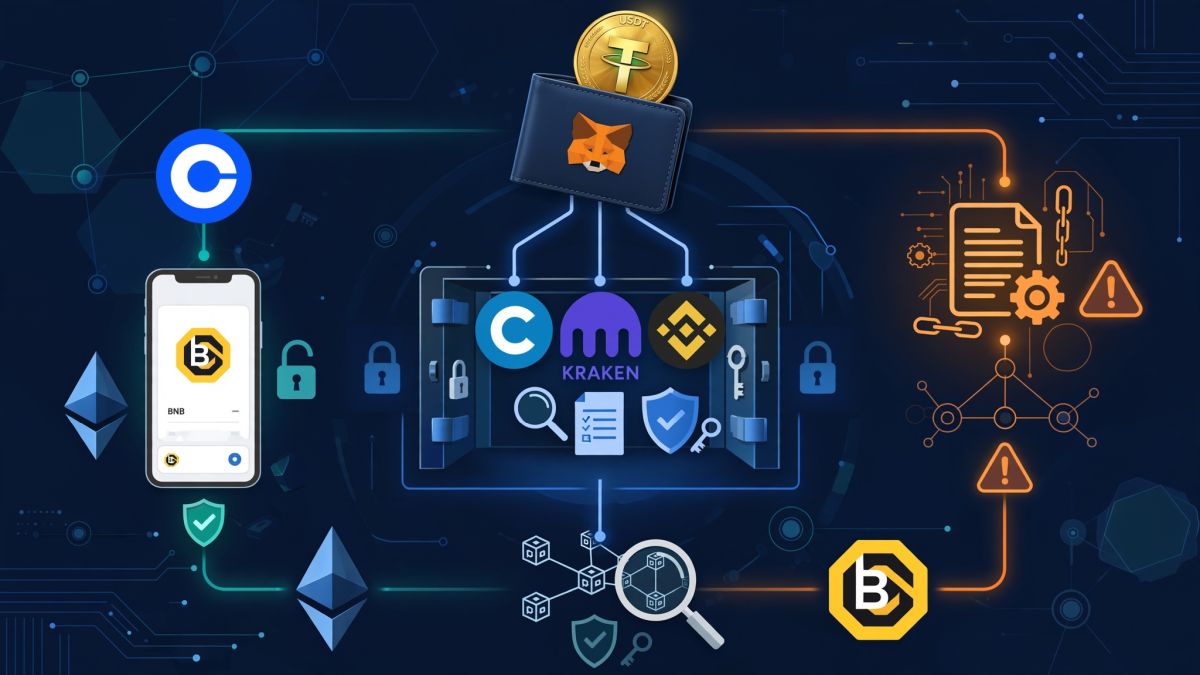
Crypto sent on the wrong network may be recoverable. The deciding factor is who controls the receiving address on the blockchain you actually used. A regular self-custody wallet, an exchange deposit address, and an unrelated smart contract require different recovery methods. As outlined in MetaMask’s official wrong-network recovery guidance, treating all three situations the same can turn a recoverable mistake into a second loss.
If you are staring at a missing USDT balance right now, take a breath. Do not reset your wallet, send another large transfer, or give anyone your recovery phrase.
After 25 years in traditional banking, I approach this as a settlement investigation: first establish where the payment settled, then identify who has the authority to move it. “The balance is not showing” and “the funds are permanently inaccessible” are not the same diagnosis.
One correction before we start: importing a private key is not the default solution. If the receiving wallet already supports the network you used, switching its network view and displaying the correct token may be enough. Exporting keys unnecessarily creates another security risk.
The 60-second wrong-network recovery decision tree
Start with the transaction status, then classify the receiving address by control, not by the wallet brand.
Follow these questions in order:
- Has the transaction been confirmed on the actual sending network?
- If it is still pending, use the sending wallet’s cancellation option immediately if available. Cancellation is an attempt to replace the pending transaction, not a guaranteed recall.
- If it failed or reverted, the intended transfer did not complete, although an included failed transaction can still consume network fees.
- If it succeeded, continue below.
- Does the destination belong to a centralized exchange or another custodial service?
- Go to Scenario 2. Only the receiving custodian can assess recovery.
- This remains true if the exchange uses smart contracts for deposits.
- Is the destination a regular private-key-controlled EVM account that you or the intended recipient control?
- Go to Scenario 1. Access may be restored by selecting the actual network and displaying the token.
- Did the token transfer credit an unrelated smart contract address?
- Go to Scenario 3. Recovery depends on the contract’s withdrawal capabilities or a narrowly applicable issuer process.
- Is it a smart wallet, multisig, non-EVM address, or address belonging to someone else?
- Read the exceptions later in this guide. The ordinary EVM account shortcut does not establish control over those destinations.
Here is the practical distinction:
| Destination | Who can authorize movement? | First recovery action |
|---|---|---|
| Your regular self-custody EVM account | The holder of that account’s private key | Select the actual network and display the correct token |
| A centralized exchange deposit address | The exchange’s custody infrastructure | Submit an official deposit recovery request |
| An unrelated smart contract | Whatever its code and permissions allow | Ask the project to assess an authorized recovery path |
| Someone else’s regular wallet | That recipient | Ask the recipient to return the funds |
These are control categories, not promises of recovery. In particular, an exchange account password does not give you the private key to its deposit address, and deploying a contract does not automatically give its developer unrestricted withdrawal powers.
The receiving account matters. If you sent from MetaMask to someone else’s Trust Wallet, that recipient must perform the wallet-side recovery. Importing the sender’s key cannot recover assets credited to a different account.
Before attempting recovery, verify where the transfer actually settled
The blockchain record, not a wallet’s portfolio screen, tells you where a confirmed transfer happened.
Open the transaction from the sending wallet’s activity history or the exchange’s withdrawal history. Use its block explorer link rather than searching for a “recovery website.”
Record the following:
| Information | What to capture |
|---|---|
| Actual network | The blockchain on which the transaction was broadcast |
| Intended network | The blockchain the recipient expected |
| Transaction hash | The complete on-chain hash, not an exchange’s internal withdrawal number |
| Transaction status | Pending, successful, failed, or replaced |
| Token recipient | The address credited in the token transfer |
| Token contract | The contract that issued the transferred token |
| Amount | The actual token quantity, not merely its USD value |
| Time | The transaction timestamp, preferably in UTC |
| Receiving service | Your wallet, another person’s wallet, an exchange, or a protocol |
Exchanges use these details to investigate misplaced deposits. For example, Kraken’s deposit recovery instructions request the transaction ID, asset, amount, deposit address, and transaction date and time.
Pending, failed, and successful transactions require different responses
A pending transaction may still be replaceable. A confirmed transaction cannot be undone through a wallet’s cancel button.
MetaMask’s pending transaction cancellation guide explains the replacement mechanism: another transaction uses the same account nonce and sufficient fees to compete with the original. If the original confirms first, the cancellation cannot reverse it. If the sender was an exchange, contact that exchange immediately about any withdrawal that has not yet been broadcast.
A failed EVM transaction is a different situation. Its reverted execution does not leave the intended token transfer completed, but gas can still be charged. Do not pay a “recovery specialist” to retrieve a token transfer that never executed. Ethereum’s transaction documentation explains the distinction between executing a transaction and paying for its computational work.
If a transaction cannot be found, do not immediately conclude that the funds disappeared. Check the network, hash, and sending platform’s broadcast status. As defined in the EIP-1474 Ethereum JSON-RPC specification, a missing receipt can mean the transaction is pending or is unknown to the node you queried.
Read the token recipient, not just the transaction’s “To” field
A normal USDT transfer calls a token smart contract, so seeing a contract in the transaction’s top-level “To” field does not prove you sent your money to the wrong contract.
This distinction prevents a surprising number of false diagnoses.
In a straightforward ERC-20 transfer:
- Your account submits a transaction to the token contract.
- The transaction data specifies the transfer recipient and amount.
- The token contract updates its balance records.
- A Transfer event identifies the token sender, recipient, and quantity.
The recipient inside that token transfer is the address you need to investigate. The ERC-20 token specification defines these transfer methods and events.
Also, a successful transaction status means the transaction did not revert. It does not independently prove that an exchange credited your account, that the token is authentic, or that a more complicated contract interaction produced the result you expected. Check the relevant token transfer and resulting balance.
Why BEP20 and ERC20 can use the same wallet address
Ethereum and BNB Smart Chain can use the same ordinary account address while maintaining completely separate balances.
A conventional Ethereum-style account address is derived from its public key. Using the same private key with the same address-generation scheme produces the same account address on compatible EVM networks. The address does not contain a routing instruction that automatically moves assets between those networks. Ethereum’s account documentation explains the underlying key and address relationship.
For the common USDT mistake:
| Item | Ethereum mainnet | BNB Smart Chain mainnet |
|---|---|---|
| Common exchange network label | Ethereum or ERC20 | BSC, BNB Smart Chain, or BEP20 |
| Chain ID | 1 | 56 |
| Native network fee asset | ETH | BNB |
| Ordinary EVM account format | 0x address | 0x address |
| Balance ledger | Ethereum state | BNB Smart Chain state |
The Ethereum JSON-RPC documentation identifies Ethereum mainnet’s chain ID, while the official BNB Smart Chain wallet configuration specifies chain ID 56 and BNB as its native currency.
My banking analogy is an account identifier appearing in two separate settlement systems. The identifier may match, but the balances do not merge.
Two consequences follow:
- Switching the wallet’s network changes which blockchain it reads and uses.
- Switching the network does not convert BEP20 tokens into ERC20 tokens or move them to Ethereum.
A simple wallet transfer spends assets on its current chain. It does not automatically transform an Ethereum token into a BSC representation. Cross-chain movement requires an additional service or protocol.
“USDT” alone does not identify the asset
Identify a token by its network and contract address, not just its name or ticker.
Tether publishes integration details for its supported token issuances, while Binance maintains separate collateral information for its B-token representations. A wrapped or pegged representation can involve a different issuer, custodian, or bridge arrangement from the token it represents. I therefore do not assume that the same company can recover every asset displaying “USDT.”
Scenario 1: Self-custody wallet to self-custody wallet
If the tokens reached a regular EVM account whose exact private key the recipient controls, the usual task is restoring visibility and access on the actual network.
These instructions cover the ordinary account case. A smart contract wallet or multisig requires the additional checks discussed later.
Suppose you sent 500 USDT from MetaMask over BNB Smart Chain to a Trust Wallet address, but the recipient expected Ethereum.
The first wallet to open is the receiving Trust Wallet account, not the sending MetaMask account. Both applications can work with BNB Smart Chain, so exporting a private key should not be your first move.
Step 1: Match the complete receiving address
The wallet must control the exact address credited in the token transfer.
Compare the full recipient address from the explorer with the receiving wallet’s address. Do not rely only on the first and last few characters.
If they differ, stop. That is an address-control problem, not merely a hidden-network problem.
If the recipient is another person, ask them to perform these checks themselves. They should not send you their seed phrase or private key.
Step 2: Select BNB Smart Chain in the receiving wallet
Viewing the actual network is often enough to locate a recoverable wrong-network balance.
In Trust Wallet:
- Open the intended receiving wallet.
- Open its asset or token management controls.
- Select or filter for BNB Smart Chain.
- Enable the relevant token on that network.
- If necessary, add it as a custom token.
The current interface can vary by device and version, so check Trust Wallet’s official custom token guide for the required network selection and token details.
In MetaMask:
- Select the receiving account.
- Open the network selector.
- Select BNB Smart Chain if already available.
- If it is absent, add it using verified network information.
MetaMask’s network configuration instructions recommend checking the supported network list before adding a network manually.
For manual configuration, the official BSC mainnet values can be represented as:
{
  "chainId": "0x38",
  "chainName": "BNB Smart Chain",
  "nativeCurrency": {
    "name": "BNB",
    "symbol": "BNB",
    "decimals": 18
  },
  "rpcUrls": [
    "https://bsc-dataseed.bnbchain.org"
  ],
  "blockExplorerUrls": [
    "https://bscscan.com"
  ]
}
This is network configuration data, not a recovery transaction. The hexadecimal chain ID 0x38 means decimal 56. The native currency’s 18 decimals describe BNB, not every token on the chain. The parameter structure follows the wallet network-addition specification in EIP-3085.
Step 3: Display the token using its actual contract address
A wallet can control tokens without automatically displaying them.
Find the token contract associated with the actual transfer. Cross-check it against the issuer’s information or maintained wallet metadata.
For example, Trust Wallet’s metadata for a commonly used BSC USDT contract records its contract identifier, BEP20 classification, and 18-decimal precision. Those details apply to that particular contract, not every asset named USDT.
Then use the wallet’s custom-token function. MetaMask’s token display guide explains how to add a token using its contract address when automatic detection does not show it.
Do not paste the token contract address into a sending transaction as your personal receiving address. It identifies the asset’s program, not your wallet.
Step 4: Confirm access before funding transaction fees
Seeing a balance is not the same as possessing spending authority.
A watch-only wallet or explorer can display an address’s holdings without controlling them. Confirm that you are using the receiving account with its legitimate signing capability before adding gas or attempting another transfer. Private-key control is what authorizes an ordinary EVM account’s transactions.
For a standard, unsponsored BSC transfer, the account needs BNB on BNB Smart Chain for network fees. ETH on Ethereum will not pay that BSC transaction’s fees. MetaMask’s gas explanation distinguishes these chain-specific fee assets.
Some eligible wallet transactions offer alternative fee payment. For instance, MetaMask’s gas-included transaction feature can let users cover fees with supported tokens. Availability and prerequisites matter, so do not assume every wallet or recovery transaction supports it.
If you use a conventional gas top-up, send only enough to cover the wallet’s current estimate and an appropriate buffer. Do this only after confirming the address is under your control and is not compromised.
Step 5: Decide whether the assets actually need to move
Restoring access and moving the assets to the originally intended network are separate tasks.
Once the receiving account can access the tokens, you have resolved the immediate access problem. You do not have to bridge them merely to prove that recovery worked.
If Ethereum is still the intended destination, choose a separate, verified transfer route. Changing the network selector alone will not accomplish that.
When is importing a private key actually necessary?
Importing is a fallback for an incompatible wallet interface, not a requirement for every wrong-network transfer.
If the existing software wallet cannot access the actual network, a compatible application may provide another interface to the same ordinary account.
For an existing software-wallet account:
- Obtain the compatible wallet through its official distribution channel.
- Follow its documented account-import process.
- Import the receiving account’s private key locally in the verified application.
- Confirm that the imported account produces the exact destination address.
- Select the actual network and display the token.
MetaMask’s current import instructions distinguish importing one account with its private key from restoring a wallet using its recovery phrase. They also warn about key-export risks and explain how social-login configurations can link imported accounts. Review those implications before importing.
A recovery phrase can derive multiple accounts. Account selection, derivation paths, and any additional passphrase matter, so restoring a phrase does not mean the first displayed address must be the destination you need. The BIP44 account derivation standard explains why one seed can lead to multiple account paths.
For a hardware wallet, use its supported connection to a compatible interface instead of entering its recovery phrase into software. MetaMask’s hardware wallet guidance describes using the device to authorize transactions while keeping its signing keys protected by the hardware.
My rule is simple: change the interface before exposing the secret. Do not uninstall or reset a working wallet just to force an import.
How to move recovered BEP20 USDT onto Ethereum
Moving between chains requires a supported exchange route or a genuine cross-chain mechanism.
There are two common approaches:
Use an exchange that supports the exact asset on both relevant networks.
- Confirm that your existing, eligible exchange account accepts that specific token on BNB Smart Chain.
- Obtain a current BSC deposit address from its authenticated deposit page.
- Check deposit minimums and any restrictions.
- Send a small test amount that satisfies those minimums.
- Wait for actual account credit.
- Only then consider the remaining amount.
- Withdraw using Ethereum if the exchange supports the required Ethereum asset and destination.
This introduces custodial exposure, platform rules, and additional fees. Do not assume an exchange supports a network because it lists the token’s ticker. Kraken’s missing-deposit checklist specifically separates network compatibility, minimum deposits, confirmations, and other crediting requirements.
Use a bridge or cross-chain swap supporting the exact route.
Verify the source token, source network, destination network, destination token contract, recipient, and quoted fees. Do not manually send tokens to a bridge contract unless its official procedure explicitly requires that action.
Ethereum’s bridge documentation explains that bridges introduce their own contract and trust risks. A bridge can solve a network mismatch, but it also adds another system that can fail.
Scenario 2: Self-custody wallet to a centralized exchange
If the destination is an exchange deposit address, only the receiving exchange can decide whether its custody system can recover the assets.
You cannot import that deposit address into MetaMask and gain control. Adding an address to a wallet does not create its private key.
This is where I draw the clearest distinction between on-chain settlement and the exchange’s customer ledger. The blockchain may show a token balance at a deposit address while the exchange has not recognized that asset and network combination as a credit to your account. Exchange recovery is a custody and reconciliation process, not a reversal of the original blockchain transaction.
If the exchange account belongs to another person, that account holder may need to initiate the case. For example, Binance’s self-service recovery policy excludes applications submitted on behalf of others.
How an exchange asset recovery service works
An exchange recovery service investigates whether it can safely identify, control, and return an unsupported deposit.
The exact procedure varies, but expect the following stages:
- Identify the transfer. Supply the actual network, transaction hash, token contract, amount, and destination.
- Establish the account connection. The exchange verifies that the deposit relates to your account and may request supporting records.
- Assess technical eligibility. The platform determines whether the address, network, token, and custody setup permit recovery.
- Provide terms. The exchange may quote fees, documentation requirements, and an estimated processing period.
- Execute an authorized movement or account adjustment. Depending on the service, it may return assets to a compatible wallet or credit an eligible balance.
- Verify the outcome. Check the recovery transaction, destination network, and actual received balance.
The current Coinbase unsupported-asset recovery process and Kraken’s recovery policy illustrate these eligibility and verification requirements. Neither offers universal recovery for every asset or network.
Possessing custody infrastructure does not mean a support agent can casually export a key. Coinbase’s announcement of expanded BNB Smart Chain and Polygon recovery describes moving eligible unsupported assets without exposing private keys. That expansion was announced on February 27, 2024. Current eligibility must still be checked in the live tool.
What recovery fees should you expect?
Recovery pricing can be percentage-based, a modest token charge, or hundreds of USD. There is no universal flat fee.
I would not budget on the assumption that every exchange charges USD 100 to USD 500.
I checked the following published policies on October 19, 2026:
- Coinbase’s fee disclosures describe its percentage charge.
- Kraken’s recovery fee schedule distinguishes supported-network and unsupported-network cases.
- Binance’s self-service recovery schedule lists separate retrieval categories.
| Provider and eligible case | Published charge | Main limitation |
|---|---|---|
| Coinbase, eligible unsupported-asset recovery | Network fees, plus 5% of estimated recovery value above USD 100 | Only eligible assets and networks |
| Kraken, unsupported token on a supported network | USD 200 | Subject to case assessment |
| Kraken, unlisted asset on an unsupported network | USD 500 | Some cases remain technically unrecoverable |
| Binance global, listed or unlisted token on certain unsupported EVM networks | 20 USDT | Eligibility and operational conditions apply |
| Binance global, eligible Smart Retrieval | 1 USDT | Limited to qualifying deposits |
These are published categories, not binding quotes for your transfer. Fees and eligibility can change.
For an eligible Coinbase recovery valued at USD 1,000, the percentage recovery component would be USD 45, with network charges additional. The fee is applied to the value above USD 100, not automatically to the entire recovered amount.
Binance.US is not the same recovery service as Binance global. Its deposit recovery tool policy says unsupported tokens or networks are not recoverable through that service. Its published 5% charge concerns deposits missing a memo, not a general wrong-network recovery offer.
These examples are not recommendations to open another exchange account or bypass regional restrictions. Use the policy applicable to the entity where the mistaken deposit actually arrived.
Example: Using Coinbase’s recovery process
For an eligible Coinbase deposit, use the official browser-based recovery workflow rather than a third-party recovery website.
The documented process is:
- Enter through Coinbase’s official recovery instructions.
- Select the network actually used.
- Enter the transaction hash and Coinbase destination address.
- Let the tool assess whether it can locate an eligible transfer.
- Connect the self-custodial wallet intended to receive the recovery.
- Review the destination and disclosed charges before continuing.
- Verify receipt on the explorer for the recovery network.
Coinbase warns that the funds go to the wallet connected during recovery. Connecting a different wallet or creating a new address during sign-in can therefore produce another “missing balance” misunderstanding.
Copy this support ticket template
A useful recovery ticket gives support precise transaction evidence and asks for eligibility, cost, and refund instructions.
I would submit something like this through the exchange’s authenticated support channel:
Subject: Wrong-network deposit review, USDT on BNB Smart Chain

Account ID: YOUR_ACCOUNT_ID

I sent a deposit to an address associated with my account using
BNB Smart Chain instead of the intended Ethereum network.

Asset shown by sending wallet: USDT
Actual network: BNB Smart Chain mainnet
Intended network: Ethereum mainnet
Transaction hash: FULL_TRANSACTION_HASH
Token contract: ACTUAL_TOKEN_CONTRACT
Token transfer recipient: FULL_RECEIVING_ADDRESS
Token amount: EXACT_TOKEN_AMOUNT
Transaction time in UTC: ACTUAL_TIMESTAMP
Sending wallet or platform: SENDING_SERVICE

The transaction is confirmed on the actual network, but my
exchange account has not been credited.

Please confirm:

1. Whether this network, token contract, and destination qualify
   for recovery.
2. The full recovery charge and how it is collected.
3. Whether recovery would be a refund or an account credit.
4. The network and destination requirements for any refund.
5. Any additional documentation and estimated processing time.

I can provide the sending wallet's transaction record and the
public blockchain transaction details through this support case.
Attach the sending wallet or withdrawal record if requested. Keep transaction hashes and addresses available as copyable text, not only screenshots.
Do not include your seed phrase, private key, password, or authentication codes in the ticket. Keep identity documents inside the exchange’s verified submission process.
Ask where the refund will actually go
A recovery refund does not necessarily arrive on the network you originally intended.
Ask support to confirm:
- Which blockchain will carry the refund.
- Which token contract will be returned.
- Whether you may choose a destination.
- Whether the process requires returning funds to the original source.
- Whether a memo or destination tag is required.
Some Binance recovery procedures, for example, restrict returns to the source address. If the original transfer came from another exchange’s hot wallet, a return may require coordination with that sending exchange. The official Binance memo recovery instructions explicitly discuss source-address returns and deposits originating on other platforms.
What if support says recovery is unavailable?
A rejection may reflect current service limitations, technical impossibility, or both.
Ask for the reason and preserve the case number. Useful distinctions include:
- The platform does not support that recovery network.
- The token is excluded.
- The destination is not controlled by the platform.
- Its custody or contract architecture does not permit the required movement.
- The deposit cannot be linked to your account.
Do not interpret a rejection as proof that a freelancer can bypass the limitation. Binance.US explicitly notes that unsupported deposits can remain inaccessible unless the relevant asset or network becomes supported later. That is a possibility, not a promise.
Timeframes also vary. Binance global currently estimates 30 working days for certain unsupported-EVM recoveries and warns that actual completion can take longer. An estimate is not a settlement guarantee.
Scenario 3: You sent tokens directly to an unintended smart contract
Tokens credited to a smart contract may be permanently inaccessible if no authorized mechanism can move them out.
First, revisit the distinction between the transaction’s top-level “To” field and the token-transfer recipient. A normal token transfer calls a contract. The problem here is that the token balance itself was credited to the wrong contract address.
Why a successful transfer can leave tokens stuck
An ordinary ERC-20 transfer does not require the receiving contract to acknowledge or correctly manage the incoming tokens.
The basic sequence is:
- The token contract checks whether the transfer is permitted.
- It reduces the sender’s balance.
- It increases the balance associated with the recipient address.
- It records the transfer.
If that recipient is an unrelated smart contract, a standard ERC-20 transfer does not automatically call a recovery function or create an internal credit for you.
Ethereum’s explanation of the ERC-20 reception problem identifies this exact failure mode: tokens can be credited to contracts that have no functionality to handle or extract them.
A contract is not an ordinary wallet with a conveniently exportable private key. Its permitted behavior comes from its code and authorization rules. The account that deployed it does not automatically possess a separate private key that can sign as the contract. Ethereum’s smart contract introduction explains this code-controlled account model.
When can a project recover tokens from its contract?
Recovery requires an existing authorized capability or another valid, contract-specific mechanism.
Potential routes include:
- A token rescue function. The contract may allow an authorized role to transfer accidentally received assets.
- A general execution function. Some smart wallets can execute an authorized token transfer.
- An authorized upgrade. A properly upgradeable proxy may permit new withdrawal logic, subject to its governance and security rules.
- A narrowly applicable issuer recovery process. Some centrally administered tokens have separate recovery policies.
Function names such as “rescue,” “recover,” or “sweep” are not universal standards. Someone must inspect the actual implementation and permissions.
OpenZeppelin’s upgrade documentation explains why a proxy can sometimes change implementation while retaining its address and state. That does not mean every contract is upgradeable, or that its administrators will authorize a recovery.
Token compatibility matters too. OpenZeppelin’s SafeERC20 documentation describes wrappers for tokens with different return behaviors. A project must assess its real withdrawal code, not merely find a promising-looking function name.
If no authorized withdrawal, upgrade, deployment, or applicable issuer route exists, changing RPC servers or importing the sender’s key does not create one.
For native ETH or BNB, first check whether the attempted transfer reverted. If a native-asset transfer succeeded, receiving the asset still does not establish that the contract has an authorized way to send it back.
Can Tether recover USDT sent to a contract?
Tether has a limited discretionary recovery policy, but it is not a universal USDT reversal service.
Under Tether’s published token recovery policy:
- Requests concern amounts exceeding USD 1,000.
- Tether assesses whether a case is technically recoverable.
- Recovery is not guaranteed.
- The schedule specifies a USD 1,000 minimum or a percentage charge of up to 10%, whichever is greater.
- The charge is deducted from the recovered amount.
- Verification is required.
- Cases can take months.
Eligibility also depends on Tether’s service restrictions.
For American readers, Tether’s jurisdictional access restrictions specifically restrict U.S. persons unless the applicable eligible-contract-participant conditions are met. Do not assume a retail U.S. holder can use every direct Tether service.
And remember the token’s actual issuer or administrator. A policy for Tether-issued tokens does not establish that Tether can recover a separate pegged representation administered elsewhere.
Exceptions: Smart wallets and non-EVM networks
The same-private-key shortcut applies to compatible ordinary accounts, not to every address that a wallet application can display.
A smart wallet’s owner key is not the wallet address’s private key
Smart contract wallets require the correct contract deployment and authorization setup on the actual destination chain.
A Safe owner’s private key controls the owner account. It is not a private key for the Safe contract address.
If funds reached a Safe address on another network, recovery may require recreating the appropriate Safe deployment at that exact address. Safe’s official recovery deployment guide describes conditions involving the singleton, proxy factory, fallback handler, original owners, threshold, and deployment salt. It explicitly warns that recovery is not always possible.
This is a protocol-specific engineering task. Importing an owner’s key into another app does not, by itself, recreate the Safe.
TRC20, Solana, and Bitcoin require chain-specific analysis
Do not apply an Ethereum-to-BSC recovery recipe blindly to unrelated address systems.
TRON has its own address encodings and account activation rules, as described in the TRON account and key documentation. Solana uses a different account model with 32-byte addresses, described in the Solana account documentation.
Some cross-system mistakes are rejected before broadcast. Others involve valid destinations but different derivation or encoding rules. Certain specialized recoveries are possible, so “non-EVM always means permanently lost” is too broad. Equally, sharing a ticker or recovery phrase format is not proof that a generic import will work.
Do not manually edit address prefixes, invent an address conversion, or put your phrase into an online derivation tool while panicking.
Missing memos are a separate recovery category
A correct network with a missing memo or destination tag is usually an account-identification problem, not the same mistake as choosing the wrong blockchain.
Some exchanges use a shared receiving address and a memo or tag to identify the customer. Follow the receiving service’s memo-recovery process rather than trying the private-key method. TheBinance deposit memo guidelines above explain this distinction in detail.
Optional technical check: Inspect the transfer without signing anything
Public RPC queries can help verify the network, receipt, and address code without a recovery phrase, wallet connection, or on-chain transaction.
Skip this section if you are not comfortable with a terminal. The explorer workflow above is sufficient for most readers.
For BSC, the endpoint below appears in the official BNB Smart Chain RPC endpoint list. Replace the two uppercase placeholders before running the commands. Use the actual token recipient, not automatically the transaction’s top-level destination.
RPC_URL='https://bsc-dataseed.bnbchain.org'
TX_HASH='REPLACE_WITH_FULL_TRANSACTION_HASH'
RECIPIENT='REPLACE_WITH_ACTUAL_TOKEN_RECIPIENT'

# Check the network.
curl -sS "$RPC_URL" -H 'Content-Type: application/json' --data \
'{"jsonrpc":"2.0","id":1,"method":"eth_chainId","params":[]}'

# Retrieve the transaction receipt.
curl -sS "$RPC_URL" -H 'Content-Type: application/json' --data \
"{\"jsonrpc\":\"2.0\",\"id\":2,\"method\":\"eth_getTransactionReceipt\",
\"params\":[\"$TX_HASH\"]}"

# Inspect current code at the token recipient's address.
curl -sS "$RPC_URL" -H 'Content-Type: application/json' --data \
"{\"jsonrpc\":\"2.0\",\"id\":3,\"method\":\"eth_getCode\",
\"params\":[\"$RECIPIENT\",\"latest\"]}"
The first response should identify BSC mainnet:
{
  "jsonrpc": "2.0",
  "id": 1,
  "result": "0x38"
}
The methods are documented in the Ethereum JSON-RPC API and the EIP-1474 RPC specification linked earlier. These requests inspect public data; they do not grant spending authority.
Interpret the results carefully:
- Chain ID 0x38: BSC mainnet.
- Receipt status 0x1: Transaction execution succeeded without reverting.
- Receipt status 0x0: Transaction execution failed.
- Null receipt: The queried node has no included receipt for that hash. Recheck network, hash, and transaction status.
- Code result 0x: No code is currently stored at that address on that chain. This does not prove anyone has its private key.
- Nonempty code: Investigate the account type and implementation before deciding recoverability.
There is a modern complication: nonempty code no longer proves an address is a conventional contract without a controlling EOA key. EIP-7702 account delegation allows an EOA to have a delegation indicator beginning with 0xef0100. Conversely, a smart wallet address can have no deployed code yet. Neither result alone proves that funds are lost or recoverable.
Finally, querying the account’s native balance will not tell you its USDT holdings. An ERC-20 balance is obtained from the relevant token contract through its balanceOf method.
Avoid recovery scams while you are trying to fix the mistake
A genuine wrong-network problem does not justify giving anyone control of your wallet.
Stop if someone asks you to:
- Enter your seed phrase into a “validation,” “synchronization,” or “rectification” website.
- Send your private key through a support chat.
- Install remote-control software for an unsolicited recovery agent.
- Pay a stranger to “unlock the blockchain.”
- Sign unexplained approvals or account authorizations.
- Send more funds because recovery supposedly requires “matching liquidity.”
The FBI’s cryptocurrency guidance warns about recovery services, especially those demanding upfront payment. The FTC’s recovery-scam warning specifically advises against paying people who contact you offering to recover lost money.
A disclosed fee inside an authenticated exchange recovery process is different from an unsolicited payment demand. Some legitimate workflows also require a wallet-ownership signature, but that does not make an arbitrary signature request safe. Verify the official process and the authorization you are granting.
If your gas top-up disappears, stop funding the wallet
Immediate unauthorized outgoing transfers indicate possible compromise, not merely a network display problem.
A sweeper can move new deposits from a compromised account before you act. MetaMask’s sweeper-bot guidance warns against depositing more funds into an affected account.
Do not try to beat an automated attacker by repeatedly sending more BNB or ETH. Treat that as a separate security incident and use official incident-response guidance.
Frequently asked questions about wrong-network crypto recovery
I sent USDT via BEP20 instead of ERC20. Is it lost?
Not necessarily. If it reached a regular EVM account whose exact private key the recipient controls, select BNB Smart Chain and display the transferred token. If it reached an exchange, recovery depends on that exchange’s current eligibility rules.
Can switching the RPC network turn BEP20 USDT into ERC20 USDT?
No. Changing the RPC changes the network your wallet communicates with. Moving value between BSC and Ethereum requires a separate supported cross-chain or exchange route.
Can I recover the funds using the sending wallet’s private key?
Not if the tokens were credited to a different recipient account. The relevant authority belongs to the destination account, its custodian, or its contract permissions. The original sender cannot simply pull back a confirmed transfer.
Can MetaMask or Trust Wallet reverse my confirmed transaction?
A wallet application cannot reverse a confirmed blockchain transfer. As noted in the Ethereum community support FAQ, a wallet may help you access an account on another network, but returning the assets requires a new authorized action.
Will recovery support move the funds onto my intended network?
Do not assume so. Recovery may return assets on the actual network or credit an eligible exchange balance. Confirm the refund network, token contract, destination, and fees before authorizing the process.
My final checklist before you send anything else
The safest next transaction is the one made only after you have verified the actual network, recipient control, and destination requirements.
Before moving the recovered assets:
- Confirm the full receiving address from a trusted, current source.
- Confirm the destination supports the exact asset and network.
- Verify the token contract or representation where relevant.
- Include any required memo or destination tag.
- Check deposit minimums and available transaction fees.
- Send an appropriately sized test transfer.
- Wait for the recipient’s actual balance or exchange credit before sending the remainder.
Current exchange recovery instructions emphasize these same compatibility, address, memo, and test-transfer checks.
My bottom line: do not begin with “Which recovery company should I hire?” Begin with “Where did the assets settle, and who can authorize their movement there?”
That question tells you whether you need a wallet display adjustment, a custodian’s recovery process, or an honest assessment that no usable withdrawal path exists.
Sponsored Partner: Volet.com
Looking for a simple, everyday way to buy, hold, and sell cryptocurrencies alongside your traditional currencies and payment cards?
- Read my full breakdown: Complete Volet Review on DoraMilen.com
- Get started right away: Open your free Volet account using my referral link