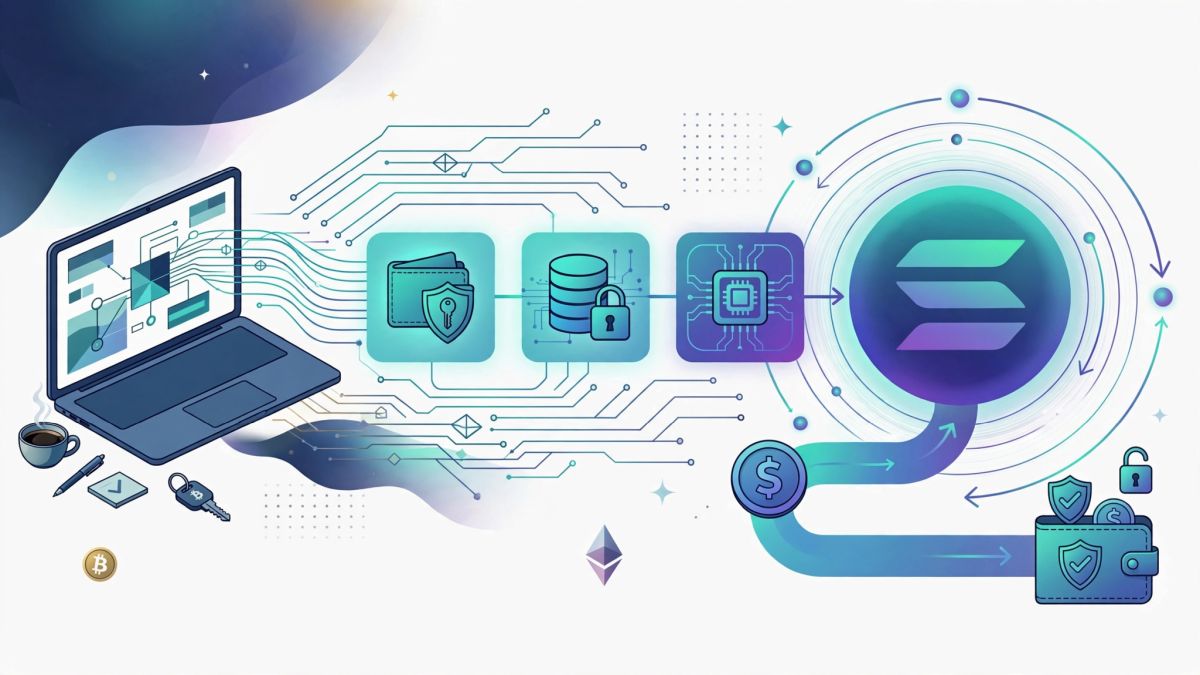
Solana lets applications update shared blockchain state through signed, atomic transactions. For developers, the important point is that Solana is not just a network for sending tokens. It is a distributed execution environment that explicitly separates program logic, application data, and authorization.
After 25 years in traditional finance, I look at any payment system through a practical lens: What did the customer authorize? What actually happened? When can I treat the payment as settled? And how do I reconcile it when something goes wrong?
Those questions matter just as much on Solana as they do in banking.
Solana’s architecture affects almost every technical decision. A program does not keep persistent application state in its own private memory. Instead, it receives the accounts it is allowed to read or modify. The transaction declares those accounts in advance. The client builds instructions, collects signatures, and submits a serialized transaction to an RPC node. The network then executes the instructions as one atomic operation, as described in Solana’s documentation on transactions and atomic execution.
I see a good reason to use this model when an application needs publicly verifiable state changes, interoperable tokens, or execution that does not depend on one operator’s database. If ordinary PostgreSQL solves the problem cleanly, I would not add a blockchain just to make the architecture sound more impressive.
How Solana Executes Transactions: Accounts, Wallets, and Programs
An account is Solana’s basic unit of on-chain state; a program supplies the logic that operates on that state.
Every account has a 32-byte address, a balance denominated in lamports, a data field, an owning program, and runtime metadata. Understanding Solana’s account model is the starting point for understanding how applications actually work.
Three terms are worth separating:
- Wallet: The software or signing arrangement through which a user manages keys and authorizes transactions. In a simple setup, signing authority comes from a public/private keypair.
- Account: An on-chain record that can hold lamports, application data, or information associated with executable code.
- Program: Executable on-chain logic, identified by a program ID, that processes instructions. User-deployed Solana programs execute as sBPF bytecode.
As explained in Solana’s overview of on-chain programs, programs are stateless in the persistent-storage sense. Mutable application state lives in separate data accounts supplied to the program through instructions.
That distinction matters. A program can use temporary memory while it executes, but it does not preserve application state in a private process between calls.
The runtime also enforces ownership rules. Only an account’s owning program can modify its data or debit its lamports, subject to the other runtime restrictions. A program can credit lamports to another writable account, but it cannot simply rewrite data owned by a different program. These are runtime-enforced account modification rules, not conventions developers can choose to ignore.
Here, “owning program” does not mean the same thing as a human user’s wallet. A token account, for example, is owned at the runtime level by a token program, while its data identifies the authority permitted to authorize token operations.
Compared with platforms where a smart contract looks like an object containing its own mutable fields, I find it more useful to think of a Solana program as a service function. The runtime hands that function a specific set of resources.
A typical instruction identifies:
- The program ID to invoke.
- The accounts the program may use.
- Which accounts must be writable.
- Which accounts must have signer authorization.
- The instruction-specific binary data.
A transaction can contain multiple instructions. If an instruction fails during on-chain execution, the transaction’s application-state changes are rolled back. The transaction fee can still be charged.
Atomic execution does not mean failed execution is free.
Why Solana Requires Explicit Account Lists
Explicit account lists let Solana identify transactions that can execute independently without conflicting state access.
When the runtime knows in advance what each transaction will read and write, it can schedule nonconflicting work in parallel. Transactions can share read-only accounts. A write, however, conflicts with another transaction’s read or write access to the same account.
Solana’s program architecture guidance on concurrency and shared accounts explains why shared writable accounts can become application bottlenecks.
The trade-off is additional client-side complexity.
The client often needs to calculate every address the instruction will require before execution begins, including accounts needed by downstream program calls. Leave out an account, mark a required signer incorrectly, or fail to make an account writable, and the operation will fail.
This is where a Program Derived Address, usually shortened to PDA, becomes useful.
A PDA is an address deterministically derived from a program ID and a set of seeds, with a bump used in the derivation process. It has no private key. Instead, the deriving program can obtain signer authorization for that PDA during a cross-program invocation under the runtime’s rules, as explained in Solana’s documentation on Program Derived Addresses.
For an invoice system, the semantic seed inputs might look like this:
["invoice", merchant_address, invoice_id]The same program ID and consistently encoded inputs produce the same derived address. The backend, frontend, and on-chain program can independently locate the invoice state without relying on a central address registry.
In an actual implementation, I would make the seed encoding and canonical bump handling explicit. The example above describes the naming scheme, not a complete account-creation routine. Deriving an address does not, by itself, create or fund an account at that address. The PDA derivation reference covers those implementation details.
Seeds are not secrets. They provide addressing and namespacing, not encryption.
A Practical Use Case: Stablecoin Payments With Invoice Tracking
A reliable stablecoin payment integration must verify the asset, destination, amount, confirmation level, and connection to a specific invoice.
Consider a service that accepts a stablecoin on Solana for a digital product.
The simplest implementation gives the customer an address and watches for an incoming payment. That is enough to demonstrate a transfer. It is not enough to define a reliable payment system.
The questions appear quickly:
- Which invoice does the payment belong to?
- Did the customer send the correct token, or merely a token with the same symbol?
- Did the payment reach the correct token account?
- Was the amount calculated using the correct number of decimal places?
- Has the transaction merely been observed, or has it reached the required confirmation level?
- What happens if the customer submits the same invoice twice?
A token symbol is not an asset identifier. The application must validate the exact mint address and the expected token program.
Amounts should be represented as integers in the token’s smallest unit. I would not use JavaScript number or binary floating-point arithmetic as the application’s general-purpose representation for token amounts. Use bigint, a suitable database integer type, or digit strings at system boundaries.
Solana’s token transfer documentation shows how transfers operate on base-unit amounts and how checked transfers validate mint and decimal information.
There are two common ways to organize invoice tracking.
Off-Chain Invoice Tracking
Off-chain tracking keeps the invoice in your database and verifies the payment against blockchain transaction data.
The backend creates the invoice in its own database. The frontend then builds a transaction that transfers the token to the merchant’s token account.
After signing and submission, the backend receives the transaction signature, uses it as the transaction identifier, and checks the transaction through RPC.
The advantages are straightforward:
- Less custom on-chain logic.
- Easier changes to business rules.
- Lower program-maintenance and deployment overhead.
The disadvantage is that the backend remains responsible for connecting the transfer to the correct invoice.
That connection can use a unique receiving address, a reference or memo instruction, or a transaction constructed in advance for that invoice.
I treat all of those as matching mechanisms, not proof of payment. A valid-looking reference does not establish that the correct asset and amount reached the correct destination.
On-Chain Invoice Tracking
On-chain tracking can make the payment and invoice-status change succeed or fail together.
In this architecture, the application introduces its own program. The program validates the invoice, invokes the approved token program to move the funds, and updates the invoice PDA from unpaid to paid.
That program-to-program call is a cross-program invocation, or CPI. It lets one program execute an instruction on another program while remaining inside the same transaction.
The important business rule becomes atomic: the token transfer and invoice update succeed together, or the application-state changes are rolled back.
The program can reject:
- An unexpected mint.
- The wrong amount.
- An unauthorized destination.
- An invoice that has already been paid.
But the operational burden is larger. You now need a program, a deployment process, upgrade-authority management, tests for every relevant account constraint, and a plan for migrating state.
For a first integration, I would usually start with off-chain verification. A custom program becomes worthwhile when atomic state transitions solve a real business problem, not merely because deploying a smart contract is an option.
A Solana Payment Workflow, Step by Step
The payment workflow should connect invoice creation, wallet authorization, transaction submission, verification, and an idempotent database update.
A practical flow looks like this:
- The backend creates an invoice containing an internal ID, the expected mint address, the amount in base units, and an expiration time.
- The frontend receives the payment parameters and checks the expected network configuration, including the wallet’s network information where available.
- The client requests a fresh blockhash from the RPC node.
- The client builds the token transfer and any application-specific instruction.
- The wallet presents the transaction to the customer and signs it after approval.
- The signed transaction is submitted to an RPC node.
- The backend stores the transaction signature against the invoice.
- A worker checks the transaction’s status and then retrieves its complete transaction data.
- The backend checks execution errors, the mint, destination, amount, and required instructions or invoice reference.
- The invoice is marked paid through an idempotent state transition.
For a transaction using a recent blockhash, that blockhash limits how long the signed message remains eligible for processing. The getLatestBlockhash RPC method returns both the blockhash and its lastValidBlockHeight. I would track that validity boundary instead of hard-coding a countdown in seconds.
If the blockhash expires before the transaction is processed, the client needs a new blockhash, a rebuilt message, and new signatures.
A timeout alone is not sufficient evidence that the payment failed. Before requesting a replacement signature, I want the application to reconcile the original attempt. A newly signed transaction is a new transaction, not simply another delivery attempt for the old one.
Ordinary presigned transactions are therefore not files you can safely put aside for days and submit whenever convenient.
Specialized workflows can use durable nonce transactions, which replace the ordinary recent-blockhash lifetime with nonce-account state. That introduces an additional account, authority management, and a different lifecycle.
One important detail is that a valid nonce transaction can consume the nonce and charge its fee even when an instruction subsequently fails. That behavior needs to be part of the application’s recovery logic.
Sending a Solana Transaction Is Not the Same as Confirming It
A successful sendTransaction response means the RPC accepted the transaction for forwarding, not that the payment succeeded.
The sendTransaction RPC reference explicitly separates submission from confirmation. The method can return the transaction’s first signature without waiting for the network to process or confirm it.
This is where my banking background makes me cautious. An instruction being accepted for processing is not the same thing as a reconciled payment.
Check Transaction Status With getSignatureStatuses
The backend should monitor the transaction’s status. A minimal implementation can call the standard getSignatureStatuses JSON-RPC method:
type SignatureState = {
    slot: number;
    err: unknown;
    confirmationStatus?: "processed" | "confirmed" | "finalized";
};

async function getSignatureState(
    rpcUrl: string,
    signature: string
): Promise<SignatureState | null> {
    const response = await fetch(rpcUrl, {
        method: "POST",
        headers: { "content-type": "application/json" },
        body: JSON.stringify({
            jsonrpc: "2.0",
            id: 1,
            method: "getSignatureStatuses",
            params: [
                [signature],
                { searchTransactionHistory: true }
            ]
        })
    });

    if (!response.ok) {
        throw new Error(`RPC returned HTTP ${response.status}`);
    }

    const body = await response.json();

    if (body.error) {
        throw new Error(body.error.message);
    }

    return body.result.value[0];
}
This function answers a limited set of questions:
- Does this RPC node currently have a status for the signature?
- What confirmation status does it report?
- Did execution report an error?
It does not verify payment.
The searchTransactionHistory option requests a search beyond the recent status cache. It does not guarantee that the provider retains every historical transaction. A null result should not automatically be interpreted as a failed payment.
For production, I would also add request deadlines, retry backoff, response validation, and monitoring. The example deliberately shows the RPC interaction, not an entire payment-processing service.
Verify Payment Details With getTransaction
Payment verification requires inspecting what the transaction actually did, not merely checking its signature status.
Once the transaction reaches the required verification stage, the backend should retrieve it using the getTransaction RPC method.
For this method, use confirmed or finalized commitment. Do not assume that a preliminary processed notification means the complete transaction is already available through getTransaction.
For a token payment, my minimum verification checklist is:
meta.errmust benull.- The mint must exactly match the invoice’s expected mint.
- The destination must be the expected merchant token account, with the expected token-owner authority.
- The credited amount must satisfy the invoice’s amount requirement.
- The transfer must use the expected token program.
- The payment must be linked to the intended invoice, and the transaction must not already have been credited to another invoice under the application’s matching rules.
- Verification must run against the production cluster the application expects.
The verifier also needs to inspect inner instructions.
A custom program can invoke the token program through CPI, so the relevant transfer may not appear among the transaction’s top-level instructions. The transaction response includes metadata for these inner calls.
Comparing pre-transaction and post-transaction token balances can sometimes be more useful than relying exclusively on parsed instruction output. Even then, a balance increase does not automatically prove that a particular invoice was paid.
The verifier must establish the transaction’s business meaning, not merely observe a final number.
There is also a transaction-version requirement: a verifier that supports v1 transactions must opt in with the integer maxSupportedTransactionVersion: 1 when fetching them. Setting that parameter is a declaration of decoder support, not a substitute for implementing it. Solana’s transaction-format migration guidance explains the required reader changes.
Solana Commitment Levels: Processed, Confirmed, and Finalized
Commitment describes how strongly the network has established a transaction’s place in the chain, not whether the transaction satisfied your invoice rules.
The Solana RPC documentation on commitment levels distinguishes three commonly used states:
processed: The node has processed the transaction in its current view of the chain. That view can still be rolled back.confirmed: The containing block has received direct votes from a supermajority of active stake.finalized: The block has reached the network’s strongest standard confirmation state, with maximum lockout.
There is no single correct setting for every product.
An interactive interface can show a provisional update at processed, then a stronger confirmation at confirmed. Irreversible delivery or external settlement may justify waiting for finalized.
I would make that a deliberate risk-policy decision rather than letting an SDK default decide it accidentally.
A useful backend status model is therefore more expressive than a single paid boolean:
created
wallet_signed
submitted
processed
confirmed
finalized
failed
expired
These are application lifecycle states, not necessarily one uninterrupted linear sequence. A transaction can fail or expire before reaching later stages, and the application should preserve the evidence behind each transition.
Customers do not need to see every internal status. The backend should still distinguish them. That makes retries, support investigations, and disputed-payment reconciliation much easier to reason about.
Solana Transaction Fees and the Costs Around Them
Solana transaction fees are paid in SOL, but the network fee is only one part of the cost of operating an application.
The documented fee structure has two components:
- A base fee associated with signatures.
- An optional prioritization fee.
The current Solana transaction fee documentation lists a base fee of 5,000 lamports per signature. A prioritization fee can improve the likelihood that a leader schedules a transaction ahead of competing work, but it does not guarantee successful execution.
For legacy and v0 transactions, the prioritization fee is calculated from the requested compute-unit limit and the price per compute unit. Importantly, that calculation uses the requested limit, not simply the compute units eventually consumed.
The v1 format differs: its priority fee is an absolute lamport amount in the message configuration. The detailed fee structure reference explains these calculations. I would not carry legacy per-compute-unit fee arithmetic into a v1 implementation.
I also would not translate a lamport fee into a permanently fixed fiat amount in application code or business documentation. SOL’s market value changes, and transactions can require multiple signatures or additional priority fees.
Beyond the transaction fee, I would budget for:
- The minimum lamport balance required for data-account storage.
- The storage balance needed when creating token accounts.
- Program deployment and upgrade transactions, including any additional storage funding.
- Production RPC service charges.
- Historical indexing, webhook delivery, monitoring, and reconciliation infrastructure.
For some applications, indexing and integration infrastructure can cost more than the on-chain transaction fees. I would price the complete operating model, not just the cheapest transfer in a demo.
Storage Balances Are Not the Same as Transaction Fees
A refundable account balance and a nonrefundable transaction fee belong in different cost categories.
As described in Solana’s explanation of account storage balances, accounts must hold a minimum lamport balance related to their storage requirements.
That minimum balance is not necessarily money permanently consumed. It can be recovered when the account is closed correctly, provided the program, account type, and relevant authorities permit closure.
That is an important accounting distinction. I would not describe every lamport committed during account creation as a transaction expense.
Paying in Tokens Still Requires a SOL Fee Payer
A customer paying in a stablecoin still needs a transaction fee paid in SOL. The application can use a separate fee payer to sponsor that cost.
That changes the backend’s security responsibilities.
A sponsorship service must decide exactly which transaction messages it is willing to sign. I would restrict approved programs, permitted operations, payment destinations, fee exposure, and any other effects relevant to the service.
A fee payer that blindly signs arbitrary transactions is an open spending account for attackers.
For v1 transactions, sponsorship controls must inspect the message’s transaction configuration. A service that only scans legacy Compute Budget instructions can miss the actual v1 fee and resource settings. This is one of the sponsorship changes identified in the v1 transaction migration checklist.
Solana Limits You Notice in Production
Production reliability depends on transaction size, account contention, compute budgets, and RPC behavior, not just program correctness.
These constraints are easy to miss when the application has one developer, one wallet, and one successful test transaction.
Transaction Size Depends on the Format
A transaction has a limited serialized size. Signatures, account addresses, instruction data, and message structure all compete for that space.
The original 1,232-byte limit still applies to legacy and v0 transactions. It is no longer a universal limit for every Solana transaction.
According to the official larger-transaction upgrade announcement, the v1 format became active on mainnet on September 15, 2026, increasing its maximum serialized size to 4,096 bytes.
The Solana transaction-format comparison distinguishes the formats:
| Transaction format | Maximum serialized size | Address lookup tables |
|---|---|---|
| Legacy | 1,232 bytes | Not supported |
| v0 | 1,232 bytes | Supported |
| v1 | 4,096 bytes | Not supported |
A v0 transaction can use Address Lookup Tables to reference eligible account addresses more compactly instead of placing every full address directly in the message. The trade-off is additional lookup-table state that clients, wallets, and backend decoders must handle correctly.
V1 provides more space but removes lookup-table references and changes the wire layout. “Versioned transaction support” is therefore not a single yes-or-no capability. I want to know which versions every component can actually build, sign, submit, and decode.
A transaction can exceed its size limit even when its program consumes very few compute units. Byte size and execution cost are different constraints.
Shared Writable Accounts Create Contention
A global writable account can serialize transactions that otherwise look independent.
If every payment updates the same global merchant-state account, that account becomes a shared point of contention.
A better design may partition state by invoice, customer, or another natural business key. PDAs make that organization practical, but seed design and account lifecycle management still need care.
Splitting invoice state does not automatically remove every bottleneck. Payments may still write to the same receiving token account or use the same fee payer.
I would inspect the complete writable-account set, not just the application’s invoice accounts. Solana’s guidance on shared-account concurrency and definition of the transaction fee account explain why those shared resources matter.
Compute Units Are Not Server CPU Time
Compute units measure execution under Solana’s runtime budget, not elapsed time on an ordinary application server.
For legacy and v0 transactions, Compute Budget instructions can specify a compute-unit limit and a price per compute unit.
An unnecessarily high requested limit combined with a high compute-unit price can increase the priority fee without buying useful execution. An insufficient limit can cause the transaction to fail.
V1 moves these settings into the message configuration. Its compute-unit limit and loaded-account-data-size limit must be set explicitly. Leaving those limits unset does not provide the legacy defaults. Compute Budget instructions do not configure v1 budgets.
These differences are covered in Solana’s compute-budget documentation.
Simulation helps estimate resource requirements. It does not reserve state or guarantee that a transaction will arrive and succeed after the network’s state has changed.
My approach would be to simulate, add appropriate headroom, set explicit limits, and still handle execution failure as a normal operational possibility.
An RPC Endpoint Is Not the Blockchain
An RPC node is an access point to the network, not a guarantee of unlimited availability or complete historical coverage.
Shared public endpoints have rate limits and are not intended to be the sole infrastructure behind a production application. Solana’s guide to choosing an RPC provider recommends evaluating method support, history retention, freshness, delivery behavior, reliability, and pricing.
I would design the backend to handle:
- HTTP errors and request timeouts.
- Temporarily different observations between nodes.
- Rate limiting.
- Delayed or unavailable retrieval of older transactions.
- Interrupted WebSocket connections.
- Duplicate notifications or duplicate delivery through the surrounding event pipeline.
These are failure conditions to test for, not promises that every provider behaves identically.
The database should retain transaction signatures and processing outcomes. Reprocessing the same event must not credit the invoice twice.
A WebSocket notification can make the interface faster. I would still keep periodic reconciliation through HTTP RPC so that an interrupted subscription does not become a permanently missing payment.
Solana Security Extends Beyond the Smart Contract
A program audit does not secure a compromised frontend, an exposed signing key, or a backend that accepts unverified transaction data.
When I look at payment security, I want a threat model for the whole path from invoice creation to treasury custody, not just the on-chain program.
At a minimum, that model should cover:
- A frontend that substitutes an attacker’s receiving address.
- A wallet being asked to sign a transaction different from what the interface describes.
- Payment on the wrong cluster.
- A counterfeit token using the expected name and symbol.
- Reuse of a valid transaction as evidence for another invoice.
- A compromised fee-payer key.
- A compromised program upgrade authority.
- Verification that examines only top-level instructions.
- Loss of the treasury wallet’s private key.
This is the practical checklist I would use to connect the account, signing, transaction-verification, and upgrade rules discussed throughout this article.
For a noncustodial payment integration, the backend should not need customers’ private keys.
For server-controlled authorities, I would separate the fee payer, treasury, and program-upgrade roles. Their permissions and exposure are different. A key used by an automated service for routine signing should not also hold a substantial treasury balance.
Solana’s production transaction-signing guidance is relevant here because where a private key lives, and what the signer is permitted to authorize, are production architecture decisions.
Upgrade Authority Is Part of the Trust Model
An upgradeable program’s authority can change the code that defines the application’s rules.
That authority retains the ability to replace the program’s code. It can therefore change the rules users are relying on.
Under the documented upgradeable deployment model, removing the upgrade authority makes the program immutable and permanently prevents further code updates. That also removes the straightforward path to fixing a discovered bug.
The Solana program deployment and upgrade documentation explains this trade-off.
I would consider a multisignature authority, an enforced delay, and a public upgrade policy before defaulting to one administrator’s key.
Immutability and upgradeability each introduce risks. Neither word is a substitute for explaining who can change what.
Local Development, Devnet, Testnet, and Mainnet
Solana’s clusters serve different purposes, and configuration must keep their assets, addresses, and programs separate.
The official reference for Solana clusters and public RPC endpoints distinguishes:
- Devnet: A public environment for application development and experimentation.
- Testnet: A network primarily used to test validator behavior, performance, and network upgrades.
- Mainnet: The production network, where assets can have real economic value.
For everyday development, I would use a local validator or suitable local testing environment to keep the feedback cycle fast and controlled.
Devnet then helps test the application with a remote RPC service, a real wallet interface, and less predictable network conditions. Solana’s RPC overview for public clusters and local development documents the available access patterns.
Devnet is not a perfect copy of production.
Mint addresses differ. Programs may have different IDs. Availability can vary, and development networks may reset. Devnet SOL is a testing asset, not production SOL with market value.
I would explicitly bind all of the following to the selected cluster:
- RPC endpoints.
- Program IDs.
- Token mint addresses.
- Merchant addresses.
- Explorer links.
- Permitted wallet-network configurations.
The backend must enforce its own expected cluster configuration. I would not let a browser-provided network label decide which chain the server treats as authoritative.
The most dangerous configuration error is not necessarily a transaction that fails. It can be a transaction that succeeds on the wrong network or transfers the wrong token.
When to Build a Custom Solana Program
Build a custom program when the application needs an on-chain rule that participants should not be able to bypass unilaterally.
Examples include:
- Escrow between multiple parties.
- Atomic payment and issuance of an on-chain entitlement.
- A marketplace with enforceable settlement rules.
- Delegated permissions restricted by program conditions.
- Shared state used by multiple independent applications.
Those are the kinds of requirements for which I would consider the additional engineering and governance work justified.
A custom program is not required merely to accept a token transfer or read a wallet’s balance.
Every additional program introduces another attack surface, more accounts to maintain, migration decisions, and questions about upgrades. I would want a clear explanation of what trust assumption the program removes or what atomic guarantee it adds.
If you do build one, Anchor can reduce boilerplate through declarative account validation and generated interfaces. The Anchor account-constraint reference describes checks for signers, writable accounts, ownership, seeds, and relationships between accounts.
But a framework does not remove the need to understand Solana’s ownership, signer, and writable-account rules.
I would be at least as concerned about incorrect business assumptions as about framework configuration. An account can satisfy its declared constraints while the application still enforces the wrong payment rule.
When Solana Is a Good Fit, and When It Is Not
I consider Solana when public state, program composability, and user-authorized transactions provide more value than the complexity they introduce.
The architecture is particularly relevant to products with many smaller interactions, operations that combine multiple programs in one transaction, or workflows where customers authorize changes without handing their private keys to the application server.
I would consider it a potential fit for:
- Stablecoin payment acceptance.
- On-chain marketplaces.
- Loyalty systems with transferable tokens.
- Gaming inventories that interact with other applications.
- Escrow and programmable settlement.
- Publicly verifiable ownership records.
I would be more skeptical when:
- Every participant already trusts one operator.
- The underlying information must remain private.
- Records frequently need to be deleted or retroactively changed.
- Business rules change every week.
- User key management creates more problems than it solves.
- The regulatory or accounting workflow requires centralized control that the proposed architecture does not accommodate cleanly.
These are architecture-selection criteria, not a claim that every application in a category should use the same infrastructure.
Blockchain does not automatically reduce complexity. It changes where the complexity sits.
You may reduce reliance on one central database while taking on more responsibility for signatures, finality, public state, indexers, account lifecycles, and key management.
My recommended first serious experiment is deliberately small: build a payment verifier.
Create an invoice in a local database. Make a token transfer on devnet. Store the signature. Check its status. Retrieve the full transaction and validate the asset, destination, amount, execution result, and invoice linkage before updating the database.
That exercise exposes most of the practical Solana transaction model without forcing you to build a custom program before you know why you need one.
Sponsored Partner: Volet.com
Looking for a simple, everyday way to buy, hold, and sell Solana and Bitcoin alongside your traditional currencies and payment cards?
- Read my full breakdown: Complete Volet Review on DoraMilen.com
- Get started right away: Open your free Volet account using my referral link