TRON is often reduced to a single description: the network people use to send USDT. For developers, I think the more interesting question is what makes that payment activity possible, and what the underlying architecture requires once real money is involved.
TRON is an independent Layer 1 blockchain with roughly three-second blocks, Delegated Proof of Stake consensus, Solidity smart contracts, and a transaction-cost model built around two resources: Energy and Bandwidth. It looks familiar enough that Ethereum knowledge transfers, but it behaves differently enough that a straightforward EVM integration can create serious production problems.
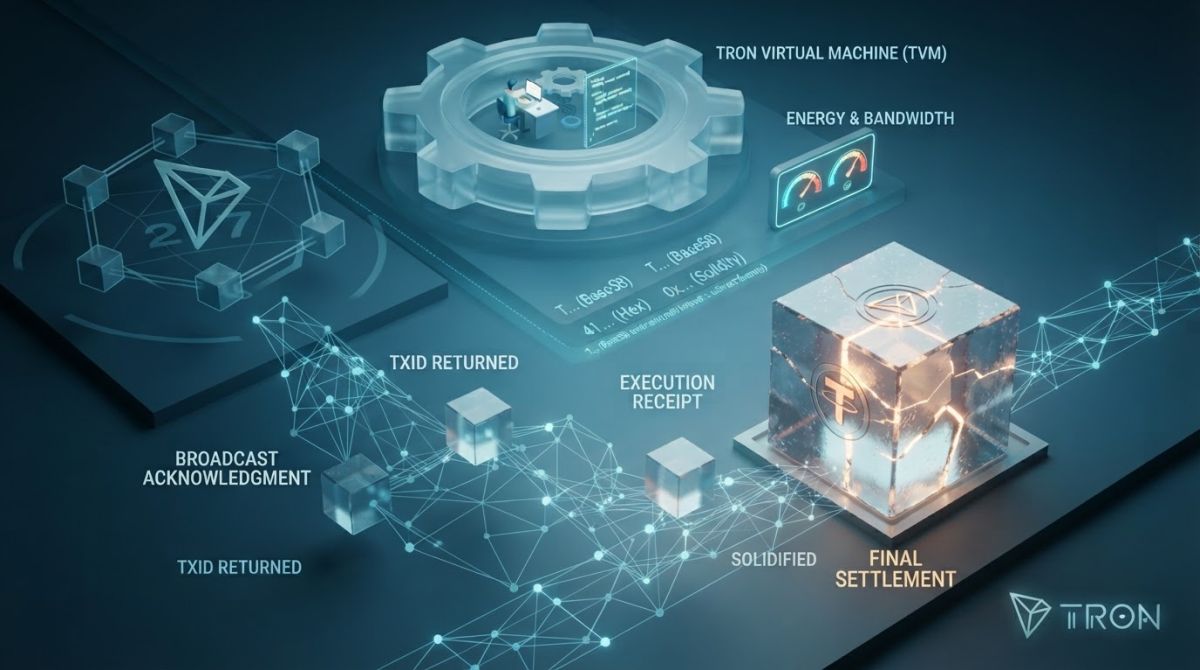
My 25 years in traditional finance taught me to distinguish a payment instruction from an executed payment and an executed payment from final settlement. I apply the same discipline here. A fast acknowledgment is useful, but it is not the same thing as money that can safely be credited to a customer’s account.
The most expensive TRON integration mistakes usually are not in the Solidity code. They happen when a backend treats a successful broadcast response as final confirmation, mixes up Base58Check and hex addresses, calculates feeLimit incorrectly, ignores the Energy model, or assumes an indexed API represents the network’s final consensus state.
In this guide, I look at TRON from the perspective of a developer building a wallet, deposit and withdrawal platform, payment gateway, or service that handles TRC-20 tokens.
What Are TRON and TRX?
TRON is a public blockchain that maintains its own state, produces its own blocks, executes smart contracts, and operates its own consensus mechanism.
It is not an Ethereum Layer 2, and it does not inherit another blockchain’s security.
Its native asset is TRX. TRX is used to:
- Transfer value.
- Pay network charges when an account does not have sufficient resources.
- Stake for Energy or Bandwidth.
- Obtain voting power.
- Vote for Super Representatives.
- Provide the staked capital behind resources delegated to other addresses.
The smallest unit of TRX is called sun. One TRX contains 1,000,000 sun.
The lowercase spelling matters. In TRON documentation, sun is the denomination. Uppercase SUN can refer to a separate token in the TRON ecosystem.
TRX-denominated amounts in node APIs, raw transactions, and parameters such as feeLimit are generally expressed in sun, not TRX. If an API expects sun and you pass 1000000, you are specifying 1 TRX, not one million TRX.
That denomination rule does not automatically apply to TRC-20 tokens. Each token contract defines its own decimal precision.
USDT on TRON uses six decimals, but I would not build a generic token integration around that assumption. Read decimals() from the approved contract, or use a trusted, network-specific token configuration that you have independently verified.
Why Would a Developer Choose TRON?
TRON is particularly relevant for products that process large numbers of relatively straightforward transfers and can actively manage network resources.
It deserves a serious look when the product needs:
- Fast transaction inclusion.
- Broad support for TRC-20 tokens.
- A way to subsidize users’ network costs.
- A resource-based cost model rather than an auction-style gas market.
- Reuse of existing Solidity knowledge.
- Resource delegation between accounts.
- Established support across wallets, exchanges, and payment services.
Typical projects include:
- Custodial and noncustodial wallets.
- Payment gateways.
- Merchant checkout systems.
- Payout and payroll services.
- Remittance platforms.
- Exchanges and brokerage platforms.
- Treasury automation.
- Applications with frequent stablecoin transfers.
- Services that want to cover network costs for users.
TRON is a less obvious choice when the product depends on Ethereum-specific composability, a particular Ethereum infrastructure stack, a rollup security model, or numerous libraries that assume standard Ethereum JSON-RPC behavior.
My starting point is simple: TVM compatibility reduces the cost of learning and migration. It does not make TRON interchangeable with an Ethereum network.
TRON Consensus: When Is a Transaction Actually Confirmed?
TRON uses Delegated Proof of Stake, with 27 active Super Representatives producing blocks on a scheduled rotation.
Under the TRON consensus and DPoS rules, each scheduled block-production slot lasts approximately three seconds.
That fast block interval is useful for user experience. It is not, by itself, a finality guarantee.
A block becomes solidified when at least 19 of the 27 distinct active Super Representatives have each produced a block at that height or higher. Under healthy network conditions, this generally takes about one minute.
For an application, that creates at least four different states:
- The broadcast call has returned without a reported error.
- A FullNode can return the transaction body.
- Execution information is available in a transaction receipt.
- The transaction belongs to a solidified block.
These distinctions are central to the confirmation semantics of TRON transactions.
Consider this broadcast response:
{
  "result": true,
  "txid": "..."
}
It does not mean that a payment succeeded.
It means that the broadcast call completed without reporting an error. It is not proof that the transaction remains in a node’s pending pool, propagated successfully, entered a block, executed successfully, or became solidified.
After broadcast, a smart contract can still revert. Execution can run out of Energy. The transaction can also expire before inclusion.
To establish the execution outcome, read the receipt. For financial settlement and higher-value transfers, verify the solidified transaction and its solidified execution result.
A practical lifecycle is:
CREATEDSIGNEDBROADCASTINCLUDEDEXECUTED_SUCCESSorEXECUTED_FAILEDSOLIDIFIED, while retaining the execution outcome
I would store execution status and finality separately rather than letting one field erase the other. A failed transaction can also become solidified. “Final” does not mean “successful.”
The application also needs an indeterminate state:
UNKNOWNAn RPC timeout is not evidence of failure.
If the backend loses its connection after broadcast, the transaction may already be circulating or included. Before constructing and signing a replacement, look up the original txID.
That is the blockchain equivalent of checking whether a payment instruction was processed before sending it again.
How a TRON Transaction Moves Through the Network
Every state-changing TRON operation follows a construction, authorization, broadcast, execution, and confirmation process.
The TRON workflow for constructing, signing, and broadcasting transactions separates these responsibilities clearly:
- The client constructs an unsigned transaction.
- The transaction receives a TAPOS reference to a recent block.
- An authorized key signs the hash of the serialized
raw_data. - The signed transaction is sent to a FullNode.
- The node validates the signature, structure, TAPOS reference, and applicable admission conditions.
- The scheduled Super Representative includes the transaction in a block.
- The TVM executes the operation if it is a smart contract deployment or call.
- Execution produces a receipt, logs, and any successful state changes.
- The containing block later becomes solidified.
TAPOS, short for Transactions as Proof of Stake, binds a transaction to a recent block. The TRON transaction structure and TAPOS mechanism use ref_block_bytes and ref_block_hash to identify that reference.
This helps protect against replay on incompatible forks. Transaction expiration provides a separate validity deadline. The reference and expiration work together, but they are not the same mechanism.
If a transaction expires, rebroadcasting the old payload does not renew it. You need to construct a new transaction with a valid block reference and expiration, then sign it again.
Changing raw_data produces a different txID.
While the original signed transaction remains valid, rebroadcasting that exact payload is generally safer than constructing a new one. TRON identifies duplicate transactions by txID, so rebroadcasting the identical transaction does not create a second independent payment.
A duplicate-transaction response still is not proof of successful execution. The worker must continue checking the original transaction.
TVM vs. EVM: Compatible Does Not Mean Identical
The TRON Virtual Machine is an EVM-compatible, stack-based runtime, but Ethereum compatibility is not a guarantee of identical behavior.
The TRON Virtual Machine execution model takes compiled smart contract bytecode and executes it deterministically across validating nodes.
The TVM operand stack has a maximum depth of 1,024, with 256-bit values. Nested contract-to-contract calls have a separate depth limit of 64.
For ordinary Solidity development, much of the mental model is familiar:
msg.senderidentifies the immediate caller.msg.valuerepresents the attached native value, denominated in sun.- Storage persists between transactions.
- Events are written to transaction logs.
viewandpurefunctions can be executed locally without broadcasting a transaction.- State-changing functions require an authorized transaction.
- ABI encoding generally follows familiar EVM conventions.
The important word is “generally.”
Differences that deserve explicit testing include:
- Off-chain address formats.
- The address prefix expected by node APIs.
CREATE2address derivation.- Particular opcode and precompile behavior.
- Features activated through network parameters.
- TRX and sun instead of ETH and wei.
- Separate Energy and Bandwidth accounting.
- Protocol-level TRC-10 support.
- Different API surfaces and confirmation semantics.
- A different development and deployment toolchain.
TRON can activate functionality associated with Ethereum upgrades through its own protocol releases and governance-controlled settings. References to Constantinople, Istanbul, London, Shanghai, or Cancun support do not mean every Ethereum feature is automatically available on every TRON network.
Before selecting a compiler version or using newer Solidity features, verify the actual capabilities of the target network.
I also pay attention to denomination assumptions embedded in Solidity. Familiar Ethereum literals and hardcoded wei-based calculations can produce completely inappropriate values on a network whose native asset has six decimal places.
A contract that compiles successfully is not necessarily a contract that behaves identically.
Porting a straightforward token, escrow, or multisignature contract may require limited changes. Porting inline assembly, factories, deterministic deployments, advanced proxies, or logic that depends on exact opcode costs should be treated as a new deployment target, with renewed testing and an appropriately scoped security review.
TRON Addresses: Three Representations Developers Must Understand
TRON integrations commonly encounter Base58Check addresses, 21-byte prefixed hex addresses, and 20-byte Solidity address values.
Mixing them up is one of the quickest ways to break otherwise reasonable EVM code.
The user-facing representation usually looks like this:
T...That is the Base58Check form used by wallets and explorers. It is designed for display, copying, and checksum validation.
A node API may instead expect a hex address containing the 41 prefix byte followed by the underlying 20-byte address:
41 followed by 20 address bytesInside standard Solidity ABI encoding, an address remains a 20-byte value. The 41 prefix is not part of that 20-byte ABI value.
This distinction becomes especially important when an address is:
- Packed into
bytes. - Encoded manually.
- Used in a bridge message.
- Included in an off-chain signing structure.
- Compared across SDKs or database records.
Use the representation expected at that particular boundary. A Base58Check string and a 21-byte prefixed address are not substitutes for an ABI-encoded 20-byte address.
TronWeb provides conversion helpers:
const hex = TronWeb.address.toHex(base58Address);
const base58 = TronWeb.address.fromHex(hexAddress);
Validate addresses before constructing transactions:
if (!TronWeb.isAddress(recipient)) {
  throw new Error('Invalid TRON address');
}
Checking that a string starts with T is not validation. Base58Check includes a checksum, and the SDK can verify it.
There is another operational detail I would not overlook: mainnet, Shasta, and Nile use the same address prefix. A valid-looking address does not tell you which network your application is using.
Network selection must come from trusted application configuration and verified node context, not from the first character of an address.
Energy and Bandwidth: How TRON Transaction Costs Work
TRON separates transaction data costs from smart contract execution costs through Bandwidth and Energy.
The TRON resource model for transaction processing is the foundation of any realistic cost estimate.
On Ethereum, developers typically think in terms of gas units and a gas price. On TRON, those responsibilities are split.
What Is Bandwidth?
Bandwidth covers the network and storage footprint of a transaction, primarily its serialized size.
It is consumed by state-changing operations such as:
- TRX transfers.
- TRC-10 transfers.
- TRC-20 transfers.
- Smart contract calls.
- Staking.
- Resource delegation.
- Voting.
Read-only queries do not consume on-chain Bandwidth.
An activated account has access to a limited free Bandwidth quota that recovers over time. Additional Bandwidth comes from staking TRX or receiving delegated resources.
The fallback charging rule deserves special attention.
For an ordinary transaction, the network first tries the account’s staked or delegated Bandwidth. That source must cover the full transaction requirement. If it cannot, the network tries the free Bandwidth quota, which must also cover the transaction in full.
If neither source can cover the full requirement, the network burns TRX for the transaction’s entire Bandwidth cost.
It does not normally combine a partially sufficient staked quota with a partially sufficient free quota and burn TRX only for the difference.
Special rules can apply to account creation and certain TRC-10 transfers, so those should be modeled separately.
What Is Energy?
Energy meters the computational work performed by TVM instructions.
Operations that consume Energy include:
- TRC-20 transfers.
- DeFi contract calls.
- Token approvals.
- Minting and burning.
- NFT transfers.
- Smart contract deployments.
- Other state-changing smart contract functions.
An account can cover its Energy requirement through its own stake, delegated resources, or a TRX-burn fallback.
Unlike Bandwidth, Energy has no general free per-account quota.
For the caller’s portion of a contract call, available Energy can cover part of the requirement, with TRX burned for the remainder. Depending on the contract’s settings, the deployer may also contribute Energy.
A contract call can therefore complete without burning TRX if all applicable resource requirements are covered.
I would still avoid describing that execution as economically free. Someone supplied capital, delegated capacity, or a paid resource service. The cost has changed form, not disappeared.
Stake 2.0: Treating Resources as Infrastructure
Stake 2.0 lets an account stake TRX to obtain recurring resource capacity rather than paying for every transaction entirely through TRX burns.
The Stake 2.0 model and its explicit staking lifecycle distinguish resource allocation from the eventual withdrawal of staked capital.
For the current mainnet resource model, an account stakes for one of two resources:
ENERGYBANDWIDTH
Staking also provides TRON Power for voting under that model. Because governance can alter resource-related behavior, I would verify the applicable chain settings instead of assuming every network uses identical rules.
The staked TRX is not consumed when a transaction uses resources. Available Energy or Bandwidth decreases with usage and then recovers over time, generally through a rolling 24-hour recovery process.
That recurring capacity is why staking can make sense for a wallet, exchange, or payout service with continuous transaction volume.
The lifecycle has five distinct stages:
- Stake TRX for a resource.
- Use the resource while tracking consumption and recovery.
- Initiate unstaking.
- Wait for the network-defined withdrawal period.
- Withdraw the matured TRX into the spendable balance.
Current documentation lists a 14-day unstaking delay for mainnet and Shasta. Nile can use a different delay.
The production value should come from getUnfreezeDelayDays on the selected network, not from a permanently hardcoded assumption.
Resources can also be delegated to another eligible account without transferring ownership of the underlying staked TRX.
That enables several useful architectures:
- A central treasury stakes TRX and delegates Energy to hot wallets.
- A DApp operator supplies resources for a user’s initial transaction.
- Different payout wallets receive separate operating budgets.
- Capacity is withdrawn from inactive accounts and assigned to active ones.
- A user signs a transaction while an operator provides the resources.
Delegation does not give the recipient permission to spend the staked TRX. It gives the recipient the ability to use the delegated resource.
I think of this as capacity management. The treasury owns the capital, while operational accounts receive permission to consume a controlled share of the network capacity that capital supports.
The resource yield per staked TRX can also change as network-wide staking and governed resource limits change. Staking a fixed quantity of TRX is not a promise of permanently fixed throughput.
How TRON’s Dynamic Energy Model Changes Estimates
TRON’s Dynamic Energy Model can increase the Energy required to interact with heavily used smart contracts.
That means execution cost is not always just a static sum of opcode charges.
The model is designed to keep a small number of popular contracts from consuming a disproportionate share of the network’s execution resources.
For a contract call, distinguish:
- Base Energy consumption.
- The contract’s current dynamic Energy factor.
- Total expected Energy consumption.
- The caller’s available Energy.
- Any contribution the contract deployer can make.
- The remaining caller-side requirement that may trigger a TRX burn.
This matters particularly for popular stablecoin and DeFi contracts.
An estimate that was accurate last week is not a contractual guarantee for next week. Even without a code change, contract state, recipient state, execution paths, or the dynamic factor can change.
Before sending, simulate the actual call against the actual contract, using the same caller, parameters, and attached value, with state as close as practical to the expected execution environment.
I would also check whether the estimation result already includes a dynamic Energy penalty before applying another adjustment. Counting the same factor twice is not prudent budgeting.
How Much Does It Cost to Use TRON?
A TRON transaction can burn no TRX for resource consumption, or it can burn the amount required to cover resource shortfalls.
There is no single universal price for a TRC-20 transfer.
If staking or delegation fully covers the required resources, execution may not burn TRX. If resources are insufficient, the network applies its resource charging rules.
For the Energy portion, the simplified calculation is straightforward: multiply the missing caller-side Energy by the current Energy price in sun, then divide by 1,000,000 to express the result in TRX.
For example, suppose:
- The call requires 65,000 Energy.
- The caller has no available Energy.
- The deployer contributes none.
- The Energy price is 100 sun per unit.
The Energy-related burn would be 6.5 TRX, before any separate Bandwidth or other applicable charges.
That is an arithmetic example, not a guaranteed USDT transfer price.
Actual Energy consumption depends on the contract, current state, recipient, dynamic Energy factor, and execution path.
The 2025 proposal to reduce the Energy unit price proposed lowering it from 210 sun to 100 sun, with an anticipated effective date of August 29, 2025. Current developer documentation uses 100 sun as its reference value.
However, a historical proposal and a documentation example are not substitutes for querying the target network. Energy pricing is a governance-controlled chain parameter.
Retrieve chain parameters through:
POST /wallet/getchainparametersFind each parameter by its key, not by its position in the returned array.
Relevant keys include:
getEnergyFeefor the Energy unit price.getTransactionFeefor the Bandwidth burn rate.getMaxFeeLimitfor the maximum permitted caller-side Energy budget.getUnfreezeDelayDaysfor the unstaking delay.
Fiat-denominated cost also depends on the market price of TRX.
For that reason, I would track at least three separate metrics:
- Energy consumed by operation type.
- TRX actually burned per transaction.
- Fiat value at the time of execution.
That separation tells you whether costs increased because the contract became more resource-intensive, because a resource price changed, or because TRX moved in the market.
What Does feeLimit Actually Do?
feeLimit caps the caller-side Energy budget for a smart contract transaction. It is not an estimate, a flat charge, or a complete transaction-fee ceiling.
The TRON explanation of FeeLimit and Energy costs is worth reading carefully because this parameter is frequently misunderstood.
TronWeb uses the camelCase option feeLimit. Raw transaction data and node APIs commonly use fee_limit.
The value is expressed in sun:
const feeLimit = 100_000_000; // 100 TRXA transaction that requires less does not automatically burn all 100 TRX.
However, the limit applies to the caller’s Energy budget whether that Energy comes from staking, delegation, or burning TRX. It is not merely a cap on the burn portion.
That distinction has a practical consequence: a transaction can fail with OUT_OF_ENERGY because feeLimit is too low even when the caller has substantial staked Energy.
Conversely, a sufficiently high feeLimit does not create resources. The caller must still have enough available Energy, spendable TRX, or an applicable deployer contribution.
If the limit is unnecessarily high, it increases the maximum resource exposure to an unexpected or malicious execution path.
Current documentation lists a mainnet maximum of 15,000 TRX, equivalent to:
15,000,000,000 sunThat maximum is controlled by getMaxFeeLimit. It is a protocol limit, not a recommended setting.
Also remember that feeLimit does not cover Bandwidth or every possible additional protocol charge. It should not be presented to customers as an absolute ceiling on all TRX movement associated with a transaction.
My sizing procedure would be:
- Simulate the intended call.
- Read the estimated Energy requirement.
- Check the contract’s dynamic Energy factor and whether the estimate already includes it.
- Add a controlled safety margin.
- Convert the required caller-side Energy budget into sun using the current
getEnergyFee. - Apply a separate business maximum for that operation.
- Reject or escalate the transaction if the estimate exceeds the permitted budget.
Do not size feeLimit from the expected burn alone. The budget must allow the caller’s total Energy contribution.
I would not use one global value for every contract function. An approval, token transfer, swap, and complex multi-contract operation do not share the same risk or resource profile.
Production Example: A Custodial USDT Deposit and Withdrawal System
A custodial USDT platform needs more than transfer detection. It needs asset validation, execution verification, finality checks, and idempotent accounting.
Imagine a payment platform that assigns each customer a TRON deposit address and later sends USDT withdrawals.
The apparent workflow has three steps:
- The customer sends tokens.
- The backend sees a transfer.
- The platform credits the customer’s balance.
The production workflow is more demanding:
- The customer sends a TRC-20 token.
- The transaction enters a block.
- An indexer discovers a candidate
Transferevent. - The backend validates the emitting contract and event structure.
- The backend checks the execution receipt.
- A confirmation worker waits for solidification.
- The ledger credits the deposit through an idempotent database operation.
- The platform either retains the funds at the deposit address or schedules a sweep.
The platform must establish:
- Whether the token contract is the expected contract.
- Whether the log represents the standard
Transferevent. - Whether execution succeeded.
- Who actually received the tokens.
- The amount in integer base units.
- The token’s decimal precision.
- Whether the block is solidified.
- Whether the event has already been processed.
- Whether the event resulted from a direct transfer call or nested contract execution.
- Whether the indexed API is lagging or pagination has omitted results.
For token deposits, the relevant evidence is the validated event in a successful, solidified execution. Looking only at the top-level function call is not enough because another contract can trigger a token transfer internally.
How to Identify a TRC-20 Deposit Uniquely
A transaction ID alone is not always a sufficient deposit identifier.
One transaction can emit multiple events, including multiple Transfer events.
A reliable business identifier combines:
network
tokenContract
txID
logIndex
If you use the TronGrid event API, the event-position field may be called event_index. If you read the receipt directly, use the log’s position in the receipt’s log[] array.
When combining providers, verify and normalize those indexing conventions. Do not assume differently named fields automatically use identical numbering semantics.
Create a database unique constraint over the canonical identity.
That prevents an indexer retry, block rescan, or duplicated API result from crediting the same deposit twice.
The network component matters even if addresses look identical across environments. Testnet activity must never collide with production accounting.
How to Validate a Transfer Event
The standard TRC-20 event is:
event Transfer(
    address indexed from,
    address indexed to,
    uint256 value
);
The backend should not simply search for an event named Transfer.
It should verify:
- The address of the contract that emitted the log.
- The event signature topic.
- Correct decoding of the indexed
fromandtoaddresses. - The integer amount encoded in
data. - A successful execution receipt.
- Solidification before final ledger credit.
The destination must also match an address your system controls and associates with the correct customer.
An attacker can deploy a worthless token that emits an identical event and reports the symbol USDT. If your backend identifies an asset by its symbol rather than its approved contract address, it can credit a fake deposit as real money.
Token names and symbols are metadata. The contract address, interpreted within the correct network, identifies the asset.
FullNode, SolidityNode, and TronGrid: Which Data Should You Trust?
FullNode, SolidityNode, and TronGrid serve different integration purposes and should not be treated as interchangeable sources of final financial state.
The TRON API guide to node interfaces and indexed services separates node APIs from ecosystem indexing services.
TRON nodes expose HTTP, gRPC, and compatible JSON-RPC interfaces. JSON-RPC availability and configuration depend on the node or provider, and compatibility does not eliminate TRON-specific behavior.
What Does a FullNode Provide?
A FullNode works with the current chain head.
Typical uses include:
- Constructing transactions.
- Broadcasting signed transactions.
- Reading the latest state.
- Debugging.
- Displaying low-latency, not-yet-final information.
FullNode data can be useful immediately, but it is not necessarily solidified.
For a wallet interface, I may want that speed. For a final ledger posting, I want stronger evidence.
What Does a SolidityNode Provide?
The SolidityNode interface serves solidified state.
Typical uses include:
- Final transaction confirmation.
- Financial settlement.
- Solidified execution receipts.
- Confirmed balances.
- Reading solidified blocks.
The name can be misleading. A SolidityNode is not simply a node that executes Solidity code. For an integrator, its important role is access to the solidified chain view.
The HTTP path families make the distinction visible:
/wallet/
/walletsolidity/
A transaction returned through /walletsolidity/gettransactionbyid belongs to the solidified chain. A smart contract transaction still requires its receipt to determine whether execution succeeded.
Use /walletsolidity/gettransactioninfobyid for that solidified execution information.
What Does the TronGrid V1 API Provide?
TronGrid provides indexed data that is convenient for:
- Account history.
- TRC-20 transfer history.
- Event discovery.
- Internal transaction records.
- Pagination.
- Search.
An indexer can lag behind a node, enforce pagination constraints, or temporarily return incomplete results.
A sensible production architecture combines these sources:
- The indexer discovers a candidate transaction or event.
- A FullNode supplies fast information for the interface.
- The SolidityNode interface verifies final chain state.
- A local database maintains processing cursors and idempotency.
For financial accounting, I would not make an event API the sole source of truth.
Getting Started With TronWeb
TronWeb is the main JavaScript SDK for building TRON integrations.
The TronWeb JavaScript SDK documentation covers account management, transaction construction, contract interaction, and TRON-specific resource operations.
TronWeb can:
- Convert and validate addresses.
- Read balances.
- Build transactions.
- Sign transactions.
- Broadcast signed payloads.
- Load contract ABIs.
- Call read-only functions.
- Send state-changing contract calls.
- Work with staking and delegation.
- Communicate with node APIs.
Install it with:
npm install tronwebHere is a basic Shasta testnet initialization:
const { TronWeb } = require('tronweb');

const privateKey = process.env.TRON_PRIVATE_KEY;

if (!privateKey) {
  throw new Error('Missing TRON_PRIVATE_KEY');
}

const tronWeb = new TronWeb({
  fullHost: 'https://api.shasta.trongrid.io',
  privateKey
});

console.log('Address:', tronWeb.defaultAddress.base58);
For a controlled test script, loading a dedicated testnet key from the environment is convenient. It is not the full security architecture I would use for custody.
Common HTTP endpoints are:
| Network | FullNode HTTP endpoint |
|---|---|
| Mainnet | Connect to TronGrid mainnet |
| Shasta | Connect to Shasta through TronGrid |
| Nile | Connect to Nile through TronGrid |
| Local node | Connect to a local FullNode |
Mainnet TronGrid requests generally use the TRON-PRO-API-KEY header:
const tronWeb = new TronWeb({
  fullHost: 'https://api.trongrid.io',
  headers: {
    'TRON-PRO-API-KEY': process.env.TRONGRID_API_KEY
  }
});
A read-only client does not need a private key. Some contract simulation methods still require an explicit caller address, which can be provided without granting signing authority.
For production, pin the SDK version you test and review upgrade behavior deliberately. Method return types and convenience options are part of your integration contract.
Never embed a private key in a browser application’s TronWeb configuration. Let TronLink or another compatible wallet provider handle user authorization and signing.
Reading TRC-20 Token State
TRC-20 balances and metadata can be read without broadcasting a state-changing transaction.
The distinction between read-only calls and state-changing contract interactions determines which SDK method to use.
Load a contract instance by address:
const token = await tronWeb.contract().at(tokenAddress);Use .call() for functions that do not change state:
const [name, symbol, decimals, rawBalance] = await Promise.all([
  token.name().call(),
  token.symbol().call(),
  token.decimals().call(),
  token.balanceOf(accountAddress).call()
]);

console.log({
  name,
  symbol,
  decimals: decimals.toString(),
  rawBalance: rawBalance.toString()
});
These calls execute locally against a node’s state. They do not broadcast a transaction or charge on-chain Energy, although the node still performs computation and the provider can impose API limits.
In production, distinguish:
- The displayed amount, such as
1.25. - The integer base-unit amount, such as
1250000. - The token’s decimal precision, such as
6.
Use integer base units for transactions and accounting.
Avoid this conversion pattern:
const amount = 1.25 * 10 ** 6;This particular value may happen to be represented safely, but the pattern becomes unreliable with other decimal inputs or larger amounts.
Use an exact decimal parser or a suitable arbitrary-precision library. For a simple known amount, pass an integer string:
const amountBaseUnits = '1250000';I would apply the same discipline to database columns, JSON serialization, reconciliation jobs, and reporting. Precision errors do not become less dangerous because they occur outside the signing code.
Also distinguish a balance read for display from a balance read for financial reconciliation. The latter should use an appropriate solidified state view.
Sending TRC-20 Tokens With TronWeb
A TRC-20 transfer is a state-changing smart contract call that requires signing, resources, execution verification, and confirmation.
The TRC-20 contract interaction workflow uses .send() for this kind of operation.
The following helper illustrates the established TronWeb interface:
const { TronWeb } = require('tronweb');

async function transferToken({
  tronWeb,
  tokenAddress,
  recipient,
  amountBaseUnits
}) {
  if (!TronWeb.isAddress(tokenAddress)) {
    throw new Error('Invalid token contract address');
  }

  if (!TronWeb.isAddress(recipient)) {
    throw new Error('Invalid recipient address');
  }

  if (
    typeof amountBaseUnits !== 'string' ||
    !/^\d+$/.test(amountBaseUnits) ||
    BigInt(amountBaseUnits) <= 0n
  ) {
    throw new Error(
      'Amount must be a positive integer string in base units'
    );
  }

  const token = await tronWeb.contract().at(tokenAddress);

  const result = await token
    .transfer(recipient, amountBaseUnits)
    .send({
      feeLimit: 150_000_000,
      callValue: 0,
      shouldPollResponse: true,
      keepTxID: true
    });

  const [txID, contractResult] = result;

  return {
    txID,
    contractResult
  };
}
The 150_000_000 value represents a 150 TRX caller-side Energy budget. It is illustrative, not a universal recommendation.
In a real system, calculate the limit from simulation, current Energy pricing, expected caller responsibility, and an internal risk policy.
These options have different meanings:
feeLimitcaps the caller-side Energy budget.callValueattaches TRX to a payable contract call.shouldPollResponseasks the SDK to wait for an execution response rather than immediately returning only the transaction ID.keepTxIDretains the transaction ID alongside the decoded contract result when polling is enabled.
Verify the return shape against the SDK version you have pinned.
Do not treat a decoded token return value as your entire success criterion. Token implementations can have nonstandard return behavior, including USDT-specific behavior on TRON. Confirm the successful execution receipt and the expected transfer event from the approved token contract.
Even when the SDK polls, the backend needs its own durable confirmation worker.
An HTTP connection can break. A process can restart. A provider can time out after a successful broadcast. None of those events should make the withdrawal disappear from your operational records.
For that reason, I would not keep a customer’s withdrawal request open while waiting for solidification.
A better asynchronous workflow is:
- Receive
POST /withdrawals. - Validate the business request.
- Create the withdrawal record and reserve the required ledger balance.
- Queue a signing job.
- Broadcast the signed transaction.
- Let a confirmation worker track execution and solidification.
- Finalize the business status from the verified outcome.
The API can return a withdrawal identifier immediately, while a status endpoint reports progress.
How to Make TRON Withdrawals Idempotent
An idempotent payout system prevents queue retries and uncertain network responses from creating duplicate payments.
A minimal withdrawal record can contain:
withdrawal_id
idempotency_key
network
token_contract
recipient
amount_base_units
status
unsigned_tx_hash
tx_id
created_at
broadcast_at
solidified_at
Before constructing a transaction, reserve the business operation using a unique idempotency_key.
The database transaction should also enforce the necessary ledger reservation and prevent two workers from independently processing the same withdrawal.
After construction, persist the transaction ID before broadcast whenever the workflow allows it. Also retain the signed payload securely enough to rebroadcast it without rebuilding.
If unsigned_tx_hash means the hash of the serialized raw_data, it is already the TRON txID. Be explicit about your field definitions so different services do not invent incompatible identifiers.
If broadcast times out, the worker first checks the existing txID. It does not immediately construct a replacement.
A replacement is justified only after establishing that:
- The original transaction was not included.
- Its validity window has expired.
- No successful or otherwise relevant final execution record exists.
- The underlying business operation still needs to be completed.
A single empty API response does not establish those facts.
A safer replacement policy waits until the solidified chain has progressed beyond the original transaction’s expiration and checks the relevant solidified history through reliable, synchronized infrastructure.
Every reconstructed transaction changes its block reference, expiration, and txID. It must remain attached to the same withdrawal request.
For an auditable system, I would keep a separate attempt history rather than overwriting the old transaction ID. The business withdrawal is one operation, even when it has multiple transaction attempts.
Private Key Management for a TRON Custodial Backend
A production signing service should be isolated from the application backend and enforce transaction policy before releasing signatures.
The process.env.TRON_PRIVATE_KEY example is useful for a testnet script. It is not sufficient architecture for a platform holding customer funds.
A stronger workflow separates responsibilities:
- The payment backend approves a business operation.
- A transaction builder prepares the complete unsigned transaction.
- A policy engine validates the proposed operation.
- An isolated signer or compatible HSM authorizes the approved payload.
- The signed transaction is stored with its transaction ID.
- A broadcast worker submits it.
- A confirmation worker monitors the chain outcome.
The signer should inspect the complete transaction and validate:
- The intended network context.
- The transaction type.
- The token or application contract address.
- The function selector.
- The recipient.
- The amount.
feeLimit.callValue.- Expiration.
- Applicable daily and per-transaction limits.
Network validation requires more than recognizing a TRON address. It should include trusted configuration and an appropriate TAPOS reference from the intended chain.
I would not expose the signer as a general-purpose sign(bytes) function that blindly accepts requests from the backend.
TRON also supports account permissions with multiple keys, weights, and thresholds. An owner permission can remain in a colder environment, while active permissions authorize narrower categories of daily operations.
There is an important limitation: active permission operation bitmaps restrict protocol transaction types. They do not automatically enforce a token contract allowlist, recipient allowlist, function selector, or daily spending budget within every TriggerSmartContract transaction.
Those finer controls still belong in the signing policy.
For treasury and exchange systems, separating owner authority from operational signing is substantially safer than keeping one unrestricted private key online.
TRON Development Networks: Nile, Shasta, and Private Chains
TRON development should use different environments for reproducible testing, upcoming protocol changes, and final integration checks.
The TRON network guide for mainnet, Shasta, and Nile explains the available environments and their connection options.
TRON has two public testnets. A private chain adds a separate layer of control.
When to Use Nile
Nile is the forward-looking testnet where new protocol capabilities and governance changes are generally introduced first.
It is useful for:
- Testing upcoming features.
- Working with future parameter settings.
- Identifying integration changes early.
- Running your own testnet node.
I would use Nile when I need to understand a change before it reaches mainnet, not as evidence that mainnet already supports it.
When to Use Shasta
Shasta is commonly used for tutorials, integration development, and final preproduction testing.
It is useful for:
- Building the first working integration.
- Running end-to-end integration tests.
- Checking behavior before a mainnet release.
- Testing TronGrid-based workflows.
Shasta is often treated as the closer-to-mainnet testing environment, but that does not make it a perfect mainnet mirror. Its chain parameters, enabled features, and node versions can differ.
Verify the settings relevant to your release on both networks.
Shasta does not currently accept new external node operators in the same way Nile does. Programmatic access typically uses TronGrid or another available hosted interface.
When to Use a Private TRON Network
A private chain makes sense for:
- Continuous integration.
- Deterministic test fixtures.
- Fast state resets.
- Tests without faucet dependencies.
- Direct control over chain parameters.
- Failure-scenario simulations.
The trade-off is realism.
A private network does not reproduce public validator distribution, third-party infrastructure failures, indexer delays, or the real activity surrounding popular contracts.
For releases involving protocol changes, a useful progression is:
- Local or private-chain tests.
- Nile tests for upcoming behavior.
- Shasta integration checks.
- Carefully limited mainnet transactions.
For an ordinary first integration, starting on Shasta is entirely reasonable. Nile is an additional testing target when its particular capabilities matter.
TRON Smart Contract Development Tools
TRON development uses familiar Solidity concepts, but its build, deployment, resource, and integration tools need to be configured specifically for TRON.
The TRON smart contract development workflow covers the lifecycle from contract preparation through deployment and verification.
The main tools include:
- TronWeb for JavaScript integration.
- TronBox for compilation, migrations, and testing.
- TronIDE for browser-based development and manual deployment.
- Trident for Java integrations.
- java-tron for operating your own node.
- TronScan for exploration, verification, and debugging.
TronBox is conceptually similar to a Truffle workflow.
A project commonly contains:
contracts/
migrations/
test/
tronbox-config.js
Network configuration defines the endpoint, signing configuration, feeLimit, and deployment-related Energy settings.
One distinction I would make explicit is the difference between caller costs and deployer contributions.
A contract’s deployment configuration can include:
consume_user_resource_percentorigin_energy_limit
consume_user_resource_percent controls the intended split between caller and deployer. A value of 100 assigns the full Energy requirement to the caller. Lower values allow a deployer contribution, subject to available resources and applicable limits.
origin_energy_limit caps the deployer’s per-call Energy contribution. Its unit is Energy, not sun.
These settings let a contract operator subsidize calls, but the subsidy is not unlimited or guaranteed independently of the deployer’s resources.
If the deployer’s Energy is insufficient, the caller may have to cover the remainder. A user can unexpectedly start burning TRX or encounter failed calls if the application promises subsidized execution without monitoring the funding behind it.
The transaction’s Bandwidth requirement also remains a separate consideration.
From a financial operations perspective, a subsidized interface is a service commitment. It needs a resource budget, monitoring, and a fallback policy.
Migrating From Ethereum to TRON
Migrating an Ethereum application to TRON is a change of execution and infrastructure target, not merely a change of RPC URL.
The common conceptual substitutions are:
| Ethereum stack | TRON equivalent |
|---|---|
| EVM | TVM |
| ETH | TRX |
| wei | sun |
| ERC-20 | TRC-20 |
| web3.js | TronWeb |
| Truffle | TronBox |
| Remix | TronIDE |
gasLimit | feeLimit together with Energy accounting |
UI addresses beginning with 0x | Base58Check addresses beginning with T |
| Ethereum JSON-RPC | TRON HTTP, gRPC, or compatible JSON-RPC |
These are orientation points, not one-to-one semantic guarantees.
In particular, gasLimit is generally an execution-unit limit, while feeLimit is a sun-denominated caller-side Energy budget. ETH and TRX also have different native decimal scales.
In tests and integration code, this:
web3.eth.getBalance(address);may become:
tronWeb.trx.getBalance(address);And this:
web3.utils.toWei(value, 'ether');may become:
tronWeb.toSun(value);Use toSun for TRX denomination conversion, not as a generic conversion function for arbitrary TRC-20 tokens.
A read-only contract call takes this form:
contract.methodName().call();A state-changing call uses:
contract.methodName(arg).send({
  feeLimit: 100_000_000
});
The biggest migration risk is not syntax. It is an assumption that exact Ethereum behavior remains unchanged.
I would explicitly test:
- Address encoding.
- Signature domains.
- Message signing.
- Proxy upgrades.
- Deployment addresses.
- Factory contracts.
fallbackandreceivebehavior.- Event decoding.
- Custom errors.
CREATE2.- Inline assembly.
- Low-level
call. - Energy allocation between participants.
For deterministic deployments, even the CREATE2 derivation rules deserve special attention rather than blind reuse of an Ethereum helper.
The OpenZeppelin guidance on TVM-specific contract differences documents adaptations involving address derivation, native denominations, precompiles, token behavior, and other migration hazards.
TRON-adapted libraries can reduce implementation work. They do not remove the need to test your own assumptions.
Building a Deposit Scanner Without Depending on One API
A reliable deposit scanner maintains a local cursor over solidified blocks and can replay its work without duplicating ledger entries.
The essential algorithm is:
- Read the last successfully processed solidified block.
- Ask the SolidityNode interface for the current solidified head.
- Process the missing blocks in order.
- Retrieve the execution information needed for each transaction.
- Select logs emitted by approved token contracts.
- Decode the relevant
Transferevents. - Insert the events and associated accounting changes idempotently.
- Advance the cursor only after the database commit succeeds.
Do not move the cursor before every relevant event from the block has been durably handled.
If the process crashes after writing events but before advancing the cursor, replay should be harmless because the unique event identity prevents duplicate credits.
If the cursor advances before the events are committed, deposits can be skipped. That is the more dangerous failure.
An account-history API can be convenient, but changing pagination boundaries make it harder to prove that no page or event was missed.
A block scanner is more work to build. In exchange, it gives you a clear sequence, a replayable history, and a stronger completeness argument.
A practical hybrid architecture uses:
- TronGrid for fast discovery.
- A local queue for processing.
- SolidityNode reads for final confirmation.
- Periodic block reconciliation for completeness.
Reconciliation should compare at least:
- Relevant event counts per block.
- Transfer totals per token.
- Local ledger balances and on-chain balances.
- The latest successfully processed solidified cursor.
- Transactions stuck in
UNKNOWN.
Make those comparisons at compatible block heights and with clearly defined address and token scopes. Comparing a live balance against yesterday’s ledger snapshot can create false alarms that obscure real problems.
TRC-20 Sweeps: Solving the Deposit Address Energy Problem
A TRC-20 sweep requires resources at the deposit address that sends the tokens, even if that address already holds USDT.
Custodial platforms often assign a separate address to each customer and later consolidate funds into a central treasury. That consolidation transfer is called a sweep.
The operational problem is straightforward: a deposit address can hold tokens while having no TRX and no available Energy.
You should also check account activation. A token contract can record a balance for an address without that address necessarily being ready for every native account operation. Activation requirements must be handled before delegation and outgoing transactions where applicable.
There are several ways to organize sweeps.
Fund Every Deposit Address With TRX
Sending TRX to each deposit address is simple to implement, but it:
- Scatters TRX across many addresses.
- Adds transactions.
- Complicates consolidation.
- Increases the number of operational failure points.
It can work for small systems. At scale, the stranded balances and top-up logic become their own treasury problem.
Delegate Energy to the Deposit Address
A treasury stakes TRX and temporarily delegates Energy to the address that needs to sweep.
Advantages include:
- The deposit address does not receive ownership of the staked TRX.
- One central resource pool can support multiple operational addresses.
- Budgeting and monitoring can be centralized.
Disadvantages include:
- Delegation and undelegation are separate operations.
- Available capacity must be tracked.
- Concurrent sweeps can exhaust the pool.
- Resource recovery must be included in scheduling.
Delegation does not make consumed Energy instantly reusable. Moving a delegation around is not a way to avoid recovery constraints.
The scheduler needs to understand available capacity, recent usage, any delegation locks, and the requirements of the next sweep.
Bandwidth must also be covered separately.
Pay Through a TRX Burn at the Deposit Address
This is the pay-as-you-go approach: maintain sufficient TRX at the sending address and let the network burn it for uncovered resources.
Operationally, it is closely related to topping up deposit addresses. The distinction is that the transaction cost is deliberately paid through burns rather than primarily through a shared staked resource pool.
It is simple at low volume. Across thousands of addresses, it becomes more expensive and harder to optimize.
Use a Shared Deposit Address With an Off-Chain Invoice Model
A standard TRC-20 transfer has no mandatory destination tag or memo argument comparable to the deposit tags used on some other networks.
A merchant can use one address and assign distinctive invoice amounts off-chain, but that creates problems involving:
- Payment attribution.
- Privacy.
- Amount collisions.
- Partial payments.
- Overpayments and underpayments.
- Delayed payments against expired invoices.
An optional transaction memo is not a universal, reliably supported TRC-20 deposit-tag system.
For a serious custodial platform, resource delegation combined with a planned sweep scheduler generally gives me a more controllable design than ad hoc TRX top-ups across every address.
TRON Production Monitoring: What to Measure
RPC uptime is not enough to show that a TRON payment system is healthy.
A provider can answer requests while your scanner is behind, your Energy pool is exhausted, or your ledger has missed finalized deposits.
I would monitor four separate areas.
Network Health
Track:
- Latest FullNode block height.
- Latest solidified block height.
- The gap between those heights.
- Time since the latest block.
- RPC latency.
- Request failure rate.
A growing solidification gap is a different incident from an ordinary API timeout. Your alerting should preserve that distinction.
Transaction Health
Track:
- Number of broadcast transactions.
- Time to block inclusion.
- Time to solidification.
- Reverted calls.
OUT_OF_ENERGYfailures.- Expiration and TAPOS errors.
- Transactions in
UNKNOWN.
A withdrawal system also needs age-based alerts. Ten unresolved withdrawals that are two hours old matter more than ten that were broadcast a few seconds ago.
Resource Health
Track:
- Available Energy per hot wallet.
- Available Bandwidth.
- Delegated Energy.
- Energy consumption by contract function.
- TRX burned by function.
- Estimated versus actual resource consumption.
- Dynamic Energy factors for important contracts.
I pay particular attention to the ratio of actual Energy consumption to estimated Energy consumption.
If actual consumption starts rising relative to estimates, the cause may be changing contract state, a dynamic Energy adjustment, or a different execution path. That is more actionable than a generic alert saying fees increased.
Business and Ledger Health
Track:
- Solidified deposits that have not been credited.
- Duplicate event detections.
- Withdrawal queue status.
- Differences between on-chain assets and the internal ledger.
- Sweep backlog.
- Deposit addresses that hold tokens but lack resources to move them.
In my view, the most useful monitoring question is not “Is the node online?” It is “Can we explain every movement of customer money?”
TRON Integration Mistakes That Become Expensive
The most costly failures usually come from incorrect assumptions at the boundaries between network state, application state, and accounting.
These are the mistakes I would actively design against.
Treating Broadcast Success as Payment Success
The customer is credited, or a withdrawal is marked complete, before execution is known.
The fix is to verify the execution receipt and require solidification for final financial states.
Remember that a solidified receipt can still describe a failed transaction.
Identifying a Token by Its Symbol
An attacker deploys a contract with the same name or symbol and emits familiar events.
The fix is a network-specific allowlist of approved contract addresses.
Symbols are useful for display. They are not asset identifiers.
Using JavaScript number for Token Amounts
Large integers and decimal conversions can introduce precision loss.
The fix is integer strings, BigInt where the interface supports it, or an appropriate arbitrary-precision library.
Apply the rule across the entire data path, not just the transfer helper.
Using One feeLimit Everywhere
Complex operations fail while simple operations receive an unnecessarily high budget.
The fix is estimation and policy by contract and function selector, with a controlled safety margin and business maximum.
A low limit can fail even when staked Energy is available.
Treating an Indexer as Final Chain State
Indexer lag or pagination mistakes produce an incomplete or incorrect ledger.
The fix is solidified node confirmation and periodic block-based reconciliation.
Discovery and final verification should be separate responsibilities.
Putting a Private Key in the Frontend Bundle
Anyone who obtains the key can take control of the account.
The fix is wallet-provider signing for user-controlled accounts or an isolated signer for custodial operations.
An obfuscated frontend secret is still a frontend secret.
Rebuilding on Retry Without Checking the Original Transaction
The first payment may already have executed. The replacement creates a second payment with a different transaction ID.
The fix is durable transaction tracking, lookup before replacement, safe rebroadcasting of the original signed payload, and business-level idempotency.
A queue retry should repeat the workflow safely, not repeat the payment.
TRON’s Technical Trade-Offs Without the Marketing
TRON is not universally better or cheaper than other blockchains. It has a specific operating profile that fits some products well and others poorly.
I would evaluate it as a complete system, including consensus, resources, infrastructure, and operations.
TRON’s Advantages
- Short block-production intervals.
- Solidity and TVM compatibility.
- Established TRC-20 payment workflows.
- Energy and Bandwidth delegation.
- Operator-funded resource models for users.
- More predictable budgeting when resources are managed well.
- Multiple access interfaces, including HTTP, gRPC, and compatible JSON-RPC.
- Straightforward JavaScript integration.
- An explicit solidification model.
For a high-volume platform, the ability to organize resources centrally can be more important than a headline transfer-fee comparison.
TRON’s Limitations
- Only 27 active block producers.
- Governance can change important protocol parameters.
- TVM behavior is not identical to EVM behavior.
- The resource model requires additional operational logic.
- Popular contracts can be affected by dynamic Energy pricing factors.
- Advanced Ethereum tooling is not always directly portable.
- Indexed TronGrid data is not a replacement for final node state.
- Hot-wallet and sweep systems become more complex when they depend on resource delegation.
The model is strongest when the operator can plan capacity.
For someone sending an occasional token transfer, paying through a TRX burn can be the simplest option. For a platform processing thousands of transfers, Energy becomes infrastructure capacity that must be budgeted, allocated, and monitored.
That is not necessarily a disadvantage. It is a different responsibility.
When Is TRON a Rational Choice?
TRON is worth serious technical evaluation when stablecoin transfers and resource-managed payment operations are central to the product.
I would put it on the shortlist if the project:
- Primarily handles stablecoin transfers.
- Makes frequent payouts.
- Wants to subsidize users’ network costs.
- Already uses Solidity.
- Can manage staked capital.
- Accepts the DPoS security model.
- Does not depend on Ethereum-specific composability.
I would be more cautious if the project:
- Requires completely identical EVM semantics.
- Depends on many Ethereum-only protocols.
- Has strict requirements for a broader active validator distribution.
- Does not want to manage Energy and Bandwidth.
- Assumes the newest EVM opcodes are available without checking TVM support.
- Lacks the operational capacity for durable confirmation and reconciliation pipelines.
The final point is easy to underestimate.
A payment rail is not production-ready simply because an SDK can send a token. The organization must also be able to detect uncertainty, resolve it, and reconcile the resulting financial records.
A Minimal TRON Experiment That Actually Tests Production Assumptions
The most useful first TRON experiment is a small end-to-end payment flow, not simply deploying a token contract.
A deployment proves that you can compile and run code on TVM. A payment experiment tests the operational boundaries that tend to fail in production.
Here is the sequence I recommend:
- Create a dedicated Shasta account.
- Obtain test TRX and a test TRC-20 token.
- Read the account’s balance and resource availability.
- Call the token’s
decimals()andbalanceOf()functions. - Estimate the Energy required for a transfer.
- Send a small token amount.
- Persist the
txID. - Distinguish broadcast acknowledgment, execution receipt, and solidification.
- Decode the
Transferevent. - Store the event idempotently in a local database.
- Reprocess the same block and verify that no duplicate credit appears.
- Deliberately use an insufficient
feeLimiton testnet and inspect the failed receipt. - Repeat the experiment with staked or delegated Energy.
- Compare estimated and actual consumption.
Use dedicated test accounts for failure experiments. An intentionally failed transaction can still consume resources.
This exercise exposes almost everything a production integration needs to understand: the SDK, address formats, resources, execution, events, failure handling, persistence, and finality.
Deploying Solidity demonstrates TVM. Building and reconciling a payment flow demonstrates TRON.
Final Thoughts: Build Around Settlement, Not Just Transactions
TRON becomes most interesting when viewed as settlement infrastructure rather than simply another smart contract blockchain.
Solidity and TVM make the entry point familiar. Reliable integration depends on understanding the parts that are not standard Ethereum assumptions: Base58Check addresses, sun denominations, TAPOS references, Energy and Bandwidth, feeLimit, dynamic Energy behavior, and the distinction between FullNode state, solidified state, and indexed data.
For a wallet or payment backend, my central rule is this:
Broadcast is not execution. Successful execution is not yet solidification. An indexed event is not, by itself, final financial proof.
Keep those layers separate, and TRON can become a reasonably predictable platform for TRC-20 transfers.
Skip them, and a fast, apparently simple integration can produce the kind of accounting failure that only becomes visible after customer money has moved.
My banking background makes me skeptical of any system that cannot explain the full path from instruction to final ledger entry. On TRON, that path is entirely manageable. It just needs to be designed deliberately.
Sponsored Partner: Volet.com
Looking for a simple, everyday way to buy, hold, and sell Tron and Bitcoin alongside your traditional currencies and payment cards?
- Read my full breakdown: Complete Volet Review on DoraMilen.com
- Get started right away: Open your free Volet account using my referral link