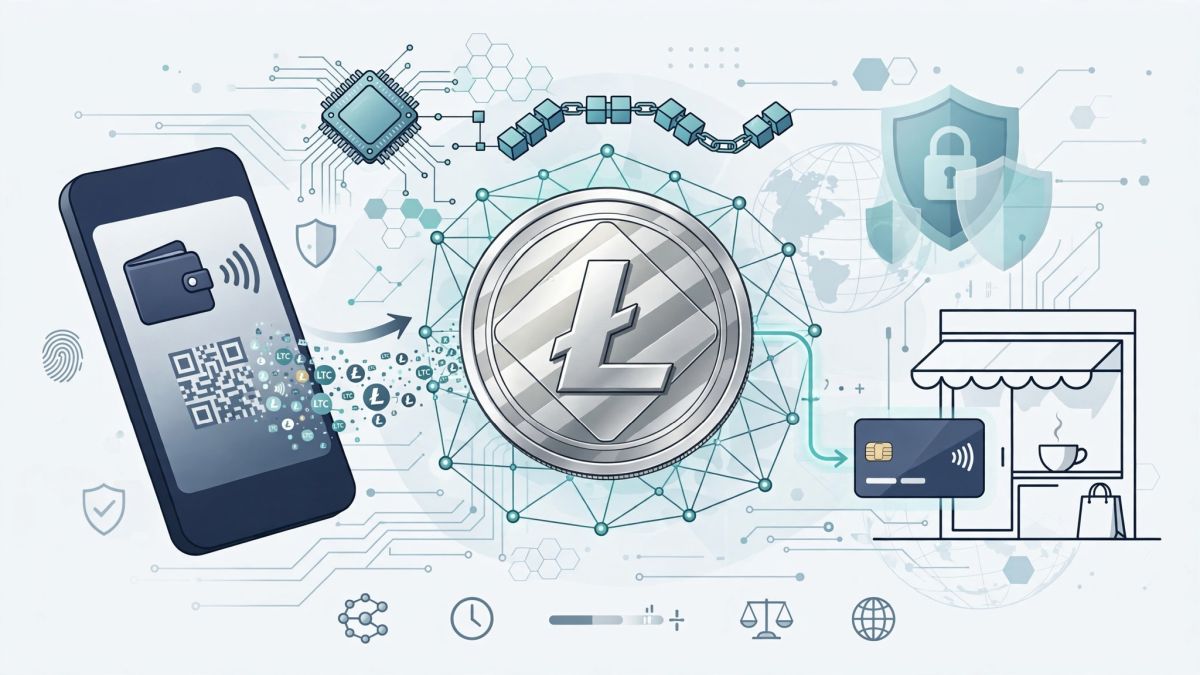
If you have spent any time around cryptocurrency, you have probably heard of Litecoin. Its ticker is LTC, it is often called “digital silver,” and the usual introduction describes it as a faster, cheaper alternative to Bitcoin.
That description is convenient. It is also incomplete.
I spent 25 years in traditional finance, and one habit has stayed with me: before evaluating a financial product, I want to understand the system underneath it. Who keeps the records? Who authorizes a transfer? What makes a payment final? What happens when something goes wrong?
Those are the questions I bring to Litecoin:
- What is Litecoin, exactly?
- Who controls its network?
- How does LTC move from one address to another?
- Where do new coins come from?
- Is Litecoin still operating and being developed?
- How secure are its transactions?
- Are Litecoin transactions anonymous?
- How does Litecoin differ from Bitcoin?
- What are its practical advantages and disadvantages?
Litecoin can provide a useful way to transfer value without a centralized payment processor. That does not make it risk-free, completely anonymous, or automatically better than a traditional payment method.
I also separate two questions that are too often mixed together: Does the network have practical utility? And is LTC an attractive investment at a particular price? A positive answer to the first does not automatically answer the second.
Litecoin Key Facts
Litecoin is a public, open-source blockchain with its own cryptocurrency, mining network, transaction history, and monetary rules.
| Feature | Litecoin |
|---|---|
| Network name | Litecoin |
| Cryptocurrency ticker | LTC |
| Network type | Public, decentralized blockchain |
| Public network launch | October 13, 2011 |
| Creator | Charlie Lee |
| Consensus mechanism | Proof of Work |
| Mining algorithm | Scrypt |
| Target average block time | Approximately 2.5 minutes |
| Maximum scheduled supply | Approximately 84 million LTC |
| Transaction model | UTXO |
| Subsidy halving interval | Every 840,000 blocks |
| Smallest base unit | 0.00000001 LTC |
| Optional transaction privacy | MWEB |
| Source code | Open source |
The target block interval, approximately 3.5-day difficulty adjustment period, and 840,000-block halving interval are defined in Litecoin Core’s network parameters.
These are protocol settings, not marketing promises. A target of 2.5 minutes between blocks does not mean every transaction will receive a confirmation exactly 150 seconds after it is sent.
How Was Litecoin Created?
Litecoin was created by Charlie Lee, a software engineer who was working at Google when the project launched in 2011.
The project was announced in early October, ahead of the public network launch on October 13.
Litecoin was not written entirely from scratch. Its software was based on Bitcoin’s code, which is why it is frequently described as a Bitcoin fork.
However, “fork” needs some clarification here.
Litecoin did not split away from Bitcoin’s existing transaction history. Bitcoin holders did not automatically receive LTC because a shared blockchain divided into two competing chains.
Instead, Litecoin launched a new network with:
- Its own genesis block.
- Its own cryptocurrency.
- Its own miners.
- Its own transaction history.
- Its own set of network parameters.
The more precise description is that Litecoin is a fork of Bitcoin’s codebase, not a continuation of Bitcoin’s blockchain history.
Lee wanted to retain several of Bitcoin’s central characteristics, including limited issuance, Proof of Work mining, and the absence of a central operator. He changed several important parameters:
- A shorter target interval between blocks.
- A different mining algorithm.
- A larger maximum coin supply.
- More frequent difficulty adjustments in calendar time.
- A design intended to make smaller, more frequent payments practical.
Litecoin’s launch was announced publicly, and the mining start was communicated in advance so interested participants could prepare.
Its genesis block contains a newspaper headline about Steve Jobs’ death, providing a contemporary reference point for the network’s creation.
The Litecoin Foundation’s account of Litecoin’s origins and launch explains the background, including Lee’s early thinking about creating a complement to Bitcoin rather than simply another proposed replacement.
That distinction still matters. Litecoin’s original proposition was not that Bitcoin had to fail for LTC to be useful.
Does Litecoin Still Work, and Is It Still Being Developed?
Yes. Litecoin remains an operating blockchain, not merely a ticker symbol traded on exchanges.
Users can send LTC between compatible wallets. Nodes validate transactions and blocks, and miners compete to add new blocks to the chain.
You do not have to take a project’s promotional material at face value to check whether its blockchain is operating. Public explorers display blocks, transaction activity, fees, and unconfirmed transactions.
For example, Litecoin Space’s explorer and API documentation provide ways to inspect block information, transaction status, mempool activity, and other network data.
Development also continues. The official Litecoin Core release history documents software updates, security fixes, and changes to MWEB validation, transaction relay, mining, and resource management.
As of this update, Litecoin Core 0.21.5.8, released in September 2026, includes further validation and security-related improvements.
That is evidence of ongoing maintenance. It is not evidence that the software has never had a serious problem. In particular, the 2026 MWEB incidents deserve attention, and I discuss them in the MWEB section below.
When someone asks me whether Litecoin “works,” I separate three questions:
- Does the protocol operate as a functioning network? Yes.
- Can people transfer LTC between compatible wallets? Yes.
- Does that guarantee LTC’s price will rise? No.
A functioning payment network and a successful investment are not the same thing.
What Is the Litecoin Blockchain?
The Litecoin blockchain is a public, chronologically ordered record of confirmed transactions.
Transactions are grouped into blocks. Each new block includes transaction data and a header containing or committing to important information, including:
- The transactions included in that block.
- The previous block’s hash.
- A timestamp.
- Mining-related fields.
- Information needed to verify the required Proof of Work.
A hash is a cryptographic digest of data. Because each new block references the previous block, the chain links its history together.
For a normal confirmed transaction, changing its committed data changes the relevant cryptographic commitments. That breaks the original block’s relationship with the blocks built after it.
An attacker cannot simply edit an old payment as though changing a cell in a private spreadsheet. The attacker would need to produce an alternative sequence of valid blocks, redo the required work, and overtake the competing valid chain in cumulative Proof of Work.
That is why additional confirmations generally make a transaction harder to reverse.
However, I avoid calling this absolute or instant finality. Proof of Work provides probabilistic finality: reversal generally becomes more difficult as more work accumulates, but the system is not based on a central institution declaring a transaction permanently settled.
Its security also depends on software correctly enforcing the rules, not only on miners consuming electricity.
Who Controls Litecoin?
No single owner has unilateral administrative control over Litecoin’s network or everyone’s LTC.
Under the network’s intended rules, no company, foundation, developer, or individual has a master switch that lets them:
- Create an arbitrary quantity of LTC.
- Confiscate coins from any address.
- Reverse a valid confirmed payment on demand.
- Change the supply limit with a button.
- Shut down every independent node and miner.
Instead, several groups contribute to the network:
- Users send and receive LTC.
- Node operators independently validate transactions and blocks.
- Miners assemble candidate blocks and provide computational work.
- Developers maintain software and propose changes.
- Exchanges, payment processors, and merchants decide which software versions and features they support.
- Economic participants decide which chain and rules they recognize as legitimate.
Developers can publish new software. They cannot automatically force everyone to install it.
When a change affects consensus rules, adoption depends on how miners, node operators, businesses, and users respond. The process is not equivalent to a company updating the terms of an account it controls.
The Litecoin Improvement Proposals repository documents proposals and their status. Importantly, publishing a proposal does not, by itself, make it an accepted network rule.
The Litecoin Foundation can support development, education, and adoption. It is not Litecoin’s central bank, and it does not hold an administrative key to every wallet.
There is an important qualification, though: the absence of a central administrator does not mean coordinated emergency intervention is impossible. During the 2026 MWEB response, developers and miners coordinated exceptional validation restrictions affecting specific exploit-related outputs.
That was not a foundation representative logging into everyone’s wallet. But it shows why “decentralized” should not be interpreted as “human coordination and governance never matter.”
How Does a Litecoin Transaction Work?
A Litecoin transaction spends existing outputs and creates new ones, with cryptographic authorization proving that the spending conditions have been met.
Let’s say Alice wants to send Bob 1 LTC.
A simplified transaction flow looks like this:
- Bob gives Alice a compatible Litecoin receiving address.
- Alice enters Bob’s address and the amount in her wallet.
- The wallet selects suitable unspent outputs that Alice controls.
- It creates an output for Bob and, if necessary, a change output for Alice.
- The wallet signs the transaction using the required private key or keys.
- The signed transaction is broadcast to Litecoin peers.
- Receiving nodes check the transaction against applicable rules and their local acceptance policies.
- Nodes that accept it generally add it to their local mempools.
- A miner includes it in a new block.
- Further blocks built on top increase its confirmation count.
Notice what is missing from that process: Alice does not ask a bank employee or card network to approve the transfer.
However, she may still depend on intermediaries elsewhere. An exchange may handle her purchase, a hosted wallet may control her keys, or a merchant processor may convert Bob’s receipt into a national currency.
Decentralized settlement does not automatically make every part of the user experience decentralized.
What Are Inputs, Outputs, and Change?
Litecoin uses the UTXO model, just as Bitcoin does.
UTXO stands for unspent transaction output. It is an output from an earlier transaction that has not yet been spent.
A wallet balance may look like a bank account balance on the screen, but the spending model is different. The wallet tracks spendable outputs and selects which ones to use.
Suppose Alice controls one UTXO worth 3 LTC and wants to send Bob 1 LTC.
Her wallet might create:
- A 1 LTC output for Bob.
- A change output worth slightly less than 2 LTC for Alice.
- A small difference between the total input and total outputs that becomes the transaction fee.
The fee is not normally a separate payment output labeled “miner.” It is the portion of the input value that the transaction does not assign to its outputs.
For illustration, if the fee were 0.0001 LTC, Alice’s change would be 1.9999 LTC. That is an example, not a statement about the fee every Litecoin transaction will pay.
The change output usually goes to a new address controlled by Alice’s wallet.
What Determines a Litecoin Transaction Fee?
Litecoin network fees depend primarily on the transaction’s resource requirements and the fee rate, not simply on how much LTC is being sent.
Sending 100 LTC does not automatically cost more than sending 1 LTC.
Important factors include:
- Transaction size in bytes or virtual bytes, depending on its format.
- The number of inputs.
- The number of outputs.
- The address and script types being used.
- Current network demand.
- The chosen fee rate per unit of transaction size.
A transaction that combines many small UTXOs can be larger and more expensive than one transferring much more value from a single input.
This is one place where my banking background makes me particularly cautious about the word “cheap.” A low blockchain fee is not necessarily the same as a low total cost.
An exchange’s withdrawal charge, trading spread, conversion fee, or merchant processing charge may be separate from the actual network fee.
Private Keys, Public Keys, and Litecoin Addresses Are Different
A private key authorizes spending, a public key helps verify that authorization, and an address provides a formatted way to receive funds.
These terms are related, but they are not interchangeable.
Private Keys
A private key is secret cryptographic information used to authorize spending.
For an ordinary single-signature output, control of the appropriate private key generally provides the ability to spend it. More complex arrangements may require multiple signatures or other conditions.
A private key should never be:
- Sent to another person.
- Entered into an unfamiliar website.
- Stored casually as an unprotected photograph.
- Posted in a message.
- Confused with a public receiving address.
Many wallets use a recovery phrase, also called a seed phrase, to back up the information needed to recreate their keys. That phrase deserves the same level of protection.
A person asking for your seed phrase does not need it to “verify” an incoming payment or provide routine customer support.
Public Keys
A public key is mathematically derived from a private key and is used in signature verification.
With properly generated keys and a sound implementation, deriving the private key from the public key is computationally infeasible using currently practical methods.
That security assumption depends on correct key generation and implementation. Weak randomness, malware, or a defective wallet can undermine it.
Litecoin Addresses
A Litecoin address is a formatted identifier used to direct a payment to particular spending conditions.
Different address formats have different prefixes, including:
- “L” for certain legacy addresses.
- “M” for newer Litecoin P2SH addresses.
- “ltc1” for native SegWit address formats.
- “ltcmweb” for MWEB addresses.
The statement that every Litecoin address starts with “L” is therefore incorrect.
Before sending LTC, check:
- Whether the receiving platform supports the Litecoin network.
- Whether it supports that particular address format.
- Whether the address was copied correctly.
- Whether MWEB is supported where relevant.
- Whether the receiving service has a minimum deposit requirement.
An address that looks plausible is not enough. Network and feature compatibility both matter.
What Is a Digital Signature?
A digital signature proves authorization to spend without requiring the sender to reveal the private key.
When Alice sends LTC, her wallet does not transmit her private key to the network. It uses the key to create a signature for the transaction.
Nodes use the relevant public information to verify matters such as:
- Whether the signature satisfies the output’s spending conditions.
- Whether the transaction is authorized to spend the referenced outputs.
- Whether those inputs have already been spent.
- Whether the transaction attempts to create more output value than its inputs permit.
- Whether it follows the other applicable protocol rules.
The signature demonstrates authorization. It does not, by itself, establish the sender’s legal identity or prove that a merchant delivered a product.
There is also no central password-reset department for self-custodied LTC.
If I lose the required keys and every usable backup, I cannot ask Litecoin’s support team to issue replacement access. There is no such central authority.
That is both the attraction and the responsibility of self-custody: direct control comes without the account-recovery procedures people expect from a bank.
What Is the Litecoin Mempool?
A mempool is a node’s temporary collection of accepted transactions that have not yet been confirmed in a block.
Litecoin does not have one perfectly synchronized global waiting room. Each node maintains its own mempool.
Those mempools overlap because nodes relay transactions to one another, but they can differ because of timing, connectivity, local policies, and resource limits.
A transaction may appear in a mempool within seconds of being broadcast. That means the node has seen and accepted it. It does not mean a miner has confirmed it.
Several outcomes are possible:
- A transaction with a low fee may wait longer for inclusion.
- An invalid transaction may be rejected.
- A node may not accept a transaction under its local policies.
- Conflicting transactions may attempt to spend the same UTXO.
Two conflicting spends of the same output cannot both remain confirmed in the same valid chain.
When I see “payment detected,” I therefore ask a second question: Detected where, and with how many confirmations?
How Long Do Litecoin Transactions Take?
Litecoin targets an average of approximately 2.5 minutes between blocks, but individual transaction confirmation times vary.
Proof of Work mining is probabilistic. One block may arrive quickly, while another takes much longer than the average.
A transaction’s confirmation time depends on:
- When it was broadcast.
- The fee rate selected.
- Mempool conditions.
- Miner and mining pool policies.
- The number of confirmations the recipient requires.
- Any additional processing by a wallet, exchange, or payment service.
One confirmation means the transaction has been included in a block.
Two confirmations mean another block has been built on top of that block.
At the target rate, a simple six-block estimate is approximately 15 minutes. That is a statistical estimate, not a promised delivery time or a guarantee that an exchange will credit the deposit immediately.
It is also important not to equate confirmation counts across different networks. Six Litecoin confirmations are not automatically the same security proposition as six Bitcoin confirmations.
Are Unconfirmed Litecoin Transactions Safe?
An unconfirmed, or zero-confirmation, transaction carries more risk than a transaction included in a block.
A merchant may choose to accept that risk for a very small purchase. That is a business decision, not a guarantee provided by the protocol.
A wallet showing an incoming payment does not mean the payment is finally settled. A sender may attempt a conflicting spend or replacement, depending on the transaction’s construction and the policies of participating nodes and services.
For larger amounts, waiting for multiple confirmations is generally more prudent.
I would not treat a transaction notification as the equivalent of a completed bank reconciliation. Visibility and settlement are different stages.
How Does Litecoin Mining Work?
Litecoin mining uses Proof of Work: miners repeatedly perform Scrypt calculations to find a block header whose proof-of-work value meets the current target.
A miner assembles a candidate block using information such as:
- The previous block’s hash.
- Selected transactions.
- A coinbase transaction.
- A Merkle root committing to the block’s transactions.
- A timestamp.
- A nonce and other required fields.
The miner changes permitted fields and repeats the Scrypt calculation.
If the resulting proof-of-work value meets the target, the miner can broadcast the block to the network.
Other nodes do not simply trust the miner’s announcement. They independently check:
- The Proof of Work.
- The block’s structure.
- The permitted subsidy and fees.
- Transaction signatures and spending conditions.
- The absence of invalid double spending.
- Compliance with other consensus rules.
A correctly validating node rejects a block that violates the rules, regardless of how much electricity its producer spent.
That separation is fundamental. Miners propose and order transactions through block production. Nodes enforce the rules implemented in the software they run.
As the MWEB incidents illustrate, those implementations must also be correct.
What Do Litecoin Miners Earn?
A miner producing an accepted block can collect the block subsidy plus the fees from transactions included in that block.
Those are two different revenue sources:
- Block subsidy: newly issued LTC.
- Transaction fees: existing LTC paid by users.
Litecoin began with a subsidy of 50 LTC per block. The subsidy halves every 840,000 blocks.
As of October 2026, the scheduled subsidy is 6.25 LTC per block. The project’s explanation of Litecoin’s issuance and halving design describes the underlying schedule, although some educational wording on that page predates the latest halving.
The coins paid through a block’s coinbase transaction cannot be spent immediately.
Litecoin requires a 100-block maturity period, also reflected in the ltcd implementation’s Litecoin network parameters. At the target block interval, that represents approximately four hours and ten minutes.
As the LTC subsidy declines, fees may need to play a larger role in Litecoin’s own reward stream. That transition is an economic question, not an automatic guarantee.
Merged mining revenue from Dogecoin also affects the incentives supporting Scrypt mining infrastructure, which I cover below.
Why Does Litecoin Use Scrypt?
Litecoin uses Scrypt for Proof of Work, while Bitcoin uses double-SHA-256.
Scrypt was selected partly because of its greater memory requirements. Early expectations were that this would limit the initial advantage of specialized hardware and keep mining more accessible to people using ordinary computers.
That advantage did not last.
Specialized Scrypt ASICs were developed, and they are substantially more efficient than general-purpose CPUs or graphics cards.
An ASIC is an application-specific integrated circuit: hardware designed for a particular computational task.
In practical terms:
- It is technically possible to attempt Scrypt mining with an ordinary computer.
- Such mining is generally economically uncompetitive.
- Competitive Litecoin mining uses specialized equipment.
- Profitability depends on electricity prices, hardware efficiency, network difficulty, coin prices, available rewards, and pool fees.
The Litecoin Learning Center provides educational and technical material on mining, and its mining guidance recognizes the efficiency advantage of Scrypt ASICs.
I would not confuse “I can run mining software on my laptop” with “my laptop can profitably compete with industrial Scrypt miners.”
Those are very different claims.
How Does Litecoin Mining Difficulty Adjust?
Litecoin adjusts mining difficulty every 2,016 blocks to keep its long-term average block interval near 2.5 minutes.
If substantial new mining power joins the network, blocks may temporarily arrive more quickly.
If substantial mining power leaves, blocks may arrive more slowly.
The difficulty adjustment responds to how long the preceding adjustment period took, within the protocol’s constraints.
At the target interval, 2,016 blocks take approximately 3.5 days. The relevant settings appear in Litecoin Core’s difficulty and block-time parameters.
That is more frequent in calendar time than Bitcoin’s approximately two-week adjustment cycle, even though both use a 2,016-block interval.
The adjustment is designed to stabilize the average over time. It does not guarantee a perfectly regular schedule for every block.
How Litecoin and Dogecoin Merged Mining Works
Merged mining lets participating miners reuse Scrypt work to help secure Litecoin and Dogecoin without performing twice the underlying hashing work.
Both networks use Scrypt. Dogecoin’s Auxiliary Proof of Work, usually shortened to AuxPoW, allows appropriately constructed work from a parent mining process to serve as proof for Dogecoin as well.
The Litecoin Foundation’s explanation of Litecoin and Dogecoin merged mining describes this relationship and its economic significance.
The two cryptocurrencies are still separate systems. They have:
- Separate blocks.
- Different consensus rules.
- Different supply schedules.
- Their own transactions.
- Distinct coins.
Merged mining does not turn DOGE into LTC or combine their account histories.
Its practical benefit is that miners can earn revenue from both networks without proportionally doubling their core hashing effort. That can improve mining economics and support investment in Scrypt infrastructure.
The implementation timeline needs a small but important clarification. Dogecoin Core 1.8 was released in August 2014, while AuxPoW activation followed at block 371,337 in September 2014. The official Dogecoin Core 1.8 release notes distinguish the software release from the activation block.
The trade-off is greater economic interdependence. Mining incentives can become tied to both coins, and the role of large pools remains important.
When I evaluate that arrangement, I see a useful revenue mechanism, not a reason to ignore concentration risk.
How Many Litecoins Can Exist?
Litecoin’s scheduled maximum supply is approximately 84 million LTC, four times Bitcoin’s approximately 21 million BTC.
That does not automatically make Litecoin “cheaper” in any meaningful investment sense.
A lower unit price can reflect a larger number of units. It does not tell me whether an asset is undervalued.
LTC’s market price depends on supply and demand, liquidity, expectations, and broader market conditions.
Litecoin is also highly divisible:
One LTC equals 100,000,000 base units.
The smallest base unit is 0.00000001 LTC. You do not need to buy a whole coin.
I also distinguish several supply concepts:
- Maximum scheduled supply: the approximate limit implied by the issuance rules.
- Issued supply: the quantity already created.
- Circulating supply: the quantity counted as circulating under a particular methodology.
- Available market supply: the amount holders are actually willing and able to sell.
Some LTC is probably permanently inaccessible because keys were lost, devices were destroyed, or users made unrecoverable mistakes.
However, the blockchain cannot reliably tell us whether a long-inactive address has lost keys or an owner who simply has no intention of spending.
Finally, a supply cap describes the intended monetary rules. It is not proof that an implementation can never contain an inflation-related bug. The 2026 MWEB incident is a concrete reason to keep that distinction in mind.
What Is a Litecoin Halving?
A Litecoin halving cuts the scheduled block subsidy in half every 840,000 blocks.
The subsidy has developed as follows:
| Reward period | Subsidy per block |
|---|---|
| Initial subsidy | 50 LTC |
| After the first halving | 25 LTC |
| After the second halving | 12.5 LTC |
| After the third halving | 6.25 LTC |
With a target block interval of approximately 2.5 minutes, each 840,000-block period lasts roughly four years.
The next scheduled reduction occurs at block 3,360,000, when the subsidy falls to 3.125 LTC. Its calendar date depends on actual block production.
A halving reduces the rate at which new LTC enters circulation. It does not automatically reduce the total existing supply.
It also does not guarantee a higher price.
Markets can anticipate a halving long before it happens. Demand, regulation, macroeconomic conditions, liquidity, and the broader cryptocurrency market can outweigh the effect of lower issuance.
In my experience, a predictable supply event is not the same thing as a predictable investment return.
Litecoin vs. Bitcoin: The Main Differences
Litecoin and Bitcoin share a similar basic design, but they differ in mining, block timing, issuance parameters, infrastructure, and optional privacy features.
| Feature | Bitcoin | Litecoin |
|---|---|---|
| Ticker | BTC | LTC |
| Network launch | 2009 | 2011 |
| Proof-of-work algorithm | Double-SHA-256 | Scrypt |
| Target average block time | Approximately 10 minutes | Approximately 2.5 minutes |
| Maximum scheduled supply | Approximately 21 million | Approximately 84 million |
| Halving interval | 210,000 blocks | 840,000 blocks |
| Common market positioning | Store of value and monetary settlement network | Payments and value transfers |
| MWEB at the protocol level | No | Yes, optional |
| Dominant mining equipment | SHA-256 ASICs | Scrypt ASICs |
Litecoin targets blocks approximately four times as frequently and has approximately four times the maximum scheduled supply.
That does not mean every Litecoin transaction settles exactly four times faster. Fees, transaction selection, confirmation requirements, and service processing still matter.
It means the average wait for the next block is shorter.
The project’s Bitcoin and Litecoin comparison discusses the main design differences. For exact consensus parameters, I prioritize the current Litecoin Core implementation over simplified educational descriptions.
Bitcoin has much stronger global recognition and a larger monetary and institutional ecosystem. Litecoin can be practical when low base-layer fees and a shorter expected wait for an initial confirmation are the priorities.
Security comparisons need more care than a block-time comparison. The networks have different mining algorithms and security economics, so raw hashrate figures are not directly comparable.
Also, neither network’s common market narrative is an exclusive protocol function. Bitcoin can be used for payments, and LTC can be held speculatively.
Is Litecoin Just a Copy of Bitcoin?
Litecoin is derived from Bitcoin’s code, but calling it “just a copy” leaves out the independent network and infrastructure built around that code.
Litecoin has:
- Its own genesis block.
- A separate transaction history.
- A different Proof of Work algorithm.
- Specialized Scrypt mining infrastructure.
- Its own issuance parameters.
- Merged mining with Dogecoin.
- MWEB extension blocks.
- A separate community and economic ecosystem.
Building on existing open-source software is normal. The origin of the code does not determine whether the resulting network will be useful, secure, or economically sustainable.
The relevant questions are whether the software is maintained, whether infrastructure exists, whether users can transact reliably, and whether people continue to assign value to the asset.
Litecoin has also served as an earlier deployment environment for technologies associated with Bitcoin.
The best-known example is SegWit, which activated on Litecoin before Bitcoin. The project’s discussion of how Litecoin has contributed to Bitcoin-related development describes that history.
I see Litecoin as a separate monetary network built from a shared technical foundation, not as extra BTC or an extension of Bitcoin’s supply.
What Is SegWit?
SegWit, short for Segregated Witness, changes transaction serialization by separating witness data, including relevant signatures, from the base transaction data.
That does not mean signatures disappear. Nodes still receive and validate the required witness information.
SegWit brought several benefits:
- It addressed important forms of transaction ID malleability for SegWit transactions.
- It introduced more flexible and efficient block-space accounting.
- It can reduce fees for certain transaction types.
- It provides a more practical foundation for payment-channel protocols, including Lightning.
Transaction malleability refers to situations in which a transaction’s identifier can change without changing its intended payment effect. That was a significant complication for protocols that depend on reliably referencing unconfirmed transactions.
Litecoin activated SegWit in 2017, before Bitcoin’s activation later that year, as described in the project’s history of Litecoin’s role in SegWit adoption.
SegWit does not make every transaction equally cheap, and it does not turn ordinary blockchain payments into instant final settlement.
Does Litecoin Support the Lightning Network?
Litecoin can support Lightning payment channels, but technical compatibility does not mean broad wallet support or an ecosystem comparable to Bitcoin’s Lightning network.
Lightning moves many payment updates off the base blockchain.
A simplified channel flow works like this:
- Participants open a channel using an on-chain transaction.
- They exchange signed updates that change how the channel balance is allocated.
- Payments can move through connected channels when suitable routes and liquidity exist.
- The channel can eventually close and settle its enforceable balance on the base chain.
The potential benefits include:
- Fast payments.
- Very low routing fees in suitable circumstances.
- More payment activity without recording every update as a separate base-layer transaction.
- Better practicality for some micropayments.
The limitations include:
- More complicated channel management.
- The need for sufficient liquidity in the right direction.
- Limited support among Litecoin wallets and services.
- A much smaller ecosystem than Bitcoin Lightning.
- Additional operational requirements for safely managing channels.
The project’s overview of Litecoin and the Lightning Network discusses its history and limited adoption.
For me, the practical question is not simply “Can Litecoin do Lightning?” It is “Does the wallet or service I intend to use support it, and is there sufficient usable liquidity?”
A protocol capability is only useful when the surrounding implementation and infrastructure meet the user’s needs.
What Is MWEB?
MWEB stands for MimbleWimble Extension Blocks, an optional Litecoin feature designed to improve transaction confidentiality and make certain transaction data more efficient to manage.
MWEB is not a separate cryptocurrency.
There is no special “MWEB token” that a user must buy to access the feature.
LTC can move from Litecoin’s transparent transaction system into MWEB, be transferred there, and later return to the transparent system.
The basic flow has three stages:
- Peg-in: LTC moves into the MWEB extension-block system.
- MWEB transfer: LTC is transferred within MWEB.
- Peg-out: LTC returns to the transparent side of Litecoin.
The LIP-0003 specification for MimbleWimble via extension blocks describes the opt-in design.
These extension blocks operate alongside Litecoin’s main blocks within the protocol. They are not an unrelated blockchain with an independently traded coin.
What Does MWEB Hide?
MWEB conceals transaction amounts and makes some direct links between participants and transfers harder to establish.
Standard Litecoin transactions expose considerably more information.
MWEB uses techniques including:
- Pedersen commitments: cryptographic commitments that conceal amounts while supporting balance verification.
- Range proofs: proofs that committed amounts fall within valid ranges without revealing the amounts.
- Stealth address mechanisms: methods that avoid publishing a recipient’s reusable address directly on each output.
- Aggregation: combining transaction data.
- Cut-through: eliminating certain intermediate spent outputs from aggregated data while retaining the information needed for validation.
Cut-through is easier to understand as removing unnecessary intermediate steps from the retained transaction representation.
It does not mean the network stops checking whether spending is authorized or whether the transaction set balances.
Is MWEB Completely Anonymous?
No. MWEB improves confidentiality, but it should not be presented as a guarantee of complete anonymity.
Privacy can be weakened by:
- The timing of peg-ins and peg-outs.
- A small set of participants.
- Recognizable usage patterns.
- Records maintained by exchanges.
- IP addresses and network metadata.
- Identity links created before entering or after leaving MWEB.
- Sharing private view keys with an untrusted service.
The Litecoin Core documentation for MWEB light clients explains a particularly important issue.
With certain server-side filtering approaches, a wallet shares a private view key with a node. That node can then identify the wallet’s outputs and learn their values.
A view key may not authorize spending, but sharing it can still undermine the confidentiality the user expected.
The documentation therefore warns against using that approach with an untrusted node.
My rule here is straightforward: a privacy feature is only as useful as the full way it is used. Wallet design, network connections, and interactions with identified exchange accounts can all matter.
Do All Exchanges Support MWEB?
No. Support for ordinary LTC deposits does not automatically include support for MWEB-related transfers.
Some exchanges support only transparent Litecoin deposits and withdrawals.
Sending funds through an unsupported method may result in an uncredited deposit, a difficult recovery process, or permanent loss.
In its notice on Litecoin deposits and withdrawals using MWEB, Binance stated that it would not support that functionality and warned that unsupported deposits would not be received or returned.
That notice dates to June 2022. Before transferring today, check the receiving platform’s current instructions rather than assuming an old announcement describes every present-day detail.
I would also avoid assuming that a transparent-looking destination address makes every MWEB-related transfer acceptable. Follow the platform’s explicit deposit rules.
What Happened in Litecoin’s 2026 MWEB Security Incidents?
The 2026 MWEB incidents involved a serious validation flaw, an emergency recovery, and a later invalid-chain reorganization.
This is important enough that I would not publish a current Litecoin guide without addressing it.
According to developer David Burkett’s April 2026 MWEB security incident postmortem, developers identified a critical flaw in the validation of MWEB input metadata.
The report describes two related incidents:
- March 2026 exploit and recovery. An attacker produced a malicious mined block that used inconsistent MWEB input metadata to create an inflated peg-out of 85,034.47285734 LTC.
- Emergency containment. Developers coordinated with mining pools to prevent further exploitation and restrict movement of the exploit-related outputs. The actor later cooperated in returning the funds, apart from an agreed 850 LTC bounty. Charlie Lee supplied LTC to cover that bounty, and the recovery process rebalanced MWEB.
- April 2026 disruption and reorganization. A later attempt triggered problems in how upgraded mining nodes handled mutated MWEB block data. Unupgraded miners extended an invalid branch containing 13 blocks before the valid chain overtook it.
The postmortem states that no confirmed user funds were ultimately lost in the March incident. It also reports losses at third-party services during the April incident.
Those are different statements. “No confirmed user funds ultimately lost in March” should not be rewritten as “the incidents had no financial consequences.”
The response included multiple software fixes and further hardening. The Litecoin Core 0.21.5.8 release notes document additional MWEB validation, relay, mining, and resource-management changes.
For me, the lesson is not that every ordinary Litecoin payment is unsafe. It is that:
- A long operating history does not eliminate software risk.
- A programmed supply schedule does not make implementation bugs impossible.
- Confirmation policies must account for exceptional network conditions.
- Emergency coordination can matter even in a decentralized system.
- Node operators, miners, exchanges, and MWEB services need to keep software current.
This was an implementation-security issue, not a reason to assume that only a conventional 51% attack can threaten a Proof of Work network.
Are Litecoin Transactions Anonymous?
Standard Litecoin transactions are pseudonymous, not anonymous.
The transparent blockchain publicly exposes information such as:
- Receiving addresses or the scripts associated with outputs.
- Transaction amounts.
- Confirmation timing and block placement.
- Inputs and outputs.
- The history of how outputs have been spent.
An address does not have to contain the owner’s name. However, it can become associated with a person through:
- An identity-verified exchange.
- A merchant’s records.
- A public donation page.
- A social media post.
- Other transaction and behavioral data.
Once an address or cluster of activity is linked to an identity, its public history may become easier to analyze.
MWEB can improve privacy, but it is not universally supported and does not remove every way to identify a user.
I would never describe a standard LTC transfer as anonymous simply because the blockchain displays an address rather than a legal name.
Where Should You Store Litecoin?
A Litecoin wallet manages the keys and information needed to spend LTC; the coins themselves are recorded by the blockchain.
Saying that coins are “inside the wallet” is convenient shorthand. Technically, the wallet provides access to the relevant blockchain outputs.
The main storage choices have different security and convenience trade-offs.
Software Wallets
Software wallets run on a phone or computer.
Advantages include:
- Convenient access.
- Often no purchase cost.
- Practicality for smaller balances and everyday payments.
Risks include:
- Malware on the device.
- A lost or stolen phone.
- Fake wallet applications that steal recovery phrases.
- Compromised data or backups.
- Inadequate device security.
I think of a software wallet as an operational tool, not an automatic security guarantee. Its safety depends heavily on the device, the application, and the user’s backup practices.
Hardware Wallets
Hardware wallets isolate private keys in a separate device and sign transactions without directly exposing those keys to the connected computer.
Advantages include:
- Better isolation of signing keys.
- A practical option for longer-term self-custody.
- Reduced exposure to certain kinds of computer malware.
Disadvantages include:
- An upfront cost.
- The possibility of physical loss or damage.
- Continued responsibility for protecting recovery material.
- Risks from counterfeit, tampered, or compromised devices.
A hardware wallet also cannot protect me from every mistake. If I approve the wrong destination on the device, key isolation does not undo that approval.
Check feature compatibility carefully. Support for LTC does not necessarily mean support for MWEB.
Exchange Wallets
When LTC remains on a centralized exchange, the platform generally controls the private keys.
Advantages include:
- Convenient buying and selling.
- Potential account-recovery procedures.
- Easier access for active trading.
Risks include:
- Restricted or suspended withdrawals.
- A frozen or compromised account.
- A platform hack.
- Insolvency or other business problems.
- Dependence on the platform’s internal procedures.
The saying “not your keys, not your coins” points to the difference between controlling private keys and relying on a custodian’s promise to honor withdrawals.
Still, I do not treat self-custody as effortless. Moving responsibility from an institution to myself only helps if I can manage that responsibility competently.
What Is Litecoin Used For?
Litecoin is primarily used to transfer value, pay participating merchants, move funds between services, and hold a speculative cryptoasset.
Its usefulness depends on the specific transaction and the alternatives available.
Sending Money Between People
LTC can be sent to someone in another city or country without relying on a bank’s business hours to process the blockchain transfer.
The recipient still needs a compatible wallet or service.
Converting LTC into local currency may require an exchange, identity verification, banking access, and additional fees.
When I compare this with a bank transfer, I look at the complete route: purchase, transfer, receipt, and conversion. The blockchain leg is only part of the process.
Paying for Goods and Services
A merchant can accept LTC directly or use a payment processor.
Potential benefits include:
- Relatively short expected waits for an initial confirmation.
- Usually low network fees.
- Availability outside banking hours.
Limitations include:
- Price volatility.
- Limited merchant acceptance.
- Processor charges or conversion spreads.
- Different merchant confirmation requirements.
A low network fee is useful. It does not eliminate the merchant’s exchange-rate risk or operational requirements.
Moving Value Between Exchanges
Some users choose Litecoin for transfers between exchanges because the network fee and confirmation wait may be lower than on certain alternatives.
That still introduces risks, including:
- An incorrect address.
- The wrong network.
- Temporarily suspended deposits.
- Minimum deposit requirements.
- Additional confirmation requirements.
- Price changes during the transfer.
Buying LTC solely as a transfer vehicle can also involve trading costs on both sides.
I would compare the total amount received, not just the fee displayed next to the withdrawal button.
Long-Term Holding
Some people hold LTC as a speculative asset or as part of a broader cryptocurrency portfolio.
That is not the same as a savings account.
LTC does not provide:
- A guaranteed interest rate.
- A guaranteed redemption value.
- Protection against market losses.
- FDIC insurance for the cryptocurrency itself.
Any service offering yield on LTC introduces additional questions about lending, custody, counterparties, and the source of the return.
Litecoin’s Main Advantages
Litecoin’s clearest practical strengths are its established infrastructure, generally low base-layer fees, relatively frequent blocks, and straightforward issuance schedule.
Those strengths are useful to evaluate on their own, without turning them into promises about price.
Faster Expected Initial Confirmations Than Bitcoin
Litecoin’s 2.5-minute target block interval generally provides a shorter expected wait for the next block than Bitcoin’s 10-minute target.
That can improve the experience of an on-chain payment.
It does not mean one Litecoin confirmation provides the same security as one Bitcoin confirmation.
Generally Low Network Fees
Litecoin often has sufficient unused block capacity that users do not need to compete aggressively with high fees.
However, fees are not permanently fixed. They depend on demand, transaction construction, wallet policies, and the fee rate selected.
A transaction with many inputs can still cost more than a simple transaction.
A Long Operating History
Litecoin has operated since 2011, giving it a much longer history than many cryptocurrency projects.
That history is relevant. It means users are not evaluating a newly launched protocol with no operational record.
The official Litecoin website reports hundreds of millions of processed transactions and promotes a long record of uninterrupted operation.
I treat those as the project’s own claims, not as a substitute for independent analysis. Public blocks and transactions can be checked independently, and claims about uptime should not be confused with an absence of serious security incidents.
The 2026 MWEB postmortem makes that distinction particularly important.
Open-Source Software
The Litecoin Core source repository is publicly available.
Developers can inspect the code, test changes, report problems, and propose improvements.
Open source supports scrutiny and collaboration. It does not guarantee that every defect will be discovered before exploitation.
A Limited Scheduled Supply
Litecoin’s monetary rules target a maximum supply of approximately 84 million LTC.
There is no central issuer that can simply decide, within those rules, to produce unlimited coins.
That predictable policy is meaningful, although demand and implementation security remain essential.
High Divisibility
Each LTC is divisible into 100 million base units.
A person does not need enough money to buy a full coin to use the network or hold a small amount.
Optional MWEB Confidentiality
MWEB provides an optional route to more confidential transactions when the wallet and the relevant receiving arrangements support it.
That offers capabilities unavailable in ordinary transparent LTC transactions.
It also introduces compatibility, privacy-model, and implementation considerations.
Merged Mining With Dogecoin
Merged mining can improve revenue for participating Scrypt miners and strengthen the economic incentives supporting mining infrastructure.
The benefit depends on the combined economics of the participating networks, not on the idea that security is free.
A Relatively Simple Monetary Policy
Litecoin’s issuance model is comparatively easy to explain:
- An initial block subsidy.
- Periodic halvings.
- A limited maximum scheduled supply.
- Rewards paid to miners.
- Fees paid by users.
From an economist’s perspective, that transparency is valuable. It makes the issuance rules easier to analyze, even though it does not make future market demand predictable.
Litecoin’s Disadvantages and Risks
Litecoin’s major risks include price volatility, competition, mining concentration, software vulnerabilities, custody mistakes, and uncertain future demand.
A fast, inexpensive transfer does not protect its owner from those risks.
Significant Price Volatility
LTC can lose a substantial portion of its market value quickly.
The blockchain may continue operating normally while the asset’s price falls sharply.
Network reliability and price stability are separate properties.
A Weaker Network Effect Than Bitcoin
Bitcoin has stronger global recognition, broader institutional infrastructure, and a more established monetary brand.
Litecoin is widely known within cryptocurrency markets, but it has not achieved Bitcoin’s overall network effect.
That can influence liquidity, developer attention, institutional interest, and long-term demand.
Competition From Other Payment Options
Litecoin competes with more than Bitcoin.
Alternatives include:
- Stablecoins.
- Low-fee blockchains.
- Networks offering faster forms of finality.
- Lightning and other layer-2 systems.
- Traditional instant payment networks.
Stablecoins are particularly relevant for international transfers because many users prefer an asset intended to maintain a relatively stable value against a national currency.
That does not make stablecoins risk-free. They bring their own issuer, reserve, depegging, freezing, custody, and blockchain risks.
Still, their appeal is a competitive reality Litecoin users and investors should not ignore.
Proof of Work Consumes Electricity
Mining requires specialized hardware and electricity.
Critics argue that the energy cost is too high. Supporters argue that real-world resource expenditure is part of the cost of decentralized security.
I do not think that debate is resolved by pretending the energy cost does not exist. It needs to be assessed alongside the security model, the energy sources, and the value users receive.
Ordinary Computers Cannot Compete Economically
Scrypt was originally associated with more accessible mining, but specialized ASICs now dominate competitive Litecoin mining.
That raises the cost of entry and favors operators with efficient hardware, inexpensive electricity, and suitable facilities.
Hobby participation is possible. Profitable competition with professional operations is a different matter.
Mining Pool Concentration
Many miners join pools to receive more regular payouts.
If a small number of pool operators direct a large share of active hashrate, that creates concerns about transaction selection, censorship, and coordination.
A pool operator does not necessarily own all the hardware connected to the pool. Miners can often redirect their equipment.
Even so, the operator may control the block templates that participating machines work on.
I therefore look at who directs mining work, not just who owns the devices.
MWEB Can Create Regulatory and Operational Friction
Optional confidentiality can improve privacy, but it can also complicate exchange and payment-service support.
Some platforms do not accept MWEB-related deposits. Others may change their policies because of legal, compliance, or operational concerns.
A wallet feature that works technically may still be unusable with a particular service.
Transfers Generally Cannot Be Recalled
If LTC is sent to an incorrect but spendable destination, there is no built-in administrator who can reverse it.
Recovery may depend on the recipient’s cooperation, assuming the recipient can be identified.
Banks and card networks may offer dispute or error-resolution procedures, although traditional transfers are not always reversible either.
The important difference is that Litecoin has no automatic institution-backed chargeback process.
Lost Recovery Material Can Mean Permanent Loss
If I lose access to the necessary keys and all usable backups, the funds may become permanently inaccessible.
Losing a recovery phrase does not necessarily destroy access immediately if a working wallet remains available. But it can turn a later device failure into a permanent financial loss.
Self-custody requires a recovery plan, not just an application download.
Fake Wallets and Cryptocurrency Scams
Common threats include:
- Fake wallet applications.
- Phishing websites.
- Fraudulent giveaways.
- Promises of guaranteed profits.
- Impersonated customer support.
- Malicious browser extensions.
- Fake mining services.
The Litecoin protocol can function correctly while a user loses funds through a scam outside it.
A working blockchain does not authenticate every business, download, or person using its name.
No Guarantee of Future Demand
A limited supply is not sufficient by itself to create lasting value.
An asset can be mathematically scarce and still lose demand.
LTC’s market value depends on whether people continue to use, hold, trade, and accept it, and on what they are willing to pay.
That is the economic uncertainty I would not hide behind the phrase “digital silver.”
Can Litecoin Suffer a 51% Attack?
A sustained majority-hashpower attack could allow an attacker to reorganize recent valid history or interfere with transaction inclusion, but it would not grant unlimited control over everyone’s coins.
The term “51% attack” usually refers to one participant or a coordinated group controlling a majority of the active mining power.
Such an attacker could attempt to:
- Reverse its own recent payments.
- Double-spend funds it controls.
- Censor selected transactions.
- Reorganize part of the recent chain.
Under correctly enforced consensus rules, that attacker could not simply:
- Create unlimited LTC.
- Forge the signatures needed to spend someone else’s outputs.
- Make validating nodes accept arbitrary rule violations.
- Empty any address it chooses.
A majority is not required for every possible short reorganization, but sustained majority control makes certain attacks much more reliable.
A large amount of active Scrypt mining power and the cost of specialized equipment can make an attack more difficult.
Neither provides a mathematical guarantee that an attack will remain impossible forever.
For large payments, recipients may therefore require additional confirmations or apply stricter policies during unusual network conditions.
I also distinguish this attack model from software exploitation. The 2026 MWEB incidents showed that a validation defect can create serious problems without being a conventional majority-hashpower attack.
Is Litecoin a Good Investment?
Whether LTC is an appropriate investment depends on the buyer’s financial position, risk tolerance, objectives, and understanding of the asset.
There is no universal answer.
I start with the potential loss, not a price target.
LTC may be worth evaluating for someone who:
- Understands cryptocurrency risks.
- Specifically wants exposure to Litecoin.
- Believes the network can retain practical usefulness.
- Can tolerate a major price decline.
- Is not investing money needed for basic living expenses.
It may be unsuitable for someone who:
- Expects guaranteed profits.
- Cannot tolerate volatility.
- Does not understand custody or private keys.
- Is using borrowed money.
- Is buying solely because of social media posts.
- Has no risk-management plan.
Before buying, investigate:
- How the LTC will be stored.
- Total buying and selling costs.
- Withdrawal charges.
- Applicable tax obligations.
- Available liquidity.
- The risks of the chosen platform.
- Your investment time horizon.
My banking experience makes me particularly wary of treating an available withdrawal button as proof that an asset is liquid under every condition. Markets and platforms can behave very differently during stress.
Also, practical utility is not a valuation model by itself. A network can process payments successfully while its token performs poorly as an investment.
This article is educational information, not individualized financial, tax, or legal advice.
How to Buy and Send LTC More Safely
Safer Litecoin use depends on checking the platform, protecting account access, verifying transfer compatibility, and maintaining recoverable backups.
My practical checklist is:
- Use an established platform, and verify that you are using its genuine website or application.
- Enable two-factor authentication, preferably with a strong authenticator or security-key option where available.
- Use a unique password rather than recycling credentials from other accounts.
- Confirm that the withdrawal and deposit both use the Litecoin network.
- Check that the receiving service supports the address format.
- Before a substantial transfer, consider sending a small test amount.
- Never share a private key or recovery phrase.
- Check withdrawal charges and minimum withdrawal amounts.
- If MWEB is involved, confirm that the recipient explicitly supports the transfer method.
- Do not install a wallet through a sponsored search result without independently verifying the source.
- For longer-term holdings, consider whether self-custody fits your knowledge and circumstances.
- Create a secure backup using the wallet’s actual recommended recovery method.
- Do not rely solely on a photograph or cloud copy of a recovery phrase.
- For larger holdings, consider a compatible hardware wallet.
Not every wallet uses the same backup format. Some require wallet files or additional recovery information rather than only a familiar recovery phrase.
I would also verify the destination on the signing device where possible. A correctly copied address on an infected computer can still be replaced before approval.
A test transaction is useful, but it does not remove the need to recheck the final transfer.
How to Check a Litecoin Transaction
A Litecoin transaction can usually be checked using its transaction ID, with additional information available from an address, block hash, or block height.
Common lookup information includes:
- TXID: the transaction identifier.
- A Litecoin address.
- A block hash.
- A block height.
For a standard transparent transaction, entering the TXID in a Litecoin explorer can show:
- Whether the transaction is unconfirmed or included in a block.
- Its confirmation count.
- Its block inclusion information.
- Inputs and outputs.
- The network fee.
- The block containing it.
MWEB changes what is publicly visible. An ordinary explorer lookup should not be expected to reveal the confidential amounts and relationships of an internal MWEB transfer.
If an exchange says it has sent LTC but the wallet does not show it, I would start by requesting and checking the TXID.
Possible explanations include:
- The platform has not broadcast the transaction yet.
- The transaction is waiting in a mempool.
- The wallet is not synchronized.
- The wrong network was selected.
- An unsupported MWEB-related transfer was used.
- The receiving platform requires more confirmations.
- The amount is below the platform’s minimum deposit threshold.
An internal exchange status such as “completed” is not a substitute for checking whether a corresponding transaction was actually broadcast and confirmed.
For an ordinary on-chain withdrawal, the TXID is the clearest starting point.
The Bottom Line: What Is Litecoin in One Sentence?
Litecoin is an open-source, decentralized digital money network that uses Scrypt Proof of Work, targets blocks approximately every 2.5 minutes, and supports relatively fast, low-cost LTC transfers with optional MWEB confidentiality.
Its main strengths include:
- A long operating history.
- Generally low network fees.
- Relatively frequent blocks.
- A straightforward issuance schedule.
- Open-source software.
- Broad support for ordinary LTC transactions among wallets and platforms.
- Optional MWEB privacy features.
- Merged mining with Dogecoin.
Its main limitations and risks include:
- A volatile market price.
- A weaker network effect than Bitcoin.
- Strong competition from stablecoins and other payment systems.
- Energy-intensive mining.
- ASIC-dominated mining infrastructure.
- Mining pool concentration.
- Limited and inconsistent MWEB support.
- Software-security risk, demonstrated by the 2026 MWEB incidents.
- Potentially irreversible user mistakes.
- Uncertain future demand.
Litecoin is not “a faster Bitcoin” in every relevant sense. It is not a completely anonymous currency, and a short block interval is not a substitute for understanding settlement risk.
But it is also not merely a defunct coin that survives on an exchange screen. It is an active, independent blockchain with its own rules, infrastructure, users, and economic incentives.
My conclusion is practical rather than promotional: Litecoin can be useful when its transfer characteristics fit the job. Whether LTC belongs in a portfolio is a separate decision, and it deserves a separate risk assessment.
Sponsored Partner: Volet.com
Looking for a simple, everyday way to buy, hold, and sell Litecoin and Bitcoin alongside your traditional currencies and payment cards?
- Read my full breakdown: Complete Volet Review on DoraMilen.com
- Get started right away: Open your free Volet account using my referral link