The most expensive number on a swap screen is often the one that never gets its own label.
It is the difference between the market value you give up and the market value you receive after the trade.
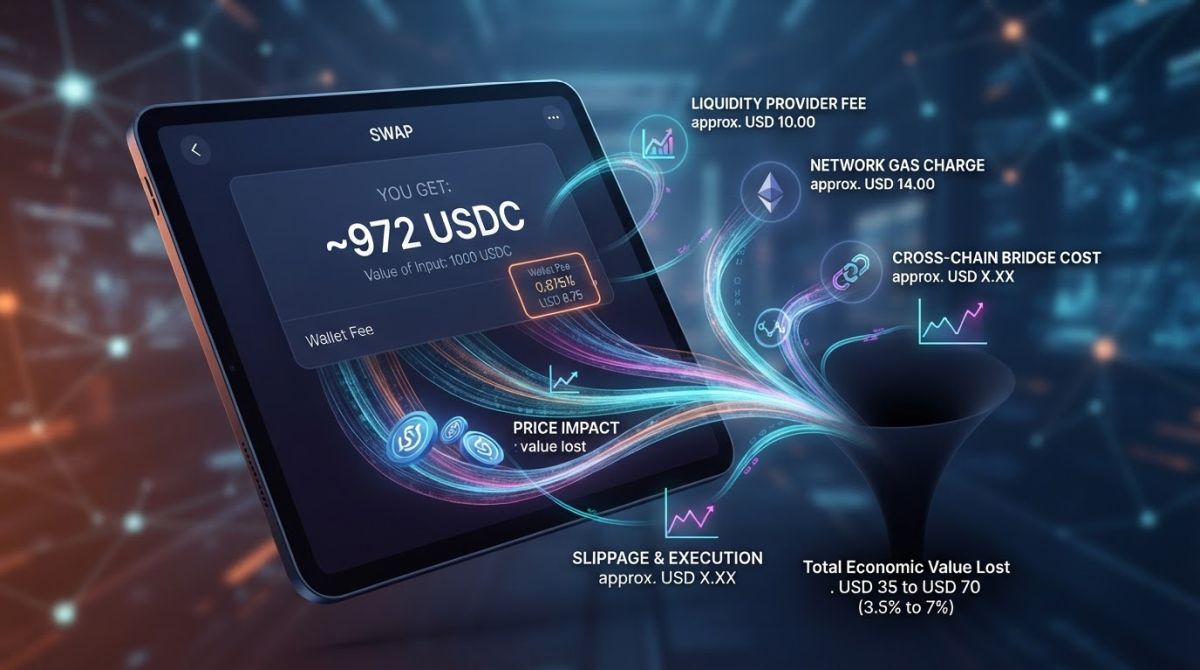
A wallet can accurately advertise a swap fee of 0.875%, yet you can finish a USD 1,000 transaction with USD 35 to USD 70 less economic value. That difference does not necessarily represent a secret fee. More often, several costs are displayed separately, built into the exchange rate, or left outside the prominently advertised percentage.
After 25 years in traditional finance, I recognize this distinction immediately. A currency conversion can have a clearly disclosed commission and still deliver an expensive exchange rate. Crypto changes the infrastructure, but it does not eliminate that basic accounting problem.
The distinction matters.
In-wallet swaps do not universally cost 3% to 7%. A trade involving a liquid pair on an inexpensive network can cost substantially less. But an all-in cost of 3% to 7% becomes entirely plausible when a wallet fee, price impact, network charges, bridge costs, and unfavorable execution appear in the same transaction.
The percentages in this article illustrate how those costs can accumulate. They are not evidence that every wallet, or even a typical wallet swap, produces that result.
Here is the distinction I keep coming back to:
A fee is what the product charges. The cost is the economic value you give up.
A Wallet Swap Fee Is Not the Same as the Total Swap Cost
An in-wallet swap is a token trade initiated through a crypto wallet, usually using liquidity and execution infrastructure provided by other services.
The wallet typically requests quotes from decentralized exchanges, aggregators, market makers, or bridge providers. It selects or presents a route, adds any wallet or integrator fee, and prepares the transaction or signing request for you to approve.
The wallet is the interface and routing layer. It is not necessarily the source of liquidity.
That is why comparing only the published wallet fee gives you an incomplete answer.
The more useful calculation is:
Total economic shortfall equals the benchmark value of the input, minus the benchmark value of the output, plus costs paid outside the quoted token amounts.
Those external costs can include separately paid gas, a required approval transaction, or a centralized exchange’s withdrawal fee.
Suppose you sell assets worth USD 1,000, receive tokens worth USD 972 using the same reference-price window, and separately pay USD 9 in gas.
The calculation is straightforward:
USD 1,000 minus USD 972 plus USD 9 equals USD 37.
Your total transaction cost was 3.7% of the amount traded, even if the wallet’s own fee was below 1%.
Throughout this article, I express cost percentages relative to the benchmark value of the traded input. That keeps the denominator consistent across routes.
There is one important accounting trap: if a fee has already been deducted from the quoted output, do not add it again. The difference between the input and output values already contains it.
A fee breakdown explains where the value went. An input-versus-output comparison tells you how much value was lost overall.
Both are useful. They answer different questions.
What Wallet and Exchange Fee Pages Actually Tell You
Headline fees are not directly comparable because different products advertise different layers of the transaction.
One interface highlights its own revenue. Another highlights its trading commission. A third emphasizes that it charges no interface fee, even though the underlying trade still has costs.
| Route | Headline fee or comparison rate | Costs outside that number |
|---|---|---|
| MetaMask Swaps | 0.875% MetaMask fee | Quoted exchange rate, price impact, network charges, other route costs |
| Phantom swaps | 0.85% for most swaps | Network charges, price impact, bridge-provider costs |
| Uniswap Labs interface | 0% interface fee under its current policy | Liquidity-provider fees, applicable protocol fees, price impact, network costs |
| Kraken Pro | Pair- and volume-dependent maker-taker fees; this article models 0.40% maker and 0.80% taker | Bid-ask spread, order-book impact, deposits, withdrawals |
| Kraken Instant Buy | Displayed fee plus an applicable spread | Payment-method charges and transfer costs may also apply |
This is why discussions about swap costs so often go in circles.
One person is talking about wallet revenue. Another is talking about gas. A third is measuring how many tokens actually arrived. They can quote different percentages and all be describing something real.
In MetaMask’s explanation of swap fees and execution, the fee structure includes the quoted exchange rate, the network fee, and a 0.875% MetaMask fee.
Phantom’s breakdown of swap fees and network charges lists a 0.85% fee for most swaps, along with network charges. Price impact can also reduce the amount received.
Its current cross-chain disclosure deserves careful reading: the bridge provider’s charge can be included in the network fee. When swapping through the Trade screen, Phantom says that charge appears separately as a “Cross Chain Swap Fee.” That is different from treating the bridge charge as pure market price impact.
Under the current Uniswap Labs interface-fee policy, Uniswap Labs does not charge an interface fee. The policy states that this has been the case since December 27, 2025. That does not eliminate liquidity-provider fees, any applicable protocol fees, price impact, or network costs.
Meanwhile, Kraken’s trading fee schedule uses maker-taker pricing that depends on the market and your trading-volume tier. For the numerical examples below, I retain 0.40% maker and 0.80% taker as explicit modeling assumptions. They should not be read as a verified universal rate for every Kraken Pro pair or account.
A trading commission also does not include the cost of crossing the bid-ask spread or moving assets onto and off the exchange.
None of these descriptions is inherently misleading. They simply describe different parts of the transaction.
The mistake is treating any one of them as the final price.
Where the Missing Value Goes
The gap between a wallet fee below 1% and an all-in cost of 3% to 7% usually comes from several costs accumulating together.
Some are explicit charges. Others appear only through a less favorable exchange rate or a smaller final output.
| Cost layer | What it represents | Where you usually see it |
|---|---|---|
| Wallet or integrator fee | Revenue collected by the wallet or application | Usually displayed as a percentage |
| Liquidity-provider fee | Payment to a pool or another liquidity source | Usually embedded in the quoted output |
| Quote-rate shortfall | Difference between an independent benchmark and the offered exchange rate | Often not displayed as a separate line |
| Price impact | Price movement caused by your own order | Sometimes displayed as a percentage |
| Realized slippage | Difference between the quote and final execution | Known after settlement |
| Network cost | Cost of processing the transaction on-chain | Usually displayed in the network’s native token |
| Approval cost | A separate transaction authorizing token spending | May appear before the swap |
| Bridge cost | Cross-chain transfer and associated execution charges | May be grouped with network charges or other route costs |
| Token fee or tax | A transfer, buy, or sell charge enforced by the token contract | May already be reflected in the quote |
| CEX transfer cost | Deposit-related network charges and exchange withdrawal fees | Outside the exchange’s trading commission |
One caution before adding these rows together: they are categories for understanding a trade, not automatically independent amounts.
For example, a quote-rate shortfall may already contain liquidity-provider fees and price impact. If you measure the full shortfall and then add those same embedded components again, you overstate the cost.
The Wallet Fee
The wallet fee is usually the easiest cost to identify.
On a USD 1,000 swap:
- A 0.875% MetaMask fee represents USD 8.75.
- A 0.85% Phantom fee represents USD 8.50.
Those amounts are not inherently outrageous. The problem is that they can sit on top of costs that would exist even without the wallet’s fee.
For a wallet route charging 0.875% to beat an otherwise equivalent fee-free alternative, it needs to recover at least USD 8.75 through better routing or lower execution costs on a USD 1,000 trade.
That is the first hurdle. If the wallet route also requires more gas or another transaction, the hurdle gets higher.
I look at it the same way I would evaluate a financial intermediary in traditional markets: what did the intermediary charge, and what measurable improvement did I receive in return?
Pool and Trading-Venue Fees
An automated market maker, or AMM, generally charges a liquidity-provider fee when a trade passes through a pool. A route using multiple pools can incur more than one such fee.
That does not automatically make a multi-hop route worse.
Trading token A for token C through token B can still be cheaper if the intermediate pools have deeper liquidity. A direct pool with shallow liquidity may produce a much worse result.
The relevant question is not how many steps the route contains. It is how much output remains after pool fees, price impact, and gas.
A centralized exchange has a different structure, but the economic principle is similar. Instead of trading against an AMM pool, a taker trades against available orders, crosses the bid-ask spread, and pays the applicable trading commission.
Different plumbing, same need to measure the final result.
The Quote-Rate Shortfall
People sometimes call this a routing spread or a hidden spread, but it is not a standardized protocol fee.
I find it more useful to describe it as the difference between an independent reference price and the exchange rate offered by the interface, after accounting for any components you can identify separately.
That difference may reflect:
- Liquidity-provider fees
- The bid-ask spread
- Price impact
- A market maker’s margin
- Bridge-provider charges
- Inefficient routing
- Short-lived price differences between venues
- Gas costs embedded in a quote that does not require a native gas token
You do not need a perfect label for every component to recognize that one quote gives you less value than another.
The interface should still make the overall economic difference visible.
A benchmark also needs to be credible. A token’s displayed portfolio price is not necessarily an executable market price, especially when liquidity is thin. I would be cautious about declaring a large “loss” based on an unreliable or stale token valuation.
Price Impact
Price impact is the change in price caused by the trade itself.
That is the central distinction in Uniswap’s explanation of how price impact works.
A USD 1,000 swap in a deep ETH-USDC market may barely move the price. The same USD 1,000 order in a shallow token pool can move it by several percentage points.
This is why trade size alone tells you very little. You need to compare the order with the amount and concentration of active liquidity available around the current price.
For concentrated-liquidity pools, the total value in the pool is not the whole story. What matters for immediate execution is the liquidity available across the price ranges your trade will actually consume.
Price impact is also not the same thing as a platform fee. The wallet does not necessarily collect that value. It is a consequence of trading through available liquidity along a pricing curve.
You still give up economic value, regardless of who ultimately benefits.
Slippage at Execution
Slippage tolerance is not a fee.
If you set slippage tolerance to 1%, your trade does not automatically cost an extra 1%. For a typical exact-input swap, the setting establishes how much worse the output can become before the transaction fails its minimum-output condition.
Realized slippage is the actual difference between the expected output and the amount ultimately received. Execution can be worse than the quote, but it can also improve.
Phantom’s guide to adjusting swap settings explains this distinction and warns that a higher tolerance allows execution at a worse price.
This matters because many interfaces display slippage tolerance more prominently than the likely execution cost. A user can mistake a protective limit for a charge.
A high tolerance still creates risk. It expands the range of outcomes you have agreed to accept, potentially including a significantly worse price.
Increasing that tolerance does not improve liquidity or reduce price impact. It simply gives the transaction more room to execute unfavorably.
Network and Approval Costs
Network costs generally depend more on transaction complexity and network conditions than on the dollar size of the trade.
If a swap requires USD 15 in gas, its percentage impact changes dramatically with trade size:
| Trade size | USD 15 network cost as a share of the trade |
|---|---|
| USD 100 | 15.00% |
| USD 250 | 6.00% |
| USD 1,000 | 1.50% |
| USD 5,000 | 0.30% |
| USD 10,000 | 0.15% |
These are illustrative amounts, not a claim about current Ethereum gas prices.
They explain why a small Ethereum mainnet swap can look absurdly expensive even when the exchange rate itself is reasonable.
An ERC-20 token may also require an approval before a swap contract can spend it. If that approval is a separate on-chain transaction, it creates another network cost.
Count that cost only when the approval is actually required. If you already have sufficient allowance, adding a hypothetical new approval exaggerates the cost of the current trade.
The same principle applies when an integration uses a supported signature-based authorization or another approval mechanism. Count the transactions the user actually needs, not the transactions a generic tutorial happens to show.
Cross-Chain Execution
A cross-chain swap can combine several economic operations into one user-facing quote.
Depending on the route, those components may include:
- A swap on the source chain.
- A network transaction on the source chain.
- A bridge-provider charge.
- Execution on the destination chain.
- Another swap on the destination chain.
- Optional delivery of a gas token on the destination chain.
These are cost components, not necessarily six separate transactions or a rigid chronological sequence.
The interface may package everything as one conversion.
That simplifies the user experience, but it makes the price harder to audit. Depending on the wallet and provider, a bridge charge may appear under network fees, as a separate cross-chain fee, or inside the final exchange rate.
Cross-chain routes also introduce a different execution problem: the source leg can complete before the destination leg does. A failed destination operation is not always equivalent to an atomic same-chain swap reverting.
I want both the cost structure and the recovery process to be clear before treating a cross-chain quote as comparable to a simple same-chain trade.
Swapping Without a Native Gas Token
“Gasless” does not always mean “free.”
There are at least three economically different models:
- The wallet or another party genuinely subsidizes the network fee.
- You pay the network fee using another supported token instead of the network’s native asset.
- A third-party executor pays the on-chain gas and incorporates its expected cost into the exchange rate.
All three can remove the need to hold a native gas token. Only the first necessarily removes that network expense from your own transaction economics.
Phantom’s explanation of gasless EVM transactions distinguishes sponsored fees from fees collected in another token. The network cost still exists.
A similar distinction appears in Uniswap’s explanation of how UniswapX handles network costs. Fillers pay most swap-related network costs on the user’s behalf and factor those costs into the swap price. Initial token approvals and wrapping a native token can still require separately paid gas.
For developers, “no native gas token required” is often a more accurate label than “free gas.”
That wording tells users what the feature actually solves without making an economic promise the system does not support.
Why Are MetaMask Swaps So Expensive?
MetaMask Swaps charges a 0.875% service fee, but the total cost also depends on the route, liquidity, gas, and final execution.
That service fee is 87.5 basis points before accounting for pool fees, price impact, network costs, or execution movement.
On a USD 1,000 trade, it creates an initial USD 8.75 disadvantage relative to a route that does not charge the same interface fee, assuming everything else is equal.
MetaMask can still win the comparison.
Its documentation explains that it searches across liquidity sources and runs test transactions to filter out options that are unlikely to succeed. If that process finds a route with lower price impact, avoids an expensive extra step, or helps prevent a failed transaction, the savings can exceed the wallet fee.
Avoiding a failed transaction has real economic value. A conventional on-chain transaction can consume gas even when execution reverts.
But routing quality needs to be measured, not assumed.
If MetaMask and a direct DEX interface return nearly identical underlying routes, the extra 0.875% will usually make the in-wallet route more expensive, all else being equal.
That is why I would not answer “Why are MetaMask swaps so expensive?” by claiming MetaMask secretly charges 4%.
The more accurate answer is that the visible 0.875% is only one layer of a transaction whose total economic cost can be several times larger.
Convenience, simulation, and routing can justify a fee. They do not make the fee disappear.
What Users Mean by a Phantom Swap “Hidden Fee”
Phantom charges 0.85% for most swaps, but that percentage does not represent the full cost of every route.
On a USD 1,000 transaction, the wallet fee alone represents USD 8.50. Network charges, price impact, and any applicable cross-chain costs can increase the total.
Some Phantom flows are exempt from the standard swap fee, so I would not assume that every conversion carries exactly the same charge.
The cross-chain presentation is particularly important.
Phantom’s current documentation says the network-fee category can include the bridge provider’s charge. When the swap starts from the Trade screen, it says that charge appears as a separate “Cross Chain Swap Fee.”
That means it would be inaccurate to describe the current documented treatment simply as “Phantom hides the bridge fee inside price impact.”
The broader usability problem remains, however: a clearly disclosed wallet fee can still be much smaller than the complete economic cost of the trade.
When someone searches for a “Phantom swap hidden fee,” the underlying question may really be:
If the wallet fee was 0.85%, why did I receive substantially less value than I expected?
That is a legitimate question. It does not, by itself, establish that Phantom collected an undisclosed extra fee.
I would separate the answer into the wallet’s fee, market impact, network processing, bridge-provider charges, and any execution difference.
Whenever the underlying provider supplies enough detail, the interface should distinguish those components instead of making users reverse-engineer them from a smaller token balance.
Is an In-Wallet Swap Cheaper Than a DEX Aggregator?
An in-wallet swap can be cheaper than a direct DEX or aggregator quote, but only if its execution advantage exceeds its additional fees and external costs.
An important detail gets lost in these comparisons: the wallet and the aggregator may not be accessing different markets.
The wallet may already use an aggregator or similar routing infrastructure behind the scenes.
The comparison may actually be between:
- An aggregator route with an added wallet fee
- A direct DEX route without that wallet fee
- Another aggregator route carrying its own integrator fee
- An intent-based route with gas embedded in the exchange rate
A wallet can find a genuinely better path. It may split an order across pools, use an intermediate token, obtain a market-maker quote, or select a less expensive bridge.
But the routing improvement needs to exceed the wallet fee and any additional network expenses.
Direct Uniswap execution is not necessarily a trade through one pool. As the description of Uniswap’s routing system explains, routing can evaluate multiple pools, protocol versions, split paths, intermediate tokens, and network costs.
The router can reject an extra hop when the expected price improvement does not justify its additional gas.
A standalone aggregator is not automatically fee-free either. Services such as 0x allow an integrating application to add a fee through parameters such as swapFeeBps. The response can identify that charge in a field such as fees.integratorFee.
Provider-level charges or trade-surplus arrangements may also depend on the integration and pricing plan.
The product label matters less than the final numbers.
For an exact-input trade, I would compare:
- Expected output
- Minimum output
- Network cost
- Required approval cost
- Wallet or integrator fee
- Bridge cost
- Quote expiration
- The policy for distributing execution surplus
- The likelihood of successful execution
The cheapest route is the one delivering the highest net output value after external costs, not the one advertising the smallest percentage.
A USD 1,000 Comparison: Wallet Swap vs. Uniswap vs. Kraken Pro
A fair venue comparison needs the same starting assets, the same desired endpoint, and the same reference-price window.
Consider a hypothetical user who holds USD 1,000 worth of USDC and wants to buy a moderately liquid token available through an in-wallet route, Uniswap, and Kraken.
The user starts in self-custody and wants the purchased token back in the same user-controlled custody environment.
That last condition matters. Buying a token and leaving it on an exchange is not the same operational outcome as receiving it in your own wallet.
Here are the assumptions:
- Quotes are collected within the same short time window.
- Every route uses the same USD reference-price methodology.
- Any required token allowance already exists.
- The token does not impose a transfer, buy, or sell tax.
- The in-wallet route uses a 0.875% MetaMask-style wallet fee.
- The direct DEX route uses the current 0% Uniswap Labs interface fee.
- The CEX route uses an explicitly assumed 0.80% Kraken Pro taker fee.
- The CEX supports the required assets, trading route, and deposit and withdrawal networks.
- Market, network, and transfer expenses are model inputs, not live quotes.
For this breakdown, the rows are mutually exclusive. The liquidity-related quote shortfall excludes the separately listed application or trading fee, network and transfer costs, and additional execution movement.
| Cost component, USD | In-wallet route | Direct Uniswap | Kraken Pro |
|---|---|---|---|
| Wallet, interface, or trading fee | 8.75 | 0.00 | 8.00 |
| Liquidity-related quote shortfall | 10.00 | 14.00 | 3.00 |
| Network or transfer costs | 14.00 | 12.00 | 11.00 |
| Execution movement | 3.00 | 2.00 | 1.00 |
| Total cost | 35.75 | 28.00 | 23.00 |
| All-in cost rate | 3.58% | 2.80% | 2.30% |
| Retained economic value | 964.25 | 972.00 | 977.00 |
The first row uses the stated platform fee policies and the explicit Kraken fee-tier assumption. Every other row is a transparent scenario assumption designed to demonstrate the accounting.
“Retained economic value” means the output’s benchmark value after allocating external costs. It is not necessarily the number you would see next to the purchased token in a wallet, because some costs may have been paid separately.
This example produces several useful lessons.
The Wallet Found a Better Route but Still Cost More
The modeled wallet route has a USD 10 liquidity-related shortfall, compared with USD 14 for direct Uniswap execution.
The wallet’s routing saved USD 4.
That was not enough to offset its USD 8.75 fee and slightly more expensive transaction. The in-wallet route still finished USD 7.75 behind Uniswap.
This is a point I would emphasize in any product review: good routing does not automatically produce the cheapest transaction.
The routing first needs to earn back the application’s fee.
A statement such as “we found a better underlying price” can be completely true while the user’s final economic result is still worse.
The DEX Had No Interface Fee but Was Not Free
Uniswap’s modeled all-in cost is USD 28 even though the interface fee is zero.
The user still pays through:
- Pool or route economics
- Price impact
- Gas
- Execution movement
A 0% interface fee means the interface is not adding that particular charge.
It does not mean the trade has no economic cost.
In traditional finance, I would never assume a transaction is free simply because one commission line says zero. I apply the same standard here.
The CEX Result Depends on Where the Assets Start and Finish
The Kraken scenario includes USD 11 in modeled transfer expenses because the user starts and finishes in self-custody.
The actual amount would depend on the asset, network, and exchange policy. I would use Kraken’s withdrawal-fee and minimum-amount information to check the supported withdrawal route rather than inventing a generic transfer charge.
If the USDC were already on Kraken and the purchased asset could remain there, the USD 11 transfer line would disappear from this model.
Total cost would fall from USD 23 to USD 12, or 1.2%.
That is cheaper, but it is no longer a like-for-like self-custody comparison.
The user would be accepting:
- Exchange custody
- Account-verification requirements
- Regional product restrictions
- Withdrawal rules
- Possible withdrawal delays
- Platform-specific operational risk
A professional CEX order book can be very cost-effective when the funds are already there.
Moving assets onto and off the exchange can erase part of that advantage. If the purchase also requires an intermediate trading pair, another commission and another spread may need to be included.
A Maker Order Can Be Cheaper Without Being Equivalent
In the fee-tier assumptions used here, the maker fee is lower than the taker fee.
The trade-off is execution uncertainty.
A taker order trades immediately against available liquidity, subject to the order’s conditions. A maker order rests on the order book and may fill later, fill partially, or never fill at all.
The market can move while you wait.
Also, a limit order is not automatically a maker order. If it immediately matches existing orders, it can incur a taker fee. A supported post-only setting can help ensure the order adds liquidity rather than taking it.
A lower maker commission compensates you for providing liquidity and accepting a different execution risk.
I would not compare an immediately executable swap with a resting limit order as though the only difference were the fee.
Instant Buy Is a Different Product
A centralized exchange’s simple purchase screen is not equivalent to its professional order book.
In Kraken’s explanation of Instant Buy fees, the cost includes a displayed fee and, where applicable, a spread built into the price.
Its current documentation describes a standard 1% trading fee for instant purchases, with qualifying Kraken+ fee-waiver provisions. Payment-method charges and spreads can still apply, and other order types may have different pricing.
That convenient conversion flow can therefore cost more than Kraken Pro, even though both products come from the same company.
When comparing an in-wallet swap with a centralized exchange, compare it with the specific CEX product the user would actually use.
“Cheaper on Kraken” is not precise enough if one person means a professional order book and another means a one-tap card purchase.
How the Same Wallet Can Reach an All-In Cost of 3% to 7%
The 3% to 7% range is not a universal wallet fee. It is a possible combined outcome when several costs become meaningful at the same time.
The following scenarios use a MetaMask-style 0.875% wallet fee. Every remaining percentage is an explicit illustration.
Each percentage expresses a nonoverlapping USD cost as a share of the same USD 1,000 starting value. The table is not assuming that every provider applies every fee to an identical on-chain fee base.
| Illustrative route | Wallet fee | Quote-rate shortfall | Network and bridge cost | Realized slippage | Total cost | Loss on USD 1,000 |
|---|---|---|---|---|---|---|
| Liquid pair on a low-cost network | 0.875% | 0.25% | 0.10% | 0.05% | 1.275% | USD 12.75 |
| Moderately liquid mainnet trade | 0.875% | 1.00% | 1.40% | 0.30% | 3.575% | USD 35.75 |
| Thin-liquidity or cross-chain route | 0.875% | 3.40% | 1.80% | 0.70% | 6.775% | USD 67.75 |
The first route shows why it would be wrong to claim that every in-wallet swap costs 3% to 7%.
The second shows how an ordinary-looking USD 1,000 transaction can cross 3% without any one component appearing extreme.
The third shows how thin liquidity or cross-chain complexity can push the result toward 7%, while the wallet still advertises a fee below 1%.
The total can rise further when:
- The token imposes a buy, sell, or transfer tax.
- A separate approval is required.
- The route uses several pools.
- Both source and destination networks impose costs.
- The quote becomes stale.
- The user accepts excessive slippage.
- The bridge lacks sufficient liquidity.
- Transaction ordering produces an unfavorable outcome, including certain MEV or sandwich-attack scenarios.
- The trade is small relative to fixed network costs.
None of those factors proves that the wallet itself collected the entire shortfall.
They do explain why the wallet’s fee percentage is an inadequate description of the user’s final result.
Why Developers Still Build Swaps Into Wallets
Integrated swaps can be economically useful even when they are not the cheapest theoretical execution route.
The cheapest route is not always the route a user can successfully complete.
Imagine a user who:
- Holds USDC in an embedded wallet
- Has no ETH or other native gas token
- Needs ETH to use an application
- Does not have an exchange account ready
- Does not want to transfer funds through another wallet
Without an integrated swap, that user may need to leave the application, find a source of ETH, copy an address, move assets, wait for confirmation, and return.
A supported swap with sponsored gas, alternate-token gas payment, or gas included in the quote can convert part of the existing USDC balance into ETH without requiring the user to acquire ETH first.
The route may not offer the absolute best execution price.
It can still be economically rational because it unblocks a workflow that would otherwise stop.
Other legitimate uses include:
- Converting an incoming payment into the asset an application requires
- Paying an invoice in a specified stablecoin
- Rebalancing an embedded-wallet portfolio
- Acquiring a destination-chain gas token
- Consolidating small balances across several tokens
- Completing a cross-chain purchase in one flow
- Avoiding manual interaction with unfamiliar contracts
The product value is not merely “one fewer click.”
It is fewer opportunities to copy the wrong address, select the wrong chain, approve the wrong contract, or abandon the transaction.
I have no objection to paying for that kind of convenience. Financial infrastructure has always charged for reducing operational friction.
The trade-off is that a smoother experience can make execution quality harder to inspect.
That is a reason to improve disclosure and measurement, not a reason to pretend convenience has no value.
A Cost-Aware Integration Flow for In-Wallet Swaps
An in-wallet swap should be treated as a trade-execution product, not just a button connected to a quote API.
The interface needs to understand user intent, normalize the economics, validate the transaction, and reconcile what actually happened.
The 0x API overview for swap pricing and routing provides one example of the infrastructure available to developers. I use its EVM Swap API terminology below, but the economic principles apply more broadly.
1. Define What the User Actually Needs
Before requesting a quote, establish:
- Whether the input or output amount is exact
- The source chain
- The destination chain
- The token being sold
- The token being purchased
- Whether the recipient differs from the sender
- Whether destination-chain gas is required
- Whether the final assets must remain in self-custody
- Whether price, speed, or execution certainty takes priority
A cross-chain payment that must deliver exactly 100 USDC is not the same problem as a portfolio swap that sells exactly 100 USDC.
The first is focused on the required destination amount. The second fixes the amount the user is willing to spend.
If the integration does not distinguish those intentions, the comparison can be wrong before it ever receives a quote.
2. Request Indicative Prices at Approximately the Same Time
Comparable quotes need to describe approximately the same market conditions.
If you request one provider’s quote now and another provider’s quote 30 seconds later, market movement can masquerade as a routing advantage.
This is particularly important for volatile assets or thinly traded pairs.
A typical EVM integration using 0x Swap API v2 can begin with GET /swap/allowance-holder/price. The AllowanceHolder indicative-price documentation explains that endpoint’s role.
A firm quote can then be requested through GET /swap/allowance-holder/quote, as described in the AllowanceHolder firm-quote documentation.
A firm quote may include:
buyAmountminBuyAmounttotalNetworkFeefees.integratorFeeissues.allowanceroutetransaction
Exact fields, units, optional values, and nullability vary by provider and API version.
“Firm” also does not mean immune to expiration or changing on-chain conditions. The transaction still needs valid balances, allowances, execution conditions, and an acceptable state when it settles.
The normalization layer should handle those realities instead of treating every returned number as a guaranteed outcome.
3. Normalize Token Units and Reference Prices
Token amounts returned by an API are commonly expressed in base units, not human-readable quantities.
For a USDC contract using six decimals, convert the integer amount using those six decimals. A typical ERC-20 token may use 18, but the integration should read the actual metadata for the specific token and chain rather than assuming it.
Wrapped and bridged representations deserve the same care.
After converting units, value the input and output using synchronized reference prices.
For a fair comparison:
- Use the same reference-price source.
- Use the same timestamp or a narrow time window.
- Use the same comparison currency.
- Record the relevant block when possible.
- Do not compare a CEX’s last traded price with an executable on-chain quote as though they were equivalent measurements.
A mid-market or composite reference price is usually more useful than the last transaction price.
For illiquid assets, I would also document why the reference is credible. A misleading benchmark can make good execution look poor, or poor execution look acceptable.
When measuring quote-to-settlement execution quality, use a clearly defined benchmark window. Otherwise, ordinary market movement can become mixed up with route costs.
4. Separate Embedded Costs From External Costs
Most quoted output amounts already reflect some combination of platform fees, pool fees, price impact, and provider charges.
Do not add those costs again when calculating the overall shortfall.
External costs may include:
- Gas paid separately
- A required approval transaction
- A separate bridge transaction not included in the quote
- A CEX withdrawal fee
- A destination-chain transaction outside the quoted route
If gas is deducted from the token being sold, paid from the output, or otherwise already reflected in the quote’s economics, it is not an additional external cost for the same calculation.
The existence of a fee field does not automatically mean you should add that field to the input-output gap. First determine whether the quoted token amounts already include it.
This is the accounting step I would review most carefully. Double-counting can make an otherwise useful comparison completely misleading.
5. Check Existing Allowance Before Requesting Another Approval
For an ERC-20 trade, check whether the current allowance is sufficient.
Do not automatically request unlimited approval. Do not hard-code a spender address copied from an old integration tutorial.
Use the current provider response and verify the spender against the provider’s current, chain-specific documentation or an appropriately maintained allowlist.
The approval target is not necessarily the same as transaction.to. An integration should not assume that the contract executing the transaction is automatically the contract that should receive token allowance.
The approval flow affects both security and cost.
A separate on-chain approval adds another signing interaction, another transaction, and another possible failure point. If an approval is unnecessary, requesting it can make the product both more expensive and less safe.
6. Simulate the Complete Transaction
The largest quoted output has little value if the transaction is unlikely to succeed.
Simulation should check:
- Token balances
- Allowances
- Expected balance changes
- Gas requirements
- Contract reverts
- Minimum output
- Transfer-fee or transfer-tax behavior
- Unsupported token mechanics
- Destination execution, where supported
A slightly worse quote with a high probability of settlement can be economically better than an optimistic quote that frequently fails.
Simulation is not a guarantee. State can change, and cross-chain execution can involve conditions that are not fully reproducible from a single source-chain simulation.
Still, it is an important part of evaluating execution quality rather than comparing promotional numbers.
7. Compare the Expected and Minimum-Output Outcomes
A compact economics helper can keep the comparison consistent:
type QuoteEconomics = {
  inputUsd: number;
  expectedOutputUsd: number;
  minimumOutputUsd: number;
  externalCostsUsd: number;
};

export function summarizeQuote(quote: QuoteEconomics) {
  if (quote.inputUsd <= 0) {
    throw new Error("inputUsd must be positive");
  }

  const expectedLossUsd =
    quote.inputUsd -
    quote.expectedOutputUsd +
    quote.externalCostsUsd;

  const worstCaseLossUsd =
    quote.inputUsd -
    quote.minimumOutputUsd +
    quote.externalCostsUsd;

  return {
    expectedLossUsd,
    expectedLossBps:
      (expectedLossUsd / quote.inputUsd) * 10_000,
    expectedRetainedUsd:
      quote.inputUsd - expectedLossUsd,
    worstCaseLossUsd,
    worstCaseLossBps:
      (worstCaseLossUsd / quote.inputUsd) * 10_000,
  };
}
Value expectedOutputUsd and minimumOutputUsd using the same reference-price window used for inputUsd.
The externalCostsUsd field must contain only costs that have not already reduced the quoted output.
That produces two useful numbers:
- Expected all-in cost
- All-in cost at the minimum permitted output, using the assumed external costs
The second number is often more useful than showing slippage tolerance by itself.
There are important implementation limits, however.
This is a compact display and comparison helper, not a production settlement engine. Use integer base units and suitable decimal handling for token accounting, rather than JavaScript floating-point number values for transaction-critical amounts. Production code should also validate all inputs.
The worstCaseLossUsd label means the minimum-output outcome for a successful execution under the stated cost assumptions. It does not cap gas changes, bridge failures, recovery expenses, or changes in the token’s market value.
A token-denominated minimum output is also not a guarantee of future USD purchasing power.
8. Rank Routes by Net Value
Do not rank routes solely by buyAmount.
A route returning more output tokens may also require:
- An expensive approval
- A more complex, gas-intensive transaction
- Destination-chain gas
- A separate bridge operation
- More time and greater exposure to price changes
A better starting metric is:
Net received value equals expected output value minus external costs.
Then show risk, expected completion time, and failure probability as separate dimensions.
I would rather see a transparent trade-off between price and reliability than a single “best route” badge that hides how the ranking was determined.
9. Disclose the Application Fee Clearly
Aggregator APIs may allow an integrating application to add its own fee.
The 0x guide to monetizing swap integrations describes parameters such as swapFeeBps, swapFeeRecipient, and swapFeeToken.
When used, the resulting integrator fee can appear in the quote response, including through fees.integratorFee.
That fee should never be disguised as a generic network charge.
The same principle applies to trade surplus, sometimes called positive slippage.
If execution improves after the user signs, the application should have a clear policy explaining who receives the improvement.
Where a provider offers a setting such as tradeSurplusRecipient, developers should treat it as an economic product decision, not merely an API option.
Availability and default surplus treatment can depend on the provider’s pricing plan or integration agreement. Do not assume all execution improvement automatically returns to the user.
For me, this is basic financial disclosure: if the product can earn revenue from a better-than-quoted execution, users should be able to understand that arrangement.
10. Reconcile the Trade After Settlement
Quote quality cannot be measured only with information available before execution.
Save enough data to compare the expected result with the actual one:
- Quoted output
- Minimum output
- Actual output
- Estimated network cost
- Actual network cost
- Quoted route
- Executed route
- Quote time
- Settlement time
- Reference prices
- Explicit fee fields
- Transaction status
- Failure reason, when available
Realized all-in cost should become a product metric.
Without reconciliation, a team may know that users completed their swaps while missing the fact that those users regularly paid 300 or 500 basis points more than expected.
That is a 3% or 5% execution gap, not a minor rounding issue.
The product needs to measure what arrived, what was spent, and what happened between the quote and settlement.
What a Trustworthy Swap Confirmation Screen Should Show
Users should not need a spreadsheet to discover that a transaction reduced their economic value by 4%.
A useful confirmation screen should answer three questions clearly.
What Am I Likely to Receive?
Show:
- Expected token output
- Expected value in the reference currency
- Effective exchange rate
- Quote age or expiration
- Route or execution provider
The expected output should describe the likely result of the current quote, not an outdated estimate collected before a material price move.
If the quote is no longer valid, refresh it before asking for approval.
What Is the Worst Acceptable Execution Outcome?
Show:
- Minimum amount received
- Benchmark value of that minimum amount
- Slippage tolerance
- The conditions under which the transaction will revert or fail its execution requirements
Expected output and minimum output should never be presented as though they were the same number.
For a cross-chain route, explain whether the minimum applies to the complete destination outcome and what happens if the source operation completes but the destination operation does not.
The reference-currency equivalent should also be identified as an estimate based on the chosen price window, not a guaranteed fiat value.
What Am I Paying?
Show:
- Wallet or integrator fee
- Liquidity or provider fee, when available
- Price impact
- Estimated network cost
- Approval cost, if required
- Bridge cost
- Destination-chain cost
- Token tax or transfer fee
- Expected all-in cost as both a percentage and an amount in the reference currency
For a cross-chain route, separate source-chain gas, bridge costs, destination-chain gas, and destination-swap impact whenever the quote provider supplies that detail.
If a bridge charge is grouped under another label, explain that in plain English.
A breakdown can still be useful when it is incomplete, provided the interface says what is included and what cannot be separated.
What I do not want is false precision: a detailed-looking fee panel that leaves the largest economic difference unexplained.
Common Mistakes When Comparing Crypto Swap Costs
Most misleading swap comparisons come from inconsistent accounting, inconsistent timing, or different assumptions about custody.
These are the errors I would check first.
Looking Only at the Advertised Percentage
A 0% interface-fee route can produce a worse result than a wallet charging 0.875% if its price impact or network cost is substantially higher.
The reverse is also true. Better routing does not guarantee that the wallet earns back its fee.
Compare net outcomes, not just the most marketable line item.
Treating Slippage Tolerance as a Charge
A 1% slippage setting does not prove you lost 1%.
After settlement, compare the actual token output with the quoted output using a consistent measurement method.
The setting defines what you permitted. The settlement tells you what happened.
Comparing Quotes Collected at Different Times
A token’s price can move enough in a few seconds to reverse the apparent ranking of two services.
Request quotes concurrently or within a narrow time window, and use the same reference-price methodology.
Otherwise, you may be measuring market movement rather than execution quality.
Ignoring Where the Assets Start and Finish
A CEX trade that begins and ends on the exchange is not directly equivalent to a self-custodial wallet swap.
Include deposits, withdrawals, and network expenses when the user’s actual goal is to end with the assets in their own wallet.
If the user is comfortable leaving assets on the exchange, state that assumption rather than quietly changing the comparison.
Counting Embedded Fees Twice
If a wallet fee has already reduced the quoted output, adding it again exaggerates the economic loss.
The same rule applies to:
- Gas embedded in a quote that does not require a native gas token
- Bridge charges included elsewhere in the quoted route
- Token taxes already reflected in expected output
- CEX commissions deducted from the asset received
A cost breakdown is an explanation of the total, not an instruction to add every visible number to it.
Ignoring Failed-Transaction Costs
A conventional on-chain transaction can consume gas even when it fails.
Simulation, certain private transaction channels, and intent-based execution can therefore offer real economic value even without improving the displayed exchange rate.
The exact protection depends on the implementation. A private route is not automatically a guarantee against failure or every form of adverse execution.
Measure the actual failure rate and the cost users bear when something goes wrong.
Automatically Raising Slippage Tolerance
Increasing slippage tolerance can reduce the chance that a transaction fails because the price moved beyond its limit.
It also expands the range of prices the user has agreed to accept.
For a thinly traded token, raising tolerance without checking pool depth, token fees, or route quality can turn a routing problem into a much larger realized shortfall.
It does not repair shallow liquidity. It permits the transaction to use it on worse terms.
The Real Trade-Offs Between Wallets, DEXs, Aggregators, and CEXs
No execution category is always cheapest, because each solves a different combination of pricing, custody, and operational problems.
| Venue | Main advantage | Main cost or operational risk | Best fit |
|---|---|---|---|
| In-wallet swap | Simple self-custodial flow, simulation, gas abstraction | Wallet fee and bundled cost presentation | Users prioritizing successful completion and convenience |
| Direct DEX interface | Self-custody with fewer application-level charges | Gas, pool liquidity, approvals, price impact | Liquid same-chain pairs with a strong direct route |
| DEX aggregator | Access to fragmented liquidity and split routing | Integrator fees and gas-intensive routes | Larger or less direct trades where routing quality matters |
| CEX Pro order book | Deep liquidity, limit orders, structured fee schedules | Custody, verification, deposits, withdrawals | Listed assets when funds are already on the exchange |
| CEX instant purchase | Simple conversion experience | Displayed fee plus an embedded spread | Users prioritizing simplicity over execution optimization |
A direct DEX can win for a liquid pair on an inexpensive network.
A CEX order book can win when the assets are already on the exchange.
An aggregator can win when liquidity is fragmented.
An in-wallet swap can be a rational choice when the user lacks a gas token, needs cross-chain execution, or would otherwise abandon the transaction.
The right answer depends on the user’s starting position, destination, trade size, and willingness to accept third-party custody or additional operational complexity.
This is another lesson traditional finance taught me: the lowest commission is not always the lowest cost, and the lowest cost is not always the most suitable workflow.
You need to know which problem you are solving.
The Swap-Cost Metric Developers Should Actually Measure
Realized all-in cost, measured in basis points against a synchronized benchmark, is more informative than the advertised fee or the swap-completion rate.
Users do not quietly lose 3% to 7% because every wallet contains one secret 7% charge.
They can lose that much because several smaller costs accumulate while the interface presents each one in a different place, under a different label, or inside the exchange rate.
The advertised fee is useful. It is not the final price.
The more honest measurement is:
Realized all-in cost equals the benchmark value of the actual input, minus the benchmark value of the actual output, plus costs paid outside those amounts.
The input and output valuations need a consistent reference-price methodology. Otherwise, the measurement can mix trading costs with unrelated market movement.
Used consistently, this metric answers the questions users are actually asking:
- Why are MetaMask swaps so expensive?
- Is an in-wallet swap cheaper than a DEX?
- Was the Phantom fee really only 0.85%?
- Did the aggregator improve execution enough to justify its fee?
- Would a CEX have been cheaper after deposits and withdrawals?
For developers, a high swap-completion rate is not enough.
A one-tap flow can have excellent conversion metrics while quietly delivering poor execution. If the team measures only whether the transaction finished, it may never notice the economic problem.
I would track realized all-in cost in basis points, compare it with the pretrade estimate, and investigate persistent gaps.
I would also separate results by trade size, network, token liquidity, route type, and whether the user needed an approval or cross-chain transfer. An average can hide a serious problem affecting a particular group of users.
An in-wallet swap can absolutely be worth using.
It can remove the need to acquire a native gas token, reduce app switching, prevent avoidable mistakes, and complete a workflow that would otherwise fail.
But convenience still has a price.
A good wallet should make that price understandable, and good execution should prove that the convenience is worth it.
Sponsored Partner: Volet.com
Looking for a simple, everyday way to buy, hold, and sell cryptocurrencies alongside your traditional currencies and payment cards?
- Read my full breakdown: Complete Volet Review on DoraMilen.com
- Get started right away: Open your free Volet account using my referral link