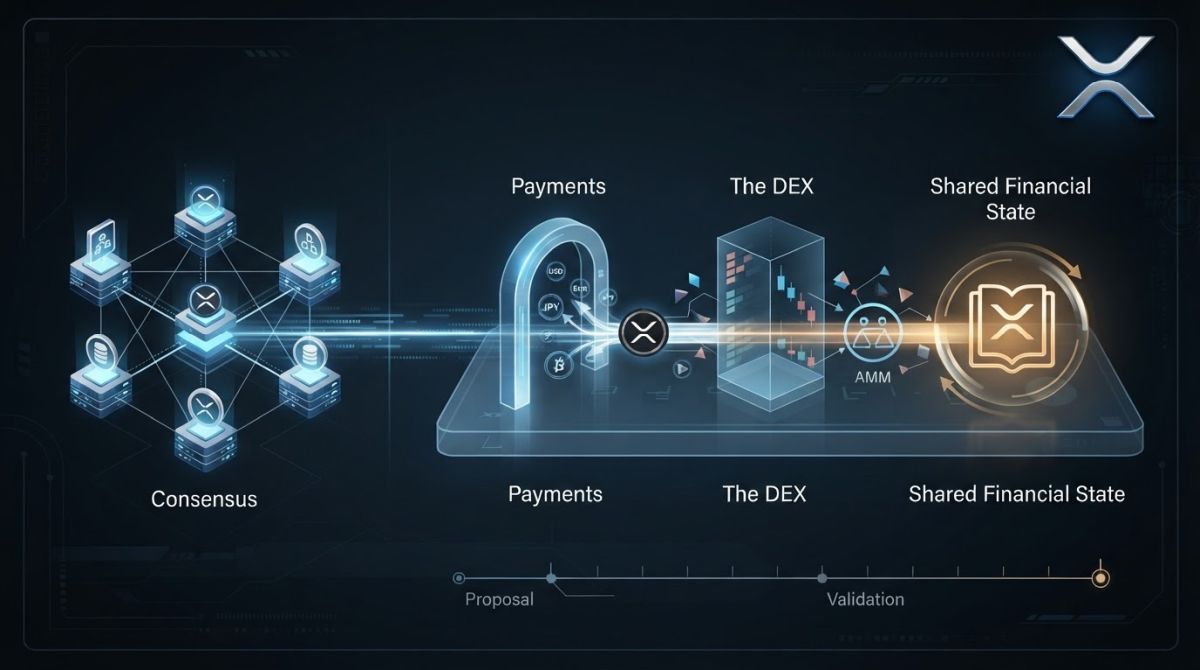
Most coverage of XRP starts with the token’s price or Ripple’s business. I prefer to start one layer below that: the XRP Ledger, a public distributed system for settling payments, exchanging tokenized value, and maintaining a shared financial state.
After 25 years in traditional finance, I find that distinction essential. A company, an asset, and a settlement network are three different things. They come with different responsibilities, dependencies, and risks.
For developers, XRPL is not simply Ethereum with cheaper gas. Its core transaction engine does not revolve around deploying arbitrary EVM smart contracts. Instead, it provides financial primitives directly at the protocol level: payments, token issuance, trust lines, a central limit order book, automated market makers, escrow, checks, payment channels, NFTs, multisignature authorization, and transactions with explicit expiration limits.
There is no mining or proof-of-stake reward system. There is also no Ethereum-style gas metering for arbitrary application bytecode. However, XRPL does have transaction queues and fee escalation under load, so low fees should not be confused with an absence of congestion management.
This specialized design limits what developers can program on the base ledger. In return, it reduces the amount of financial application logic they must build, test, and secure themselves.
In this guide, I explain what XRP and XRP Ledger actually are, how consensus works, what happens between signing and final settlement, how accounts and tokens behave, what using the network costs, and what a production integration should look like.
Ripple, XRP, and XRP Ledger Are Not the Same Thing
Ripple is a company, XRP is a native digital asset, and XRP Ledger is the public network on which that asset exists.
I separate these terms before discussing APIs or architecture:
- XRP Ledger, or XRPL: The public blockchain, its shared state, and the protocol rules governing that state.
- XRP: The ledger’s native digital currency.
- Ripple: A private company that develops payment products and participates in the XRPL ecosystem.
An application that integrates directly with XRPL does not necessarily call a Ripple business API or depend on a Ripple product. It communicates with core XRPL server software or a Clio API server through HTTP JSON-RPC or WebSocket interfaces, signs transactions with its own keys, and checks the results in validated ledgers.
The core server is commonly documented as rippled. I use xrpld below to refer to the core XRPL server role, following the terminology used throughout this guide.
Jed McCaleb, Arthur Britto, and David Schwartz developed the original XRP Ledger during 2011 and early 2012. A total of 100 billion XRP was created at its inception. As the official explanation of XRP’s supply and protocol role describes, the protocol does not create new XRP, while transaction costs permanently destroy a small portion of the existing supply.
Historically, “Ripple” was used for the technology, company, and network. For a technical integration today, it is clearer to say XRPL when discussing the ledger, XRP when discussing the native currency, and Ripple when discussing the company.
What Is XRP Ledger?
XRP Ledger is a public, permissionless, account-based blockchain built primarily for transferring and exchanging value.
“Account-based” means the shared state is represented through accounts and ledger objects associated with those accounts. Conceptually, that is closer to Ethereum’s account model than Bitcoin’s unspent transaction output, or UTXO, model.
That similarity should not be taken too far. XRPL has its own state structure, signing rules, binary serialization, and transaction semantics.
The documented structure of an XRPL ledger contains three main components:
- The current state of accounts and ledger objects.
- The transaction set applied to the previous ledger, together with execution metadata.
- A header containing identifiers, hashes, close-time information, and other metadata.
Ledger versions are numbered using ledger_index.
Each validated ledger builds on the previous one and is cryptographically linked to it. A ledger’s hash identifies its specific contents, while its index identifies its position in the sequence.
Two competing, not-yet-validated ledgers can have the same index but different hashes. Under the network’s intended consensus and trust assumptions, one becomes part of the validated history.
Current State Is Different From Complete History
An XRPL ledger contains a representation of the current state. A server does not need to replay every transaction since the network’s creation merely to work with that state.
Understanding how XRPL stores and serves ledger history is still critical for production systems.
Historical data is needed for:
- Auditing.
- Analytics.
- Investigating previous transactions.
- Reconstructing account activity.
- Proving that an expired transaction was not included during its eligible ledger range.
A server can know the current validated state while retaining only a limited transaction history. That distinction becomes especially important when a payment service tries to determine whether an earlier transaction definitively failed to appear on-chain.
What Are XRPL Ledger Objects?
The global state is more than a list of addresses and balances. It includes protocol-defined objects such as:
AccountRoot, the account’s basic state.RippleState, a trust line relationship.Offer, an open DEX order.Escrow, funds held under time or cryptographic conditions.PayChannel, a payment channel.Check, a deferred payment authorization.SignerList, a multisignature configuration.NFTokenPage, a page containing NFTs.NFTokenOffer, an offer to buy or sell an NFT.AMM, an automated market maker.MPTokenandMPTokenIssuance, objects used by Multi-Purpose Tokens.
These objects can be created, modified, or removed only through transaction types defined by the protocol and enabled on the relevant network.
There is no general-purpose instruction that simply says, “execute this arbitrary bytecode.”
To change the state, a developer selects the appropriate transaction type, supplies its fields, signs its canonical binary representation, and submits it to the network.
That is the central architectural trade-off: less open-ended programmability, but more financial behavior already specified by the protocol.
When Should Developers Use XRPL?
XRPL is a strong candidate when an application’s main job is moving and settling value, rather than executing arbitrary on-chain code.
I would consider it for:
- International payouts.
- Marketplace and creator payments.
- Treasury transfers.
- Accepting XRP or supported token payments.
- Micropayments.
- Exchanging tokenized currencies.
- Issuing a stablecoin or a restricted utility token.
- Escrow between two parties.
- On-chain limit orders.
- Payment channels supporting many small payments.
- NFT issuance without deploying a separate NFT contract.
- Auditable settlement between business systems.
The technical characteristics that make XRPL relevant to these use cases include:
- Transaction validation commonly measured in seconds.
- Explicit finality once a result is in a validated ledger.
- A low standard transaction cost.
- A built-in DEX and AMM infrastructure.
- Token issuance without deploying a conventional token contract.
- Direct and cross-currency payments.
- Local transaction signing.
- WebSocket event subscriptions.
- No mining or staking requirement.
- Relatively few moving parts for a straightforward payment flow.
“Commonly measured in seconds” is not a service-level guarantee. Network conditions, server health, and consensus participation still affect availability.
XRPL is a less natural choice when an application requires:
- Arbitrary smart contracts on the base ledger.
- Complex, custom on-chain business logic.
- Ethereum-style permissionless contract composability.
- Large amounts of arbitrary on-chain data.
- The same ABI model and tooling used by EVM applications.
- Hidden transaction details or private balances.
This article concerns native XRPL functionality, not an EVM sidechain or a separate execution environment.
One more point deserves a direct statement: XRPL transactions and ledger state are public. A pseudonymous address is not the same as privacy.
How Does XRPL Consensus Work?
XRPL reaches agreement through the XRP Ledger Consensus Protocol, not proof of work or proof of stake.
The XRP Ledger Consensus Protocol allows independent servers to exchange proposals and agree on the transactions that should form the next ledger.
Before going further, I distinguish a server from a validator.
A core XRPL server can:
- Receive client requests.
- Relay transactions to the network.
- Maintain local ledger state.
- Answer API queries.
- Exchange data with other servers.
A validator runs the core server software and additionally signs consensus-related messages and validations that help establish the validated history.
A server does not become a consensus validator merely because someone has installed and started it. Nor does operating a validator automatically mean that other operators include it in their trusted validator sets.
What Is a Unique Node List?
A Unique Node List, or UNL, is the set of validators whose consensus messages a server considers trusted.
The documented structure of XRPL consensus makes this local trust selection a central part of the system.
“Trusted validator” does not mean a server blindly accepts whatever one validator says. The model assumes that a sufficiently large portion of the selected set will not fail or coordinate maliciously at the same time.
An operator can use a published validator list or configure its own trusted set. However, that freedom comes with a responsibility: different servers’ trusted sets must overlap sufficiently for the intended safety guarantees to hold.
I consider this one of XRPL’s most important trade-offs.
In proof-of-work systems, influence comes from computing power. In proof-of-stake systems, it comes from staked capital under the protocol’s rules. In XRPL, a server explicitly chooses the validator set it relies on for consensus.
That is a different trust model, not the absence of a trust model.
A Consensus Round, Step by Step
A simplified round works like this:
- Clients submit signed transactions to XRPL servers.
- Servers perform preliminary checks and relay candidate transactions to peers.
- Validators form initial proposals for the next transaction set.
- Validators exchange their proposals.
- In subsequent rounds, validators adjust their proposals based on messages from their trusted sets.
- Once the required agreement is reached, servers apply the agreed transaction set in the protocol-defined order.
- Servers determine whether applying those transactions produces the same resulting ledger.
- Validators publish signed validation messages for that ledger.
- A server marks the ledger as validated after receiving sufficient trusted validations.
A transaction omitted from one round is not necessarily invalid. It may simply have arrived too late. It can remain a candidate for a subsequent ledger, provided it is still eligible.
What Do the 20% and 80% Figures Actually Mean?
XRPL explanations often refer to a normal-operation assumption of fewer than 20% faulty trusted validators and a validation quorum of roughly 80%.
Those figures need context.
Under the simplified model, the system can continue making progress when a sufficiently large majority of trusted validators behaves correctly. If too many trusted validators fail, become unreachable, or disagree, the intended safe outcome is that progress stops rather than that conflicting histories are accepted.
The familiar description of failures between the 20% and 80% levels is primarily an explanation of this safety-versus-availability trade-off. It is not an unconditional guarantee for every possible arrangement of validator lists.
I would not turn it into a blanket statement that “an attack requires 80% of all XRPL validators.”
The relevant percentages concern trusted sets and come with assumptions about overlap, connectivity, and server behavior. Poorly overlapping UNLs can weaken the guarantees.
There is also a distinction between compromising consensus and making an honest server accept an invalid signature or an otherwise invalid transaction. A validator supermajority does not magically give an attacker someone else’s private key or remove the server’s transaction-validity checks.
In practice, security and performance depend on:
- Network connectivity.
- Validator reliability and operational quality.
- Sufficient overlap among trusted validator sets.
- Correct server configuration.
- Running software that understands the active protocol rules.
Finality Is Not the Same as a submit Response
A successful preliminary submission response is not proof of a successful, final payment.
An XRPL server can return a provisional result immediately after evaluating a transaction locally.
For example, tesSUCCESS in an initial submit response means the transaction succeeded in that server’s preliminary evaluation. It does not automatically mean the transaction is already in a validated ledger.
The XRPL rules for transaction finality are the basis for the distinction I use in payment systems.
For a successful payment, both conditions must be satisfied:
- The transaction is included in a validated ledger.
- Its final metadata reports
TransactionResultastesSUCCESS.
A validated ledger can also contain transactions with tec result codes. Those transactions did not complete their intended operation, but they were included in the ledger and charged a transaction cost.
For an ordinary sequence-based transaction, they also consume the account’s sequence number. Ticket-based transactions have their own ticket-consumption rules.
In banking terms, receiving an instruction, accepting an instruction, and completing settlement are different events. I apply the same discipline here.
Why Canonical Transaction Ordering Matters
XRPL executes the agreed transaction set in a deterministic canonical order, not simply in the order one server received it.
Different servers can receive candidate transactions in different sequences. Once consensus establishes the transaction set, the protocol’s ordering rules determine how those transactions are applied.
Consequently, a server’s preliminary execution order may differ from the final execution order in the validated ledger.
This matters for:
- DEX trading.
- Cross-currency payments.
- Transactions competing for the same liquidity.
- Multiple transactions from one account.
- Balance or trust line changes within the same ledger.
A trade that looks successful in a preliminary response may receive a different effective exchange rate, within its permitted limits, or fail when applied in the final order.
The production rule is straightforward: do not book a financial result from an unvalidated response.
How XRPL Accounts Work
An XRPL account exists on the ledger as an AccountRoot object, not merely as a generated address.
Among other information, that object records:
- The account’s address.
- Its XRP balance in drops.
- Its current
Sequence. - Its reserve-related ownership count.
- Active account flags.
- A regular key, if configured.
- The previous transaction identifier and ledger index.
Generating a key pair and deriving an address does not create an on-ledger account.
An address can exist mathematically without an AccountRoot. An ordinary account is created on the ledger when it receives enough XRP to meet the applicable base reserve.
The relationship between cryptographic keys and XRPL account identity is therefore separate from the act of funding and activating an account.
Classic Addresses and X-Addresses
A classic address is a checksummed Base58 representation of an account identifier. It usually begins with r.
An X-address packages together:
- A classic address.
- An optional destination tag.
- A flag distinguishing Mainnet from test-network use.
That can improve the user experience by reducing the chance that someone copies the address but forgets the destination tag.
At the transaction level, the protocol still uses separate Destination and DestinationTag fields. An SDK can decode an X-address into those fields.
The protocol’s basic address and numeric data types are worth understanding before designing validation rules.
An X-address is a presentation format. It does not create a new kind of account or provide universal cryptographic replay protection between networks. I still separate keys, endpoints, and configuration by environment.
How Sequence Works
Each account has a Sequence number. An ordinary transaction from that account must use the expected next sequence value.
When such a transaction is included in a validated ledger, that sequence is consumed, including when the final result is a tec failure.
Two ordinary transactions from the same account with the same sequence cannot both execute.
This provides replay protection and makes it safe to resubmit the same signed transaction blob. Resubmitting the identical transaction does not create a second payment.
That guarantee does not apply to creating a new transaction with a new sequence number that happens to describe the same business payment. That can produce a duplicate payout.
For parallel submissions, an application must coordinate sequence allocation or use Ticket objects.
Tickets reserve sequence values for later use and allow transactions to execute without following the account’s ordinary sequence order. A ticket-based transaction uses Sequence: 0 together with TicketSequence, and consumes the relevant ticket rather than behaving like an ordinary sequence-based transaction.
Tickets also introduce ledger objects and reserve considerations. They simplify some concurrency problems, but they do not remove the need for centralized transaction coordination.
XRPL Keys, Signing, and Authorization
XRPL supports multiple signing arrangements, but private-key control remains the application operator’s responsibility.
The supported cryptographic keys and signing algorithms include secp256k1 and Ed25519.
The SDK behavior assumed in this guide uses Ed25519 as the default for wallet generation. Some server administration tools or older library versions may use a different default. For production, I would select the algorithm explicitly where supported and verify the behavior of the pinned library release.
An account can use three main authorization mechanisms:
- A master key.
- A regular key.
- A signer list for multisigning.
Master Keys and Regular Keys
The master key is intrinsically associated with the account’s address. It cannot be replaced.
It can be disabled, but only after another usable authorization method has been configured and verified. Disabling the master key before establishing a working alternative can make an account inaccessible.
A regular key is a separate key pair assigned through a SetRegularKey transaction. It can be changed.
For a production system, I would generally keep the master key offline and use a regular key for routine operations.
However, a regular key is not a restricted API credential with an automatically enforced spending limit. It is an account authorization mechanism. Business limits still need to be enforced through signing policy and account architecture.
Multisigning
The native XRPL multisigning model allows an account to define:
- A list of authorized signers.
- A weight for each signer.
- A quorum required to authorize a transaction.
This is useful for:
- Corporate treasury management.
- Separating development and operations access.
- Requiring signatures from multiple devices.
- Recovery procedures.
- Reducing the impact of one compromised key.
Multisigned transactions have higher transaction costs because the fee calculation accounts for additional signatures.
A private key or seed should not be sent to an XRPL API server. Signing should happen locally, inside an isolated signing service, on a hardware device, or in a suitable key-management system.
That separation is not an optional refinement. It is one of the foundations of a defensible custody design.
What Does an XRPL Transaction Look Like?
An XRPL transaction is a protocol-defined instruction with common fields, transaction-specific fields, and a cryptographic authorization.
The common XRPL transaction fields include:
TransactionType.Account.Fee.Sequence.Flags.LastLedgerSequence.SourceTag.SigningPubKey.TxnSignature.
Not every field is mandatory in every context. Some are optional, and multisigned transactions use a different signature arrangement from ordinary single-signed transactions.
Additional fields depend on the transaction type:
Paymentspecifies a destination and an amount.OfferCreateusesTakerGetsandTakerPays.TrustSetusesLimitAmount.
Before autofill, a minimal direct XRP payment can look like this:
{
    "TransactionType": "Payment",
    "Account": "rSenderAddress",
    "Destination": "rReceiverAddress",
    "Amount": "2500000"
}
The addresses in this schematic example are placeholders, not valid XRPL addresses.
For XRP, Amount is a string containing an integer number of drops. One XRP contains 1,000,000 drops, so "2500000" represents 2.5 XRP.
Using strings avoids treating protocol amounts as ordinary floating-point numbers. I would keep that discipline throughout the application, including its database and accounting layer.
The SDK can fill fields such as Fee, Sequence, and LastLedgerSequence using current server information.
API v2 commonly presents the payment’s delivery field as DeliverMax, while many signing interfaces and examples use Amount. Follow the schema accepted by your pinned SDK and API version rather than assuming both names should be supplied together.
Signing Changes the Nature of the Object
Before signing, the transaction is an unsigned instruction represented as JSON.
The SDK then:
- Serializes the relevant fields into the canonical binary format.
- Constructs the signing payload.
- Creates the digital signature.
- Adds the signature and public-key information.
- Returns the signed
tx_bloband transaction hash.
After signing, changing a signed transaction field invalidates the signature.
That includes changes to:
Fee.Sequence.Destination.Amount.LastLedgerSequence.
A backend should therefore never treat a hot-wallet signer as a generic service that signs whatever JSON or blob it receives.
Before signing, the signer should independently validate the transaction type, destination, asset, maximum spend, fee, expiration, and intended network.
Network checks require particular care. NetworkID is governed by protocol rules and is not a field to attach indiscriminately to every Mainnet transaction. Environment separation and signing policy remain necessary even when a transaction format does not contain a universal chain identifier.
How to Submit XRPL Transactions Reliably
Reliable submission means preserving one transaction’s identity through retries, timeouts, and process failures.
The naive workflow is:
- Submit a transaction.
- If the request times out, create and submit another one.
That is dangerous.
A timeout does not prove that the first transaction failed to reach the network. The payment may have validated successfully while the response was lost.
Creating a new transaction with a new Sequence can turn a network timeout into a duplicate payment.
I would build around the reliable transaction submission workflow instead:
- Read the account’s latest validated state.
- Construct the transaction with a coordinated
Sequenceand aLastLedgerSequence. - Sign it locally.
- Durably save its hash, signed blob, sequence, and expiration before submission.
- Submit that signed blob.
- Look up the transaction by hash.
- Record its final outcome only after confirming
validated: true. - If it is not found, continue monitoring while it can still be included.
- Treat it as definitively absent only after a validated ledger has passed
LastLedgerSequenceand the server has complete history covering the relevant inclusion range.
The final step matters. A server missing part of the required history cannot establish non-inclusion merely by returning “transaction not found.”
LastLedgerSequence limits how long a signed transaction remains eligible. It prevents a forgotten transaction from unexpectedly executing much later.
For automated workflows, a short, explicit validity window is generally preferable to leaving a transaction open indefinitely. SDK autofill can calculate a reasonable value, but I would still verify it against the application’s policy.
A production database should retain at least:
application_id
transaction_hash
signed_blob
source_account
sequence
last_ledger_sequence
first_seen_ledger
final_ledger
final_result
created_at
validated_at
If Tickets are used, store the relevant ticket identifier as well.
application_id is the application’s business-level idempotency key. transaction_hash is the identity of one specific on-chain transaction.
They are related, but they are not interchangeable. A business payment might eventually require a replacement transaction. That replacement must remain tied to the same business record without allowing both attempts to be booked as separate payouts.
Your First XRPL Integration With xrpl.js
The xrpl.js SDK provides the basic tools for connecting, preparing transactions, signing, submitting, and checking validated results.
The official JavaScript and TypeScript library is called xrpl.js; its npm package is xrpl.
The JavaScript getting-started tutorial is the natural starting point.
The compatibility baseline for this example is Node.js 20 or newer, with Node.js 22 as a practical reference. For a new production deployment, use a still-supported Node.js LTS release that satisfies the exact package version’s engines requirements.
You can inspect the published package requirement before installing:
npm view xrpl enginesInstall the package:
npm install xrplThe following example:
- Connects to Testnet.
- Creates and funds two test accounts through the faucet.
- Sends 2.5 test XRP.
- Waits for the validated result.
- Prints the resulting balance changes.
Save it as payment.mjs so Node.js treats it as an ES module.
import * as xrpl from "xrpl"

const client = new xrpl.Client(
    "wss://s.altnet.rippletest.net:51233"
)

async function main() {
    await client.connect()

    const { wallet: sender } = await client.fundWallet()
    const { wallet: receiver } = await client.fundWallet()

    const payment = {
        TransactionType: "Payment",
        Account: sender.address,
        Destination: receiver.address,
        DestinationTag: 104857,
        Amount: xrpl.xrpToDrops("2.5")
    }

    const response = await client.submitAndWait(payment, {
        autofill: true,
        wallet: sender
    })

    const meta = response.result.meta

    if (
        response.result.validated !== true ||
        meta === null ||
        typeof meta !== "object" ||
        meta.TransactionResult !== "tesSUCCESS"
    ) {
        throw new Error("Payment did not validate successfully")
    }

    console.log({
        hash: response.result.hash,
        ledgerIndex: response.result.ledger_index,
        result: meta.TransactionResult,
        balanceChanges: xrpl.getBalanceChanges(meta)
    })

    await client.disconnect()
}

main().catch(async (error) => {
    console.error(error)

    if (client.isConnected()) {
        await client.disconnect()
    }

    process.exitCode = 1
})
Run it with:
node payment.mjsTestnet XRP has no monetary value. Faucet availability, funding limits, and endpoint policies can change, and none of this implies that Mainnet offers a faucet.
In this form, submitAndWait handles autofill, signing, submission, and waiting for a final lookup result. The xrpl.js Client method reference describes these operations and their available options.
That convenience is useful for Testnet and simple integrations.
For production, I would usually separate the stages:
const prepared = await client.autofill(payment)
const signed = signer.sign(prepared)

await transactionStore.save({
    hash: signed.hash,
    blob: signed.tx_blob,
    sequence: prepared.Sequence,
    lastLedgerSequence: prepared.LastLedgerSequence
})

const response = await client.submitAndWait(signed.tx_blob)
Here, signer and transactionStore represent the application’s controlled signing service and durable storage. They are architectural placeholders, not additional SDK exports.
The important point is not the number of lines. It is that the signed blob is durably committed before the network call.
If the process crashes after submission, the application can retrieve the saved transaction, resubmit the same blob if appropriate, and query the same hash without creating another payment.
Autofill also does not replace sequence coordination. Multiple workers preparing transactions from the same account still need a shared allocation strategy.
A Destination Tag Is Not a Memo
A destination tag is a public routing number that helps a recipient assign a payment to an internal customer, invoice, or business record.
Exchanges, payment processors, and custodial services often use one XRPL address for many customers.
As the source and destination tag mechanics explain, DestinationTag is an unsigned 32-bit integer.
The ledger does not know that 104857 refers to a customer or that another number refers to an invoice. Only the recipient’s internal system knows that mapping.
If a shared address receives a payment without a tag, the funds may have arrived successfully while the receiving application has no automatic way to determine whose balance to credit.
An account can enable RequireDest. That causes payments requiring a destination tag under the applicable rules to be rejected when the tag is missing.
It does not prove that a supplied tag is valid or assigned to a real customer. The application must still check that.
For a payment processor, I would generally:
- Generate unpredictable tags for users or invoices.
- Check for collisions before assignment.
- Avoid strictly sequential allocation.
- Retain the history of assigned tags.
- Never recycle a tag that still has an active or ambiguous association.
- Enable
RequireDeston a shared deposit account when appropriate. - Display an X-address where the sending wallet supports it.
- Validate the tag again when processing the actual deposit.
Tags are public, not passwords. Randomizing them can reduce casual enumeration, but it does not make payment activity private or turn a tag into an authorization secret.
How the XRPL Partial Payment Exploit Works
A payment processor must credit the amount actually delivered, not the amount merely requested in the transaction.
One of the most important integration risks involves the tfPartialPayment flag.
Under the Payment transaction’s partial-payment rules, Amount, or DeliverMax in API v2 terminology, does not always mean the recipient received that exact amount.
Without partial-payment behavior, the delivery field generally describes the amount the transaction must deliver to succeed.
With partial payments enabled, it is an upper bound. The actual delivered amount can be smaller, subject to the transaction’s other constraints.
An attacker can exploit a poorly written deposit processor by submitting a transaction with a very large requested delivery amount while actually delivering a much smaller amount.
If the processor sees tesSUCCESS, reads only the transaction’s requested amount, and credits that value, the attacker receives an internal account balance they never funded.
The actual delivered value should be read from delivered_amount in the validated transaction metadata.
This issue is particularly relevant to issued-currency and cross-currency payment handling. A straightforward XRP-to-XRP payment does not support partial-payment behavior in the same way.
My payment-backend checklist is:
- Do not credit an unvalidated transaction.
- Do not rely only on
DeliverMaxor the olderAmountrepresentation. - Read
delivered_amountfrom validated metadata. - Verify the asset’s currency and issuer.
- Verify the destination.
- Verify the destination tag.
- Confirm the transaction has not already been processed.
- Check that the final
TransactionResultistesSUCCESS. - Parse the delivered amount using the correct asset format and decimal handling.
Historical metadata can sometimes report the delivered amount as unavailable. That is not permission to substitute the requested amount. Such cases need separate handling or additional verification.
This is one reason I would store the complete transaction metadata rather than only a hash and the amount originally requested.
XRP Payments and Cross-Currency Payments
An XRPL payment can transfer one asset directly or atomically convert the sender’s asset into the asset the recipient receives.
A direct XRP payment is the simplest form. The sender supplies the destination and an amount denominated in drops.
A cross-currency payment is more involved. The sender can spend one asset while the recipient receives another.
The transaction engine can use payment paths, DEX offers, and available liquidity to move between the source and destination assets.
Relevant fields include:
DeliverMax, the delivery amount or maximum delivery amount, depending on the flags and API representation.SendMax, the maximum amount the sender is willing to spend.DeliverMin, the minimum acceptable delivery when partial payments are enabled.Paths, explicit payment paths.Flags, options that change payment behavior.
A cross-currency payment can consume multiple liquidity sources atomically.
That does not mean every cross-currency payment must deliver the maximum requested amount. If partial payments are explicitly enabled, the transaction can succeed with a smaller delivery that satisfies its limits.
The important point is that its constituent ledger operations settle together according to the transaction’s rules. The application does not receive a collection of independently completed trades that it must later stitch into a payment.
If the payment fails, the intended asset exchange does not partially remain in place, although a validated tec failure can still charge the transaction cost.
This is useful when a customer wants to pay in one asset and a merchant wants to receive another.
However, I would never let “automatic conversion” substitute for an exchange-rate policy.
For a fixed-output payment, SendMax helps bound the sender’s maximum spend. For an explicitly partial payment, DeliverMin can set a minimum acceptable receipt. Quality limits may also be relevant.
These fields are not interchangeable, and DeliverMin is not a generic field to add to every payment.
Without appropriate limits, an application can expose users to thin liquidity, unfavorable spreads, and an exchange rate they did not intend to accept.
XRP and Issued Tokens Are Different Types of Assets
XRP is native to the ledger; an issued token represents an asset associated with a particular issuer or issuance.
XRP:
- Has no issuer address.
- Does not require a trust line.
- Pays transaction costs.
- Satisfies account reserve requirements.
- Cannot be frozen or clawed back by a token issuer.
- Is represented as an integer number of drops.
Other assets use token models defined by the protocol.
For a classic trust line token, the asset’s identity consists of two parts:
- Its currency code.
- Its issuer address.
Two tokens both labeled USD but issued by different accounts are different assets.
They can have different:
- Credit risks.
- Redemption terms.
- Liquidity.
- Compliance restrictions.
- Operational security.
- Market prices.
My banking background makes this distinction especially familiar. The label on a balance is not the same thing as the quality or enforceability of the claim behind it.
How Trust Lines Work
A trust line records an account’s relationship with a particular issued currency and helps prevent unwanted token exposure.
The classic trust line token model uses a bilateral RippleState object.
In a typical receiving setup, the holder submits TrustSet and specifies:
- The currency code.
- The issuer address.
- A limit.
- Any relevant trust line settings.
That establishes the relationship needed to receive the token through the ordinary payment flow.
The token is not deployed as an ERC-20-style contract. Instead, the issuer configures its account and issues units through payments using the appropriate trust line relationships.
Returning tokens to the issuer can reduce the outstanding issued balance and function as redemption or destruction at the ledger level.
The issuer can configure controls such as:
- Authorized trust lines.
- Global freeze.
- Individual trust line freeze.
- Transfer fees.
- Clawback, where the required settings and protocol support permit it.
- Default rippling behavior.
These controls can be useful for regulated or asset-backed products. They also create an additional trust model.
The holder depends not only on ledger consensus, but also on the issuer’s solvency, security, legal obligations, and operating rules.
Rippling settings deserve particular attention. An issuer’s configuration and an ordinary holder’s configuration serve different purposes. I would not enable intermediary-style behavior on a customer account simply because a token-issuance example enabled it on an issuer.
What Are Multi-Purpose Tokens?
Multi-Purpose Tokens, or MPTs, use an explicit issuance-and-holder model rather than the classic bilateral trust line structure.
The Multi-Purpose Token architecture uses MPTokenIssuance and MPToken objects.
This separates the issuance definition from individual holder state and provides controls intended for institutional and asset-backed token use cases.
MPT is not simply another name for a classic trust line token. The identifiers, ledger objects, amount representations, and supported operations must be handled according to the MPT specification.
Availability depends on active amendments and server support.
The initial MPTokensV1 design provides the foundation for MPT issuance and direct transfers. It should not be treated as proof that every later DEX, AMM, or other token integration is automatically available.
Before using a newer MPT capability, I would verify:
- The relevant amendment’s status on the target network.
- The server version reported through
server_info. - The API provider’s support.
- The pinned SDK release’s support.
- The behavior on the specific Testnet, Devnet, or Mainnet being used.
A feature appearing in SDK types or documentation does not establish that Mainnet has activated it.
How the Built-In XRPL DEX Works
XRPL includes a native central limit order book, with matching logic implemented in the transaction engine rather than a separately deployed DEX contract.
The XRPL built-in decentralized exchange is part of the ledger’s financial infrastructure.
An order is called an Offer, and a trader creates one with OfferCreate.
Important fields include:
TakerGets.TakerPays.Expiration.OfferSequence.- Flags controlling behaviors such as sell, passive, immediate-or-cancel, or fill-or-kill.
OfferSequence can identify an existing offer to replace or cancel as part of creating a new one.
The most common naming mistake involves TakerGets and TakerPays. These fields are written from the future taker’s perspective, not the maker’s.
If the maker wants to offer 20 TST for 4 XRP, the conceptual transaction is:
{
    "TransactionType": "OfferCreate",
    "Account": "rMakerAddress",
    "TakerGets": {
        "currency": "TST",
        "issuer": "rIssuerAddress",
        "value": "20"
    },
    "TakerPays": "4000000"
}
In other words:
- The taker gets the TST.
- The taker pays the XRP.
- The maker is on the opposite side.
The exact execution objective also depends on flags. An order prioritizing the acquisition of a stated amount is not identical to an instruction prioritizing sale of the full offered amount.
As the explanation of how XRPL offers are executed and stored describes, OfferCreate first attempts to cross existing liquidity.
If a remainder is eligible to stay on the book, it becomes an Offer object. Immediate-or-cancel and fill-or-kill behaviors can change that outcome.
An open offer contributes to the account’s owner reserve. That reserve capacity becomes available again when the offer object is actually removed through filling, cancellation, or cleanup.
Expiration does not necessarily mean immediate removal at the exact moment the clock passes its expiry.
Why Unfunded Offers Matter
An offer’s displayed size is not always the amount its owner can currently fund.
XRPL does not immediately delete every offer whose owner no longer has enough of the asset being offered.
An unfunded or partially funded offer can remain in the ledger until a later transaction encounters it.
For that reason, an application should not blindly add up the nominal sizes of every order and call the result executable liquidity.
The book_offers response can include funded amounts that indicate the currently supported portion of an offer.
A trading service should also track relevant transaction events and refresh its view as balances, offers, and liquidity change.
I would treat a displayed order book as a view of ledger state, not a promise that every quoted unit remains available until my transaction executes.
How Auto-Bridging Through XRP Works
Auto-bridging can combine two XRP markets when that route offers better execution than a direct token pair.
The automatic bridging mechanism through XRP can route an exchange in two stages:
- Exchange Token A for XRP.
- Exchange that XRP for Token B.
The engine can combine direct offers and XRP-bridged offers within the same transaction when the protocol rules and effective prices support doing so.
This behavior is available in OfferCreate trading. Cross-currency payments can achieve related routing through payment paths.
XRP can therefore serve as a bridge asset, but that role is neither mandatory nor guaranteed for every exchange.
The engine uses available liquidity within the transaction’s constraints. It does not create liquidity where none exists.
How XRPL AMMs Work With the Order Book
XRPL’s native AMMs and order books are integrated liquidity sources within the same DEX infrastructure.
The native automated market maker design uses pools containing two distinct assets, at most one of which can be XRP.
A liquidity provider deposits assets using AMMDeposit and receives LP tokens. Those tokens represent a proportional interest in the pool, including the ability to withdraw the corresponding share of pool assets under the applicable rules.
Trading fees accrue within the pool’s economics rather than becoming a guaranteed external yield.
The AMM functionality supports:
- Pool creation.
- Liquidity deposits.
- Liquidity withdrawals.
- Exchanges between the pool’s assets.
- Voting on the trading fee.
- An auction mechanism for a temporary trading-fee discount.
- Integration with order book liquidity.
A trade can use:
- Only central limit order book offers.
- Only AMM liquidity.
- A combination of both.
The engine evaluates available execution opportunities according to effective prices, fees, and the transaction’s limits.
For developers, the practical benefit is that there is no separate application-deployed router contract to call merely to combine these native liquidity sources.
The same ledger transaction infrastructure understands both offers and AMMs.
That does not remove the economic risks. A liquidity provider can still face:
- Changes in the assets’ relative prices.
- Issuer credit and operational risk.
- Token transfer-fee effects.
- Thin or uneven liquidity.
- Loss relative to simply holding the assets.
- Restrictions arising from token settings or amendment-dependent support.
I would never describe a native AMM as risk-free just because it is built into the protocol.
Escrow, Payment Channels, and Checks
XRPL provides several payment primitives because locking funds, authorizing off-chain claims, and allowing later collection are different financial operations.
These tools are related, but they are not substitutes for one another.
Escrow
Escrow holds funds until a valid completion or cancellation transaction satisfies the escrow’s conditions.
The XRPL escrow payment primitive uses these transaction types:
EscrowCreate.EscrowFinish.EscrowCancel.
Relevant fields and concepts include:
FinishAfter, a time after which completion is allowed.CancelAfter, a time after which cancellation is allowed.Condition, a cryptographic condition.- A fulfillment proving that the condition has been satisfied.
This makes it possible to create certain time-based or conditional payment arrangements without deploying a custom escrow contract.
Time passing does not, by itself, broadcast a transaction or move the funds. Someone must submit the appropriate finish or cancel transaction and pay its transaction cost.
The supported asset types and any newer escrow extensions should be checked against the target network’s active amendments.
Payment Channels
A payment channel locks XRP on-chain while allowing many incremental payments to be authorized off-chain.
The sender signs cumulative claims. The recipient does not need to submit every claim immediately.
Instead, the recipient can later submit the newest valid claim and collect the corresponding cumulative amount, subject to the channel’s rules and available funding.
This can support:
- Streaming payments.
- Per-request API billing.
- Micropayments.
- Large numbers of small transfers between the same parties.
A payment channel is unidirectional. A two-way payment relationship requires two channels or a different application design.
The operational benefit is fewer on-chain transactions, not an escape from key security, channel funding, settlement timing, or dispute-window management.
Checks
An XRPL Check authorizes the recipient to collect funds later, but does not reserve the payment amount in advance.
The recipient uses CheckCash to attempt collection within the check’s constraints.
Unlike escrow, the funds are not locked when the check is created. Collection can fail if the source account lacks the necessary balance or token availability at that time.
The check object itself can still have reserve implications.
From a financial perspective, I treat a Check as a deferred authorization, not a payment guarantee.
XRP Ledger Fees and Reserves: What Developers Actually Pay
XRPL has two separate mechanisms: transaction costs that are destroyed and reserves that remain part of an account’s XRP balance.
These should not be added together as though they were the same expense.
The numerical examples below use:
- A standard base transaction cost of 10 drops.
- A base account reserve of 1 XRP.
- An owner-reserve increment of 0.2 XRP.
Treat these as the implementation baseline used in this article, not as a substitute for querying current network parameters.
Transaction Costs
Each transaction specifies Fee in drops.
Under the protocol’s transaction cost rules, that XRP is not paid to a validator, server operator, or protocol treasury. It is permanently destroyed.
At a standard base cost of 10 drops, an ordinary transaction’s minimum cost is 0.00001 XRP.
The required fee can increase under server or network load. Some transaction types also have special minimums.
| Transaction | Base cost before load-related adjustments |
|---|---|
| Most standard transactions | 10 drops |
| Standard multisigned transaction | 10 drops for the transaction plus 10 drops for each signature |
AccountDelete | 200,000 drops at a 0.2 XRP owner-reserve increment |
AMMCreate | 200,000 drops at a 0.2 XRP owner-reserve increment |
EscrowFinish with a fulfillment | Depends on fulfillment size |
Batch | A separate calculation covering outer-transaction overhead and applicable inner-transaction and signature costs |
The special costs for AccountDelete and AMMCreate are tied to the applicable reserve increment. They should not be treated as permanently fixed at 200,000 drops.
Likewise, the standard multisigning example is not a universal replacement for transaction-type-specific minimums.
Batch needs particular care. Its support and exact fee calculation depend on the relevant protocol rules. Do not assume that ordinary nonzero Fee values should simply be copied into every inner transaction and added together. The inner transaction format and the outer fee must follow the active specification.
A production application should not hardcode the lowest possible fee as its only acceptable value.
The fee method provides current fee information, while server_info and server_state expose relevant base-fee and load details.
For example:
const response = await client.request({
    command: "fee"
})

console.log(response.result.drops)
SDK autofill normally calculates an appropriate Fee, but the signer should enforce a maximum.
Otherwise, a configuration error or an untrusted server response could cause the application to authorize an unnecessarily large transaction cost.
Reserve Requirements
The reserve requirement limits the growth of persistent ledger state without permanently charging the reserved XRP.
The account and owner reserve requirements distinguish between:
- A base reserve for the account.
- Additional reserve requirements for relevant owned objects.
Using the baseline in this article:
- The base reserve is 1 XRP.
- Each chargeable owner-reserve increment is 0.2 XRP.
The reserved XRP remains part of the balance, but generally is not available for an ordinary outgoing payment while the associated reserve requirement applies.
Suppose an account has:
- A 1 XRP base reserve.
- Three open offers.
- Two trust lines that count toward its reserve.
That is five chargeable owner-reserve increments. Those increments total 1 XRP, giving a required reserve of 2 XRP including the base reserve.
When an offer is removed, or an eligible trust line is fully removed, the corresponding reserve capacity becomes available again.
This is not a refund of a previously burned transaction fee. No such fee refund occurs.
There are exceptions and object-specific rules. For example, the first two trust lines can qualify for special reserve treatment under the relevant conditions.
A wallet should therefore not estimate reserves merely by counting every visible object. It needs the applicable protocol rules and current server data.
Trust line removal also depends on its state and settings. A line with a balance or nondefault conditions may not disappear simply because a user wants to close it.
Reserve values can change through validator fee and reserve voting. They are network parameters, not eternal constants.
Converting Network Costs Into Fiat
An XRPL transaction does not have a permanently fixed cost in cents.
Its fiat cost depends on:
- The actual
Fee. - The current market price of XRP.
- Any load-related adjustment affecting the required fee.
For a correct conversion:
- Read
Feeas a number of drops. - Divide that number by 1,000,000 to express the fee in XRP.
- Multiply the XRP amount by the current XRP price in the chosen fiat currency.
That unit conversion matters. Multiplying a drops-denominated fee directly by the price of one XRP would overstate the cost by a factor of 1,000,000.
A complete product also has expenses beyond its protocol fee:
- RPC provider or infrastructure charges.
- A self-operated XRPL server.
- Clio and historical-data storage.
- Custody systems or an HSM.
- Exchange purchase and withdrawal charges.
- Issuer transfer fees.
- AMM trading fees.
- Spreads and slippage.
- Compliance and operations.
A low protocol fee is useful. It is not the same thing as a zero-cost payment product.
Production Example: A Marketplace Payout Service
A reliable XRPL payout service is a coordinated accounting workflow, not just a call to Payment.
Imagine a marketplace paying international contributors in XRP or a supported token.
I would separate the system into:
- A treasury account holding the larger balance.
- A limited operational hot wallet.
- A signer isolated from the public application backend.
- A database of payout instructions.
- An XRPL event consumer.
- A reconciliation worker.
- One or more trusted API endpoints.
That architecture applies a principle familiar from banking: the system that accepts a payment instruction should not automatically have unrestricted authority to move the entire treasury.
Step 1: Create the Payout Request
The application creates an internal record:
{
    "payoutId": "po_01JXYZ",
    "destination": "rReceiverAddress",
    "destinationTag": 78120419,
    "asset": {
        "type": "XRP"
    },
    "amount": "25.5",
    "status": "pending"
}
For a classic issued token, the record must also include the currency code and exact issuer address.
For MPT, it must identify the specific issuance using the appropriate MPT identifier.
A ticker symbol alone is not an adequate asset identifier.
The business amount should remain an exact decimal string until it is converted into the asset’s required transaction representation.
Step 2: Check Business Constraints
Before constructing the transaction, the backend verifies:
- The payout is approved.
- The destination has a valid format.
- The destination’s tag requirement has been checked.
- The supplied tag matches the approved instruction.
- Per-transaction and daily limits permit the payout.
- The payout has not already completed.
- The operational wallet has sufficient available funds.
- The remaining balance satisfies the required reserve.
- The asset is allowed.
- The issuer or issuance matches the expected asset identity.
These checks need concurrency control. Two workers should not independently approve payouts against the same available balance or allocate the same sequence number.
Step 3: Construct and Simulate
The backend constructs the unsigned transaction.
For newer or more complex flows, a supported simulate method can help identify problems before signing, including:
- Invalid fields.
- Insufficient reserves.
- A destination account that does not exist.
- Incompatible trust line settings.
- Certain transaction or fee-related validation problems.
- Deposit authorization restrictions.
The exact checks depend on the server version and simulation request.
Simulation does not reserve funds or liquidity. Another transaction can change the state before the real transaction executes.
It also does not replace the signer’s maximum-fee policy or guarantee that a queued submission will be accepted under later load conditions.
Step 4: Autofill and Enforce Signing Policy
The backend or signing workflow obtains:
Sequence, or the appropriate ticket information.Fee.LastLedgerSequence.
The signer then checks an independent policy:
TransactionType must be Payment.
Account must be the operational wallet.
Destination must match the approved payout.
DestinationTag must match the approved routing information.
Asset and issuer must match the approved asset.
Amount and any SendMax must remain within approved limits.
Fee must remain below the configured maximum.
LastLedgerSequence must be reasonably close.
The configured network must be the intended Mainnet.
For a fixed-amount payout service, I would also restrict flags and reject unexpected partial-payment or conversion behavior.
The signer should not sign arbitrary JSON received from a public API merely because it contains a valid-looking destination.
Step 5: Persist the Signed Blob
Before submission, save:
- The transaction hash.
- The signed blob.
- The sequence or ticket identifier.
- The last eligible ledger.
- The payout ID.
- The signing timestamp.
Only submit after that record has been durably committed.
This is the point that makes safe recovery possible if the process stops between network submission and response handling.
Step 6: Monitor Validation
An event consumer can listen for transaction notifications to provide fast user-interface updates.
However, the stream should not be the only source of truth.
A broken WebSocket connection can cause the application to miss an event. A reconciliation worker should periodically query all unresolved transaction hashes.
A payout moves to completed only after checking:
validated: true
TransactionResult: tesSUCCESS
destination: expected address
destination tag: expected routing value, when applicable
delivered amount: expected amount
asset: expected currency and issuer or issuance
For a failed validated transaction, record the actual result and any consumed fee. Do not silently turn a tec result into a successful payout.
Step 7: Reconcile After a Crash
When the service restarts, it loads every payout without an authoritative final outcome.
For each saved transaction:
- Query the transaction by hash.
- If it is validated, record its final result and metadata.
- If it is not found but its eligibility window remains open, continue monitoring and resubmit the same blob when appropriate.
- If a validated ledger has passed its expiration, verify complete history across the relevant ledger interval.
- Only after establishing authoritative non-inclusion should the system decide whether to create a replacement transaction.
The replacement must still be tied to the same payout record.
I consider this recovery logic more important than the initial construction of the Payment JSON. Financial errors are often created by retries and reconciliation, not by the first submission.
How to Accept XRPL Deposits
Custodial deposit systems usually choose between one address per customer and one shared address with destination tags.
Neither model removes the need to validate transactions, inspect delivered amounts, and reconcile missed events.
A Separate Address for Each Customer
Advantages include:
- Straightforward deposit attribution.
- No destination tag requirement for ordinary customer routing.
- A simpler sending experience in some wallets.
Disadvantages include:
- A base reserve for each funded account.
- Managing more keys or signing authorities.
- Sweeping funds into operational or treasury accounts.
- More ledger objects and operational complexity.
This model can make attribution cleaner, but it can also turn account lifecycle management into a substantial part of the product.
One Shared Address With Destination Tags
Advantages include:
- One shared account reserve rather than one base reserve per customer.
- Fewer account keys to manage.
- Simpler centralized treasury operations.
- Easier consolidation of incoming funds.
Disadvantages include:
- Incorrect or missing tags.
- A required internal tag-mapping system.
- More value concentrated in one account.
- Additional privacy and analytics concerns.
- Manual investigation of some misdirected deposits.
For many custodial payment systems, a shared address with RequireDest and carefully managed tags is operationally practical.
However, RequireDest only addresses the absence of a tag. It does not solve payments containing someone else’s tag, an unassigned tag, the wrong asset, or an unexpected issuer.
The right model depends on the custody design, risk limits, product experience, and regulatory obligations.
Production Infrastructure: xrpld, Clio, and API Providers
A public endpoint is useful for prototyping, but a production payment system should not depend on one free server.
A public server can:
- Apply rate limits.
- Change access policies.
- Fall behind the network.
- Retain only part of the ledger history.
- Return errors.
- Become temporarily unavailable.
For a serious payment product, I would use a self-operated core server or, at minimum, multiple independent and carefully selected providers.
Provider diversity is useful only if the application actually detects stale data, missing history, and inconsistent responses.
The Core XRPL Server’s Role
The core server, referred to here as xrpld, can:
- Participate in the peer-to-peer network.
- Follow validated ledgers.
- Relay transactions.
- Operate as a validator when configured to do so.
- Answer current-state queries.
- Answer historical queries within the history it retains.
Running a server for reliable API access does not require operating it as a publicly trusted validator.
Those are separate architectural and operational decisions.
Clio’s Role
Clio is an API layer optimized for validated ledger data, not a separate consensus participant.
The explanation of Clio’s role in XRPL infrastructure describes how it receives ledger data from connected core XRPL servers and stores it using Cassandra or ScyllaDB infrastructure.
Clio is useful for:
- High volumes of read requests.
- Transaction history.
- Analytics.
- Reducing API load on peer-to-peer servers.
- Scaling the API layer horizontally.
Requests requiring live peer-to-peer information or transaction submission can be forwarded to a connected core server.
A typical production design separates these routes:
- Client entry: Wallets and backend clients connect through an authenticated API gateway.
- Read path: Read requests go to a Clio cluster backed by Cassandra or ScyllaDB.
- Write path: Submission requests go through a private core server to the XRPL peer-to-peer network.
- Signing path: A separate signer or HSM validates policy and returns signed blobs through a controlled internal interface.
The signer does not necessarily need direct internet access.
It can receive a prepared transaction through an internal channel, inspect it independently, enforce policy, and return a signed blob.
I would avoid placing the signer in the same trust boundary as the public API simply because doing so makes the first deployment easier.
XRPL API Methods Developers Use Most
A basic payment backend needs account state, transaction lookup, fee information, submission, and reconciliation APIs.
The following methods form a practical starting set:
| Method | Purpose |
|---|---|
account_info | Account balance, sequence, and settings |
account_tx | An account’s transaction history |
account_lines | An account’s trust lines |
account_objects | Ledger objects associated with the account |
account_offers | Open DEX offers |
tx | Transaction lookup by hash |
fee | Current fee information and recommendations |
server_info | Server status and software version |
ledger | Information about a particular ledger |
book_offers | Offers for an asset pair |
ripple_path_find | Payment-path discovery and estimates |
submit | Submission of a signed transaction blob |
subscribe | WebSocket subscriptions |
Historical methods such as account_tx can return paginated results.
A production indexer must process the pagination marker and continue until it has covered the entire required range. It should also retain durable ledger checkpoints so it can recover without depending solely on an in-memory pagination session.
For deposit monitoring, I would combine:
- A WebSocket stream for low latency.
- Periodic
account_txreconciliation. - A durable checkpoint of the last fully processed validated ledger.
- Idempotent posting keyed by transaction hash and, where needed, the specific affected object or balance-change identity.
When a transaction produces multiple relevant accounting effects, the internal posting identity must distinguish them without allowing duplicate processing.
A WebSocket notification is a signal. The validated ledger and its transaction metadata are the authoritative record.
How XRPL Amendments Change the Protocol
XRPL introduces protocol changes through amendments supported by validator voting, not through XRP-weighted governance.
The XRPL amendment activation process starts with implementation in the core server software.
Validator operators can then signal support.
The documented activation model requires an 80% supermajority maintained for approximately two weeks. Once the amendment activates, subsequent ledgers follow the new rules.
If support falls below the required threshold before the waiting period completes, the activation countdown is interrupted and must be established again.
Owning more XRP does not, by itself, provide more amendment votes.
For developers, the catalog of known XRPL amendments is an important reference. However, the target network’s actual state remains the deployment check that matters.
A server that does not understand an activated amendment can become amendment blocked.
That is a protective condition. It prevents outdated software from continuing to operate as though it understands ledger state produced under rules it does not support.
My implementation checklist is to:
- Follow stable core-server releases.
- Monitor amendment status.
- Test prerelease functionality on the appropriate development network.
- Avoid enabling a feature merely because the SDK includes its types.
- Use feature detection in production configuration.
- Schedule upgrades for self-operated infrastructure.
- Verify provider support before depending on new behavior.
Testnet, Devnet, Mainnet, and a private network are not interchangeable feature environments.
XRPL Mainnet Security Checklist
Before moving real funds, verify the key-management, transaction, deposit, and infrastructure controls together.
A secure signer cannot compensate for a deposit processor that credits the wrong amount. Likewise, correct transaction parsing cannot protect funds held behind an exposed seed.
Keys and Authorization
- Seeds are not stored in source code.
- Seeds are not kept as plain environment variables on shared hosting.
- Signing is isolated from the public API service.
- The master key has a secure offline backup.
- Routine operations use a carefully managed regular key or multisigning arrangement.
- Key rotation is documented and tested.
- Recovery authorization remains usable before disabling or replacing another method.
- Per-transaction and time-based spending limits are enforced independently of user input.
Transaction Submission
- Every ordinary application-submitted transaction has an appropriate
LastLedgerSequence. - The signed blob is durably stored before submission.
- Retries reuse the same blob while the original transaction remains eligible.
- Financial outcomes are accepted only from validated ledgers.
tecresults are not treated as successful payments.- Sequence numbers and Tickets are coordinated centrally.
- The signer enforces a maximum fee.
- Unexpected flags, conversion paths, assets, and destinations are rejected.
- Replacement transactions require authoritative resolution of the previous attempt.
Deposits
- The destination is verified.
- The destination tag is checked against the internal assignment.
- Shared deposit accounts use
RequireDestwhen appropriate. - Partial-payment processing reads
delivered_amount. - Currency codes and issuers, or the relevant MPT issuance, are verified.
- Transaction processing is idempotent.
- WebSocket monitoring has a reconciliation fallback.
- Unvalidated deposits are not exposed as spendable customer balances.
- Unsupported or ambiguous historical metadata is routed to an exception process.
Infrastructure
- At least one backup API endpoint is available.
- Production does not depend exclusively on a free public server.
- The service monitors the age and progress of the latest validated ledger.
complete_ledgersand gaps in retained history are checked.- Server and SDK upgrades follow a controlled process.
- Amendment status is checked before new functionality is enabled.
- Alerts cover signer failures, unresolved transactions, sequence conflicts, and reconciliation delays.
A checklist does not replace a threat model, but it makes hidden assumptions much easier to identify before they become financial losses.
The Main XRPL Trade-Offs
XRPL simplifies many standard financial operations by making them native, but that specialization creates clear boundaries.
| Area | Advantage | Cost or limitation |
|---|---|---|
| Consensus | Fast validation without mining | Safety depends on the trusted-validator model and sufficient UNL overlap |
| Programmability | Less custom contract code for standard financial operations | The native model does not provide arbitrary EVM-style application execution |
| Fees | Very low standard protocol cost | Required fees can rise under load, and fiat value depends on XRP’s price |
| Accounts | Straightforward account-based state | Funded accounts require reserves |
| Tokens | Issuance without deploying a conventional token contract | Holders depend on the specific issuer and token controls |
| DEX | Order books and AMMs are integrated into the protocol | Liquidity can be thin, and offer semantics require care |
| Finality | Validated outcomes are explicit and usually arrive quickly | Preliminary API responses are not final settlement |
| Custody | Local signing, regular keys, and multisigning | The operator remains responsible for key management and signing policy |
| Public data | Accessible auditing and indexing | There is no default transaction or balance privacy |
| Upgrades | Controlled amendment activation | Servers and integrations must be upgraded on time |
When Does XRPL Make Sense?
XRPL makes sense when a product needs a public settlement layer with well-defined financial primitives already built in.
The central workflow often looks like this:
- Receive or prepare a transfer of value.
- Verify validation and the actual financial result.
- Convert assets when required and supported.
- Record the final outcome.
- Reconcile that outcome with the internal database.
Its strongest developer proposition is not universal programmability.
It is almost the opposite: many standard financial operations already have protocol-defined semantics.
For a supported payment or exchange, developers do not necessarily need to select and deploy a token contract, a DEX router, an escrow contract, and a separate set of application contracts just to connect those pieces.
That does not mean every financial product can be built without external data, compliance systems, legal agreements, or custom backend logic. A ledger cannot independently establish whether an issuer has sufficient bank reserves or whether a customer is entitled to an off-chain redemption.
In exchange for the native functionality, developers accept:
- The boundaries of the transaction model.
- Issuer risk for issued assets.
- Reserve requirements.
- UNL-based consensus assumptions.
- Public transaction data.
- The responsibility to handle finality and reconciliation correctly.
If I were evaluating XRPL for a production product, my first experiment would not be another wallet interface.
I would build a small, idempotent payment service:
- Create two Testnet accounts.
- Send a direct XRP
Payment. - Persist the signed blob before submission.
- Verify
validatedand the finalTransactionResult. - Add a destination tag and validate its mapping.
- Simulate a process failure before the submission response is received.
- Restart the service and recover the transaction by hash.
- Add a test token, a trust line, and an
OfferCreatetransaction.
That exercise reveals the real integration work: authorization, state coordination, amount parsing, retry safety, and reconciliation.
It also makes XRPL’s identity clear. This is not a generic distributed computer. It is a specialized ledger for issuing, transferring, exchanging, and finally settling value.
For the right financial workflow, that specialization is precisely the point.
Sponsored Partner: Volet.com
Looking for a simple, everyday way to buy, hold, and sell XRP and Bitcoin alongside your traditional currencies and payment cards?
- Read my full breakdown: Complete Volet Review on DoraMilen.com
- Get started right away: Open your free Volet account using my referral link