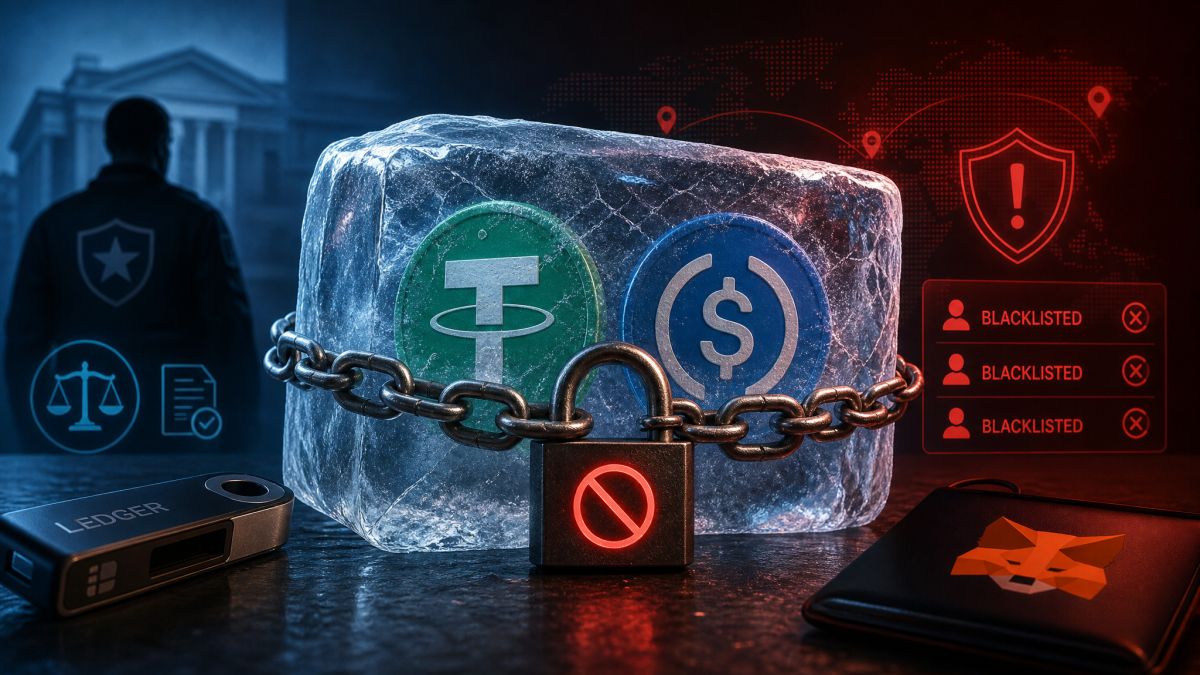
Yes. Tether can freeze USDT, and Circle can freeze USDC, at self-custody addresses. That includes addresses you manage through MetaMask or secure with a Ledger hardware wallet. They do not need your private key, your seed phrase, or your approval.
The freeze powers are not theoretical. Following the record October 29, 2026 exchange breach, Elliptic’s analysis of the Binance hack reported up to USD 6.43 billion stolen and approximately USD 2.85 billion frozen or seized within hours, almost all of it in USDT and USDC. Elliptic, alongside TRM Labs and Chainalysis, linked the attack to North Korea’s TraderTraitor hacking group.
That case exposes the gap between two very different kinds of control: controlling your wallet’s keys and controlling whether a token can move. After 25 years in traditional banking, I recognize that distinction immediately. A valid payment instruction does not force a financial institution to execute it. With centralized stablecoins, the issuer’s veto is built directly into the token’s rules. Whether you are comparing USDT and USDC architecture under the hood or setting up USDT and USDC payroll and B2B invoicing workflows, understanding how contract-level freezes work is essential before you treat stablecoins like digital cash.
Self-custody protects your signing authority. It does not remove the stablecoin issuer’s authority.
Can Tether freeze USDT in MetaMask or a Ledger wallet?
Your hardware wallet protects your private keys, not the transfer rules of every asset those keys control.
USDT is not physically stored inside your Ledger. Its balance is recorded on the blockchain through the token’s smart contract, while MetaMask simply displays that balance and prepares transactions for your Ledger key to sign. Even when your cryptographic signature is perfectly valid, the stablecoin smart contract still decides whether a signed transfer is permitted to settle.
A blacklist freeze works like this:
- An authorized issuer administrator submits an on-chain transaction identifying a wallet address for restriction.
- The token smart contract records that address as blacklisted in its on-chain storage.
- Every subsequent transfer involving the restricted address is checked against the token’s rules and automatically rejected by the contract.
As I explain in my custodial versus non-custodial wallet guide, custody only determines who holds the private keys. Holding an issuer-controlled stablecoin introduces a separate counterparty dependency that moving funds off an exchange does not eliminate.
What actually gets frozen?
A stablecoin blacklist only restricts the issuer’s specific token at the affected address, and it never gives the issuer access to your seed phrase or other crypto assets.
If Tether restricts your address, that action does not freeze the ETH, BTC, or USDC sitting in the same wallet. Because each token operates under its own smart contract, blacklist status is always asset-specific and network-specific.
There is another detail everyday users often miss: receiving and sending restrictions are not identical across issuers. On Ethereum, the verified USDT contract checks whether the sender’s address is blacklisted before allowing a transfer out, meaning a blacklisted address can still accidentally receive more USDT that instantly becomes trapped. By contrast, Circle’s contract architecture blocks both incoming and outgoing USDC transfers once an address is restricted.
In both cases, a visible balance inside your wallet app is not proof of spendable money.
Can an issuer also destroy frozen tokens?
Freezing a balance and destroying it are two separate administrative actions inside the smart contract.
Tether’s contract includes a dedicated function that allows its multi-signature owner wallet to permanently burn the USDT balance of a blacklisted address without the holder’s signature. That action is not a blockchain rollback, and the historical transactions remain permanently visible on the ledger. Instead, Tether frequently pairs the destruction of frozen funds with a fresh mint of equivalent USDT to a law-enforcement wallet or verified victim address once legal clearance is completed.
Circle’s access denial blocks USDC transfers in place rather than automatically sweeping the tokens back to Circle. In either system, an initial freeze is an emergency hold, not an automatic refund to a hacking victim.
Why do Tether and Circle blacklist addresses?
Issuers blacklist addresses to enforce international sanctions, comply with law-enforcement requests, and contain major security breaches.
The primary triggers include:
- Sanctions exposure: Wallets interacting with sanctioned entities, jurisdictions, or sanctioned mixing protocols.
- Theft and fraud investigations: Funds traced to exchange hacks, pig-butchering scams, Ponzi schemes, or money-laundering rings.
- Legal orders and urgent government requests: Restrictions imposed through court orders, prosecutor warrants, or qualifying emergency agencies.
- Token-system security incidents: Technical intervention to protect the issuer’s reserves or smart contract integrity.
Tether’s December 2023 wallet-freezing policy announcement formally extended its proactive sanctions controls to the secondary market, covering any wallet connected with persons on OFAC’s Specially Designated Nationals List. Similarly, Circle’s stablecoin access-denial policy outlines the legal, security, and urgent government circumstances in which it blocks USDC addresses.
A completed court case is not a prerequisite for a freeze. Tether operates proactively, often freezing wallets within hours of receiving credible intelligence from investigators or law enforcement before formal legal proceedings conclude. Circle historically takes a more reactive approach centered on formal court orders and direct sanctions designations, though both issuers retain full authority to act without notifying the wallet holder in advance.
How often do USDT and USDC freezes happen?
Stablecoin freezes are a routine daily compliance operation, not a dormant feature reserved for a once-in-a-decade crisis.
On-chain tracking shows a massive enforcement footprint, particularly for USDT. According to AMLBot’s multi-year stablecoin freeze analysis and subsequent 2026 on-chain data, Tether has blacklisted more than 7,200 addresses and frozen over USD 3.3 billion to USD 4.2 billion in USDT historically, while Circle has blocked roughly 372 addresses holding around USD 109 million in USDC. That 30-to-1 gap reflects both Tether’s massive volume in peer-to-peer markets and its willingness to freeze funds proactively upon law-enforcement request.
The pace has only accelerated. After blacklisting over 4,100 addresses in 2025, Tether froze nearly 2,500 additional addresses across Ethereum and Tron in the first half of 2026 alone. Beyond the October 2026 Binance response, Tether’s earlier announcement regarding Bybit-linked freezes highlighted how its T3 Financial Crime Unit (formed with Tron and TRM Labs) surpassed USD 150 million in frozen criminal assets within months of launching.
With regulatory frameworks like the U.S. GENIUS Act standardizing compliance obligations for payment stablecoin issuers, on-chain blacklisting is now permanent financial infrastructure. Issuer freezing is an active, daily enforcement mechanism, and cold storage does not switch it off.
How to check USDT for blacklisting and “tainted” funds
To protect your wallet, you must check two separate things: whether an address is currently restricted by the smart contract and whether a payment’s transaction history carries compliance risk.
“Tainted USDT” is market shorthand for funds linked to hacks, scams, or sanctioned entities. Individual USDT units do not carry serial numbers that make one specific token dirty while leaving others clean. Instead, blockchain forensic systems track fund flows across addresses, and issuer blacklists operate entirely at the wallet-address level.
Suppose you hold 20,000 clean USDT in your Ledger wallet and accept a 100 USDT payment from an over-the-counter buyer whose wallet was funded by a scam. Receiving that payment does not automatically trigger an instant smart contract freeze. However, if a subsequent investigation sweeps your address into a law-enforcement freeze request, the restriction locks your entire 20,100 USDT balance, not just the disputed 100 USDT.
Here is the five-step verification process I use before and after handling significant stablecoin transfers.
1. Verify the blockchain and authentic token
Start with Tether’s official supported-protocol list or Circle’s official USDC contract directory to confirm you are looking at the genuine token contract on the right network.
Anyone can deploy a fake token with the ticker USDT, and bridged tokens on secondary chains introduce separate bridge-operator controls. Always match the exact contract address on the network you are using, whether that is Ethereum, Tron, Solana, or an Ethereum Layer 2.
2. Inspect the payment and sender
Open the transaction or the counterparty’s wallet address in the relevant blockchain explorer and check five details:
- The verified token smart contract address.
- The sending and receiving wallet addresses.
- The transaction age, volume pattern, and current balances.
- Any public warning tags for exploits, phishing, sanctions, or mixers.
- Whether the sender is a recognized exchange hot wallet or an unhosted private address.
Explorer warning labels are immediate red flags, though an unlabeled address is never a guarantee that the funds are clean.
3. Query the current blacklist status
You can check whether an address is currently frozen directly through public blockchain explorers without connecting your wallet, paying gas fees, or entering a seed phrase.
On Ethereum, open the USDT contract’s read-only panel on Etherscan, scroll to getBlackListStatus or isBlackListed, paste the wallet address, and click Query. For USDC on Ethereum, open the USDC proxy read panel and query isBlacklisted.
On Tron, where the vast majority of peer-to-peer USDT transfers and address freezes take place, open the official TRC-20 USDT contract on Tronscan’s blockchain explorer, navigate to Contract and then Read Contract, and query the isBlackListed function with the wallet address.
The contract will return one of two values:
- True: The address is actively blacklisted on that network and its tokens cannot move.
- False: The address is not currently restricted by the issuer.
Remember that a False result only tells you the address is unfrozen right now. It does not mean the wallet has a clean compliance history or that it will not be blacklisted tomorrow.
4. Screen the history, not just the blacklist flag
For large over-the-counter trades or payments from unfamiliar clients, checking the contract’s blacklist flag is not enough. Investigators trace hops between wallets in real time. For instance, Chainalysis’s report on the Binance exploit noted that investigators linked the attackers specifically because stolen funds commingled on-chain with wallets from an earlier exchange breach.
When receiving substantial payments from private wallets, use an on-chain AML screening tool to check the sender’s indirect exposure to sanctioned entities, mixers, or stolen funds. Better yet, keep a dedicated receiving address for external payments rather than routing unknown third-party transfers directly into the vault address that holds your life savings.
5. Keep evidence connecting the payment to a real transaction
In both traditional banking and crypto compliance, a paper trail is your best defense if a counterparty later turns out to be compromised.
Always save the invoice, bill of sale, trade order, counterparty identity details, chat logs, and transaction hashes for commercial payments. My crypto proof-of-funds guide explains exactly how to organize this documentation before a compliance team or banking partner asks for it. Never assume that hopping questionable USDT through two or three intermediate MetaMask wallets “cleans” its history; on-chain heuristics flag rapid pass-through hops immediately.
What should you do if your USDT or USDC is frozen?
First confirm that the token contract is actually blacklisted, then preserve your transaction evidence and initiate a formal compliance review with the issuer.
Do not panic over a simple failed transaction in MetaMask. Running out of ETH or TRX for gas fees, using a congested RPC node, or hitting an exchange withdrawal hold can all stop a transfer without any issuer blacklist involvement.
If your read-contract query returns True, historical data shows that only around 4% to 6% of blacklisted addresses are ever unblocked, usually when an innocent third party proves legitimate acquisition. Take these four steps immediately:
- Record the on-chain facts: Save your wallet address, network, token balance, the specific transaction hash that preceded the freeze, and screenshots of the explorer’s read-contract result.
- Compile your source-of-funds proof: Gather the contracts, invoices, P2P exchange receipts, and communications showing how and why you acquired the tokens in good faith.
- Contact the issuer through official channels: Submit a formal ticket through Tether’s or Circle’s official support and compliance portal, and retain qualified legal counsel if the freeze stems from a law-enforcement seizure order.
- Ignore “unfreeze” recovery scammers: Anyone on Telegram, X, or email claiming they can unfreeze blacklisted USDT for a fee or by having you sign a smart contract approval is running a scam. Similarly, if a trading app or investment platform claims your account is frozen and demands a separate deposit for taxes or AML verification before you can cash out, you are dealing with a crypto withdrawal tax scam rather than an actual stablecoin blacklist.
Importing your seed phrase into a new Ledger, switching wallet apps, or trying to swap the frozen USDT on a decentralized exchange like Uniswap will not work. Every DEX swap still calls the underlying token contract’s transfer function, which will reject the transaction instantly.
The self-custody rule I actually use
Self-custody removes a third-party custodian’s control over your private keys, but it never removes the issuer’s control over a centralized asset.
I use hardware wallets every day, and I also use stablecoins, but I never confuse a hardware wallet’s key security with censorship resistance. Bitcoin and Ether are native protocol assets; USDT and USDC are digitized dollar liabilities governed by corporate compliance rules and smart contract kill switches.
Your keys can be 100% yours while the final permission to move your USDT or USDC still belongs to Tether or Circle. Understand that architecture, isolate your long-term vault addresses from everyday incoming payments, and manage your self-custody practices accordingly.
Sponsored Partner: Volet.com
Looking for a simple, everyday way to buy, hold, and sell cryptocurrencies alongside your traditional currencies and payment cards?
- Read my full breakdown: Complete Volet Review on DoraMilen.com
- Get started right away: Open your free Volet account using my referral link