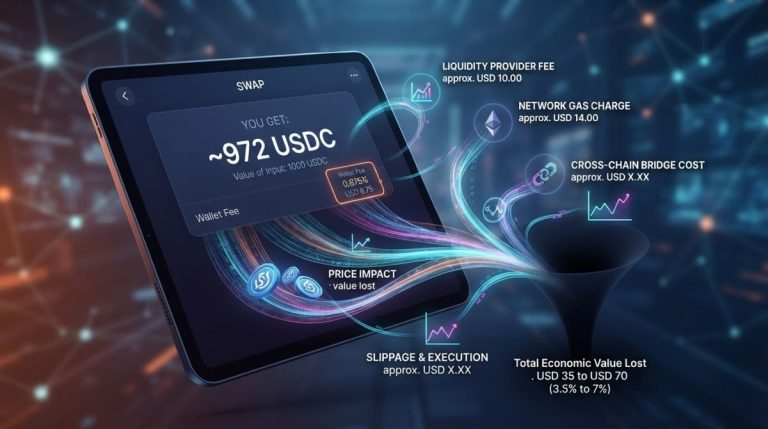
Buying USD 100 of Bitcoin does not necessarily put USD 100 worth of Bitcoin in your wallet. The difference can disappear into payment processing, an unfavorable exchange rate, trading fees, a price spread, and the cost of moving your BTC off the platform.
After 25 years in traditional banking, I recognize this pricing structure immediately.
A bank can advertise an international transfer with no transfer fee and still earn money through the exchange rate. A crypto app can charge no trading commission and still offer you less Bitcoin for the same money.
The fee has not necessarily disappeared. Sometimes it has moved into the price.
But I want to be precise about the accusation. A disclosed spread is not automatically a secret charge, and a difference between two Bitcoin prices is not automatically evidence of misconduct. PayPal, Revolut, and MoonPay also do not universally offer commission-free Bitcoin purchases.
The real problem is comparison shopping. The biggest number on the marketing page is often not the number that determines what you actually receive.
For a small Bitcoin purchase, the meaningful comparison is total cash debited versus net BTC delivered to the wallet you control.
In the transparent EUR 100 examples below, the amount reaching a private wallet ranges from approximately EUR 90.89 to EUR 97.11 in Bitcoin, measured at the same assumed reference price. Those are calculated scenarios, not fabricated live quotes from named apps.
Here is how I separate the published charges from the arithmetic, and how I would evaluate a small purchase before clicking Buy.
What Is the Cheapest Way to Buy Crypto in Small Amounts?
The cheapest practical route is often a low-cost bank deposit, a competitive spot-market purchase, and a withdrawal whose fixed cost is reasonable relative to the amount.
That is a starting point, not a universal winner.
A bank-funded order-book trade can lose its advantage if the exchange charges an expensive withdrawal fee. A commission-free broker can be competitive if its executable price is good. An in-wallet purchase can justify a convenience premium if it delivers directly to the correct address and avoids another operational step.
I would compare five things:
- The total amount leaving my bank account or card.
- The actual BTC purchase price, not just the chart price.
- Every separately charged purchase or funding fee.
- The BTC amount remaining after withdrawal or delivery.
- Whether the destination is genuinely under my control.
The last item matters. Buying a balance inside an app and receiving Bitcoin into a self-custody wallet are different outcomes.
For an initial comparison, I ignore labels such as “free,” “instant,” and “premium.” I ask a simpler question:
If I spend exactly 100 units of my local currency, how many satoshis can I independently control after the transaction is complete?
What “Buying 100 of Bitcoin” Actually Means
A fair comparison starts with a fixed total budget, a clearly defined destination, and a consistent price benchmark.
Three ambiguities can otherwise make a fee comparison misleading.
A 100 Purchase Is Not Always a 100 Debit
An app may interpret an entered amount as the trade value before fees.
If you request a USD 100 trade and the platform adds a 2% fee, your total debit could be USD 102.
Another interface might treat USD 100 as your complete spending limit and reduce the trade size to accommodate the fee.
Those are not equivalent transactions.
Where a 2% fee is added to the trade notional, a strict USD 100 budget supports approximately USD 98.04 of trade notional. The remaining USD 1.96 pays the fee.
Where the platform instead deducts 2% directly from the entered budget, the trade notional is USD 98.00.
That difference is small on one purchase, but the accounting principle is not.
Always identify what the percentage applies to.
An App Balance Is Not the Same as a Private-Wallet Balance
For this article, “reaches your private wallet” means native BTC delivered to an address controlled by your own wallet keys.
It does not mean:
- A Bitcoin balance still held in a custodial app.
- A tokenized Bitcoin product on another blockchain.
- An exchange-traded investment that tracks Bitcoin.
- A withdrawal that has been requested but not completed.
As Bitcoin.com’s wallet explanation describes, Bitcoin remains recorded on the blockchain. A wallet manages the keys used to access and spend it.
That distinction is fundamental to both custody and cost.
Bitcoin Has No Single Universal Retail Price
A price on a chart might represent the last trade, a midpoint, an index, or a platform-specific calculation.
For an economic comparison, I use a contemporaneous reference price in the same fiat currency. For an execution comparison, I also examine the price at which a competing venue would actually sell the required amount.
A midpoint is useful for measuring an economic shortfall. It is not necessarily a price at which you could have bought.
That is why I distinguish:
- Economic shortfall: The difference between cash spent and the benchmark value of BTC received.
- Execution comparison: The difference between actual available routes for the same budget.
- Platform revenue: What a provider earns, which cannot be inferred reliably from the entire shortfall.
Market spread, payment costs, price movement, and provider markup are not interchangeable categories.
The Full Crypto Purchase Fee Stack
A Bitcoin purchase can contain several independent costs, but not every transaction contains every cost.
This is the checklist I use.
| Cost layer | What it pays for | What I check |
|---|---|---|
| Bank deposit fee | Moving fiat into the purchasing account | Exchange charge, sending-bank charge, intermediary fees |
| Card or payment processing | Funding by debit card, credit card, or a card-backed wallet | Percentage, fixed charge, minimum fee, issuer charges |
| Fiat FX conversion | Converting one national currency into another | Settlement currency and the actual conversion rate |
| Trading or provider fee | Executing or arranging the purchase | Fee basis, minimum, account tier, and product |
| Market spread | The difference between available bids and asks | Executable purchase price and market depth |
| Added price markup | A provider’s adjustment to its reference price | Quoted BTC amount compared with another route |
| Withdrawal or delivery fee | Moving crypto to the destination wallet | Platform service charge, network component, minimum |
| Subscription allocation | Access to a paid plan or fee waiver | Incremental subscription cost attributable to buying |
| Future spending cost | Spending the received Bitcoin later | UTXO size and the future Bitcoin fee market |
Two cautions prevent a lot of bad arithmetic.
First, bank deposits and card purchases are usually alternative funding routes. I would not automatically add both charges.
Second, an aggregated processing fee may already include a wallet’s commission or a partner fee. Adding those components again invents a cost the buyer did not pay.
Bank Deposits: Cheap Does Not Always Mean Immediately Withdrawable
A bank transfer can be inexpensive without providing immediate access to external withdrawals.
For example, Kraken’s cash deposit schedule lists free U.S. ACH funding and several free EUR SEPA options, subject to eligibility and the selected provider. It also describes a seven-day withdrawal hold for ACH deposits through Plaid.
That is a familiar banking distinction: purchasing power is not the same as final, unrestricted settlement.
I would also check the sending bank’s charges. A free receiving-side deposit does not erase an outgoing wire fee.
Card Processing: The Convenience Premium Can Be Substantial
Card funding can consume several percentage points before the Bitcoin purchase is even evaluated.
As a concrete example, the same Kraken funding disclosure lists certain debit-card funding options at 3.75% plus a fixed 0.25 charge in the relevant currency.
That does not establish a universal card fee. It demonstrates why a 3% to 5% card-processing assumption can be reasonable for an illustrative checkout, while remaining something to verify rather than presume.
Credit cards add another potential problem. The Chase cardmember agreement classifies accepted cryptocurrency purchases among cash-like transactions treated as cash advances. Depending on the card agreement, that can introduce separate charges and interest.
I would not finance a small speculative Bitcoin purchase with credit-card debt to collect a nominal reward.
FX Conversion: Buying Bitcoin Does Not Automatically Require Buying Dollars First
A EUR-funded BTC purchase does not inherently require a separate EUR-to-USD retail conversion.
If the platform supports a BTC/EUR market and you fund it in euros, there may be no separate fiat FX step. There can still be a BTC/EUR spread and a trading fee.
The FX question becomes relevant when:
- Your account is funded in one currency but checkout settles in another.
- Your card issuer converts a foreign-currency charge.
- You manually convert funds before purchasing.
- A provider applies a currency-related pricing adjustment.
Those are different mechanisms. I would not describe all of them as the same “FX fee.”
My banking rule carries over unchanged: compare the actual amount debited in your home currency, not just the currency displayed at checkout.
Spread: The Price Can Be the Fee
A zero commission does not guarantee a competitive purchase price.
Imagine Bitcoin has a reference price of EUR 100,000, while an app offers to sell it at EUR 102,000.
With EUR 100 and no separate fee, you receive approximately 0.00098039 BTC. At the reference price, that BTC is worth about EUR 98.04 before delivery costs.
A 2% price markup therefore does not produce exactly a 2% reduction in the amount received. The denominators differ.
I also separate three concepts that frequently get bundled together:
- Bid-ask spread: The difference between available buying and selling prices.
- Provider markup: An adjustment added to the provider’s underlying reference.
- Slippage: A difference between an expected execution price and the price actually obtained.
A quote comparison can reveal an unattractive outcome. It cannot, by itself, prove which of these explains every cent.
What PayPal, Robinhood, Revolut, MoonPay, and Wallets Actually Disclose
The named apps use different pricing models, so their headline fees cannot be compared as if they were identical products.
The following is a disclosure comparison, not a live execution ranking.
| Product and jurisdiction | Published pricing feature | What remains necessary for a true total |
|---|---|---|
| PayPal crypto, United States | 2% transaction fee at the USD 75 to USD 200 tier; embedded spread | Executable rate, fee basis, funding charges, external-transfer quote |
| Robinhood Crypto, U.S. market-maker routing | No commission; compensation embedded in spread | Actual ask, BTC received, external-transfer quote |
| Robinhood Crypto, U.S. exchange routing | Base tier lists 0.50% maker and 0.95% taker | Order execution, market spread, funding and withdrawal conditions |
| Revolut retail, Cyprus euro schedule | Percentage or minimum fee; separate withdrawal components | Plan, trade-size bracket, executable rate, delivery quote |
| Revolut X, eligible markets | Separate maker-taker pricing | Eligibility, market price, funding and external delivery |
| MoonPay Rails, U.S. disclosure | Provider fee, possible ecosystem fee, spread, and network fee | Exact checkout, payment method, referral route, currency |
| MetaMask integrated purchases | 1% MetaMask fee included in quoted processing fee | Provider quote, supported asset and network, net delivery |
| Kraken Pro, base spot tier | 0.40% maker and 0.80% taker | Funding route, order-book execution, BTC withdrawal quote |
| Coinbase Advanced | Order-book trading with account-specific fees | Current fee tier, execution, funding and withdrawal costs |
The supporting disclosures are discussed below because the qualifications matter as much as the percentages.
PayPal: A Visible Transaction Fee Plus an Embedded Spread
A small U.S. PayPal Bitcoin purchase can involve both a transaction fee and a spread.
The current PayPal consumer fee schedule lists a 2% fee for cryptocurrency purchase, sale, or conversion amounts from USD 75 through USD 200.
Separately, the PayPal cryptocurrency terms describe an estimated 1% spread, which can be higher or lower with market conditions and is not separately calculated and disclosed for each transaction.
Here is a conditional USD 100 illustration:
- Total spending limit: USD 100.
- Transaction fee: 2%, assumed added to trade notional.
- Purchase-price premium: assumed exactly 1% over my reference.
- Other funding charges: none.
- Delivery charge: an illustrative USD 2.
Under those assumptions, approximately USD 97.07 of reference-price Bitcoin exists before delivery, and USD 95.07 reaches the destination after the assumed delivery charge.
That is a model, not a PayPal checkout quote. The actual spread, interface fee treatment, transfer estimate, and market price must be checked.
Robinhood: No Commission Is Not the Same as No Spread
Robinhood’s U.S. crypto cost depends partly on how the order is routed.
According to Robinhood’s crypto routing explanation, market-maker routing is the default for applicable in-app orders. Robinhood says that, as of June 15, 2026, it receives USD 0.95 per USD 100 of executed notional through that route, included in the spread.
I would not add another 0.95% to a quote that already incorporates it. Nor would I assume that the rebate equals the complete execution shortfall.
The alternative exchange-routing model charges explicit fees. The current Robinhood Crypto fee schedule lists 0.50% maker and 0.95% taker fees in the lowest volume tier.
Neither route is automatically cheaper. Compare the actual BTC delivered for the same total debit.
Robinhood also distinguishes a zero platform transfer charge from the network fee required for an external transfer. Its crypto transfer instructions explain the transfer review and fee-estimate process.
Revolut: Minimum Fees Matter, and Revolut X Is a Different Product
Revolut’s retail app and Revolut X should not be treated as one fee schedule.
For a concrete euro example, the English-language Revolut Cyprus retail schedule lists the greater of 1.49% or a minimum fee for Standard and Plus. A EUR 100 trade falls in a EUR 2.49 minimum-fee bracket.
The schedule also lists a EUR 3 service fee for BTC withdrawals, plus a variable network component, and describes product-added spreads typically ranging from 0% to 3%.
A EUR 100 trade is not necessarily a EUR 100 total debit. If fees reduce the trade size, a different bracket may apply.
Separately, Revolut X pricing advertises 0% maker and 0.09% taker fees for eligible users. Low trading fees still do not settle the external-delivery comparison.
For American readers, Revolut’s U.S. cryptocurrency terms state that its U.S. entity stopped offering cryptocurrency services effective October 3, 2023. The euro example is not a U.S. purchasing recommendation.
MoonPay: Processing, Price, Partner, and Delivery Can All Matter
A MoonPay processing percentage is not necessarily the complete cost of the purchase.
The MoonPay Rails pricing disclosure describes a provider fee of up to 4.5%, possible minimum fees, an embedded spread, a network fee, and possible ecosystem fees. Its U.S. disclosure differentiates direct and partner-referred minimum charges.
It also states that purchases and sales funded from MoonPay fiat balance incur zero MoonPay fees. That does not, by itself, establish a zero-spread or zero-delivery-cost transaction.
The referral route deserves attention. MoonPay’s partner widget configuration instructions explicitly allow partners to set their own fees on top of MoonPay’s fees.
That means the same underlying provider can produce different economics through different integrations.
For a European direct-to-wallet purchase, the MoonPay Europe terms describe buying from MoonPay and delivery to the supplied wallet address. If that delivery is already included in the quote, I would not invent a second exchange withdrawal afterward.
In-Wallet Purchases: Convenient Does Not Mean the Wallet Is the Seller
A wallet’s Buy button can be a distribution interface for a separate on-ramp provider.
The MetaMask purchase FAQ says the selected provider fulfills the transaction. It also says MetaMask receives a 1% fee, included in the quoted processing fee, while network costs appear separately.
This is an easy place to double-count.
If the quote already includes MetaMask’s share in processing, adding another 1% overstates the cost.
I would compare:
- The provider’s direct quote.
- The integrated-wallet quote.
- A bank-funded exchange purchase plus delivery.
I would also verify the asset. MetaMask now documents native BTC functionality in its Bitcoin account guide, so older blanket claims that it cannot hold native Bitcoin are outdated.
That still does not make every Bitcoin-labeled token equivalent to BTC on the Bitcoin network.
Order-Book Alternatives: Check Current Fees, Not Old Comparison Tables
An advanced interface can change the pricing model, but “advanced” does not mean free.
The current Kraken Pro spot fee schedule lists base rates of 0.40% maker and 0.80% taker. Kraken’s July 9, 2026 fee-tier announcement explains its revised cross-platform qualification structure.
I would not reuse the older 0.25% maker and 0.40% taker figures as current base pricing.
For another example, Coinbase’s pricing disclosure says Coinbase Advanced does not include its simple-trade spread because users interact with the order book.
That does not eliminate the market’s bid-ask spread. Nor does it eliminate trading fees, slippage, or withdrawal costs.
The lesson is to compare the exact product, not merely the company logo.
The EUR 100 Breakdown: How Much Actually Reaches Your Wallet?
Under the explicit assumptions below, the same EUR 100 budget delivers between EUR 90.89 and EUR 97.11 of Bitcoin to a private wallet.
These are standardized scenarios designed to expose the mechanics.
They are not live quotes, not a ranking of the named providers, and not conversions of USD 100 into euros.
Assumptions Behind the Calculation
I hold the reference BTC price constant at an illustrative EUR 100,000 throughout.
For each route:
- EUR 100 is the complete cash budget.
- There is no sending-bank charge.
- Percentage fees are added to the relevant underlying amount.
- The quoted purchase price includes the specified premium over the reference.
- External delivery costs the equivalent of EUR 2 in BTC.
- There are no additional minimum fees, subscriptions, promotions, or issuer charges.
- BTC price movement during the process is excluded.
The order-book scenario uses a 0.80% taker fee as an illustrative trading rate. Its 0.10% execution premium is an assumption, not a measured spread.
The card scenario assumes a 4.50% processing fee, a separate 1% fiat conversion cost, and a 2% purchase-price premium. Those are scenario inputs, not charges asserted against a particular provider.
The Complete Cost Waterfall
| Stage | Bank-funded order book | No-commission quote | Card-funded convenience route |
|---|---|---|---|
| Starting cash budget | EUR 100.00 | EUR 100.00 | EUR 100.00 |
| Bank deposit fee | EUR 0.00 | EUR 0.00 | Not used |
| Card processing | Not used | Not used | 4.50%, leaving EUR 95.69 for subsequent steps |
| Separate fiat FX cost | None | None | 1%, leaving EUR 94.75 |
| Explicit trading fee | 0.80%, leaving EUR 99.21 of trade notional | None | None beyond assumed processing |
| Purchase-price premium over reference | 0.10% | 1.00% | 2.00% |
| Reference value before delivery | EUR 99.11 | EUR 99.01 | EUR 92.89 |
| Assumed withdrawal or delivery cost | EUR 2.00 | EUR 2.00 | EUR 2.00 |
| Reference value in private wallet | EUR 97.11 | EUR 97.01 | EUR 90.89 |
| Economic shortfall from original budget | EUR 2.89 | EUR 2.99 | EUR 9.11 |
| Approximate BTC delivered | 0.00097107 BTC | 0.00097010 BTC | 0.00090889 BTC |
Intermediate values are rounded for display. Final BTC quantities are approximate; actual systems apply their own precision and rounding rules.
The card-funded route delivers about EUR 6.22 less Bitcoin than the bank-funded route in this model.
Notice another result: the commission-free route is almost tied with the order-book route. With a better executable quote, it could win.
The purpose of the table is not to prove that one pricing label always loses. It is to prove that the label cannot decide the comparison.
Why the Card Charge Is Not Exactly EUR 4.50 Here
The budget includes the charge.
With a 4.50% fee added to the funded amount, approximately EUR 95.69 is available beneath that fee, and approximately EUR 4.31 pays processing.
If a provider instead deducts 4.50% of the original EUR 100, processing costs EUR 4.50 and leaves EUR 95.50.
Both structures are possible modeling conventions. They should not be silently mixed.
Why I Used the Same Delivery Cost
A standardized EUR 2 delivery assumption isolates differences in funding and purchase pricing.
Actual providers do not necessarily charge the same amount.
For example, the published Kraken cryptocurrency withdrawal table showed a native Bitcoin withdrawal fee of 0.000015 BTC when researched, equivalent to 1,500 satoshis, with a stated minimum including the fee. The page warns that final confirmation charges may differ.
At the illustrative EUR 100,000 reference price, 1,500 satoshis would be EUR 1.50.
A different provider might charge more, less, or include delivery in the initial quote. Replace the model’s EUR 2 with the actual quoted amount before making a decision.
What Happens Between Clicking Buy and Receiving Bitcoin?
A custodial purchase and a Bitcoin withdrawal are separate operational events, even when the app makes them look like one action.
This is where my banking background is most useful. A customer-facing balance, a firm’s internal ledger, and final external settlement are not the same layer.
A typical custodial purchase-and-withdrawal process looks like this:
- You authorize fiat funding. A card authorization, bank transfer, or account debit starts the payment process.
- The provider makes purchasing power available. That availability may precede unrestricted withdrawal.
- The purchase is priced and executed. It may use a dealer quote, a market maker, or an exchange order book.
- Your custodial account is credited. The platform records your crypto holding under its custody arrangements.
- You request external delivery. The platform checks eligibility, withdrawal minimums, security controls, and applicable fees.
- A Bitcoin transaction is created and signed. The custodian may batch multiple customer withdrawals into one transaction.
- The transaction reaches the Bitcoin network. Your wallet can identify the output associated with its address.
- Confirmations accumulate. You assess settlement confidence before treating the payment as final for your purpose.
The PayPal cryptocurrency terms illustrate the custody, transfer, and review distinction. Bitcoin’s transaction documentation describes the underlying inputs, outputs, and spending conditions.
The crucial difference from an internal app balance is control over spending.
An on-ramp that purchases and delivers directly to your address can compress the customer experience. It does not remove the need to inspect pricing, network selection, and delivery conditions.
Why Bitcoin Withdrawal Fees Hurt Small Purchases
A fixed withdrawal charge takes a much larger percentage of a small purchase than of a large one.
The arithmetic is unforgiving.
| Amount withdrawn | Illustrative fixed charge | Charge as a share of amount |
|---|---|---|
| EUR 10 | EUR 2 | 20.00% |
| EUR 25 | EUR 2 | 8.00% |
| EUR 50 | EUR 2 | 4.00% |
| EUR 100 | EUR 2 | 2.00% |
| EUR 500 | EUR 2 | 0.40% |
| EUR 1,000 | EUR 2 | 0.20% |
This is why I do not evaluate a recurring EUR 20 purchase solely by its trading fee.
A tiny commission saving can be overwhelmed by the withdrawal policy.
The Bitcoin Network Does Not Charge a Percentage of Your Purchase
Native Bitcoin transaction fees depend on transaction size and the chosen fee rate, not directly on the fiat value being transferred.
BIP 141’s transaction-weight specification provides the basis for virtual transaction size.
For an illustrative 140-virtual-byte transaction:
- At 5 satoshis per virtual byte, the fee is 700 satoshis.
- At 50 satoshis per virtual byte, the fee is 7,000 satoshis.
At an assumed EUR 100,000 per BTC, those amounts are EUR 0.70 and EUR 7.00 respectively.
Neither the transaction size nor the fee rates are current quotes. Real transactions vary in inputs, outputs, script types, and network conditions.
If you run Bitcoin Core, the documented fee-estimation RPC can help examine your node’s estimate:
bitcoin-cli estimatesmartfee 6 "economical"An illustrative response could look like this:
{
  "feerate": 0.00005,
  "blocks": 6
}
The feerate field is denominated in BTC per 1,000 virtual bytes. In this example, it corresponds to 5 satoshis per virtual byte.
The estimate is not a guarantee of confirmation timing, and a node may return an error if it lacks sufficient estimation data.
A Platform’s “Network Fee” May Not Equal Its Exact Miner Payment
The amount quoted to a customer can be an estimate or a broader withdrawal charge.
For example, the PayPal transfer-fee terms explain that its estimated network charge can differ from the actual network cost, with the provider retaining a difference when actual cost is lower.
Batching creates another complication: one blockchain transaction can serve multiple customers.
I would not take the transaction’s entire miner fee and assume that every customer paid that amount, or assume that one customer’s quoted charge equals the transaction’s exact marginal cost.
Small Withdrawals Can Create Future Spending Costs
Each separate receipt can create another unspent transaction output, or UTXO.
When you later spend several outputs together, the transaction generally needs more input data than a comparable spend using fewer inputs.
The practical implications are explained in Trezor’s UTXO guide: repeated small receipts can increase future spending costs, while consolidation has both fee and privacy consequences.
This is not a second fee charged at purchase. It is a potential future cost of how you accumulate Bitcoin.
Should You Batch Withdrawals or Use Lightning?
Batching and Lightning can reduce some costs, but neither is a universal substitute for evaluating custody and destination requirements.
I separate purchase frequency from withdrawal frequency.
You can buy monthly without necessarily withdrawing monthly.
If twelve withdrawals each cost an assumed EUR 2, the annual delivery cost is EUR 24. Four withdrawals at the same assumed charge cost EUR 8.
That saves EUR 16 without changing the monthly buying schedule.
However, it leaves funds with the custodian longer. I would set both:
- A maximum acceptable withdrawal-cost percentage.
- A maximum balance or holding period I am comfortable leaving with the provider.
For example, a fixed EUR 2 charge becomes 0.5% of EUR 400. That is arithmetic, not a recommendation that everyone should leave EUR 400 on an exchange.
Lightning Is a Different Delivery Route
Lightning can make small Bitcoin payments economical when both the sender and receiving wallet support it.
But the complete route can include:
- An exchange’s Lightning withdrawal charge.
- Payment-routing fees.
- Wallet or liquidity-service charges.
- Channel-related costs.
- A later cost to move funds to an on-chain wallet.
Lightning Labs’ channel-fee documentation explains routing fees, while its Loop service explanation describes moving between Lightning and on-chain destinations.
If my final objective is BTC in an on-chain cold-storage wallet, I compare the complete journey to that destination.
A cheap first hop does not establish a cheap final settlement.
I also check whether the receiving Lightning wallet is custodial. A payment leaving an exchange is not automatically self-custody if another provider controls the destination keys.
How I Would Buy a Small Amount Without Paying an Unnecessary Premium
My default process is to minimize avoidable funding costs first, compare executable BTC outcomes second, and verify withdrawal conditions before buying.
Here is the practical sequence.
- Define the objective. Decide whether you want price exposure inside an app, spendable Lightning funds, or native BTC in a private on-chain wallet.
- Check local eligibility. Confirm that the product and external withdrawals are available for your jurisdiction and account.
- Choose the funding rail. Compare local bank funding with card funding, including withdrawal holds.
- Use the correct fiat currency. Avoid a separate conversion unless there is a measurable reason to perform it.
- Compare the actual products. A retail Buy screen, an advanced order book, and an integrated on-ramp can have different economics.
- Set a strict total budget. Check whether fees are included in, deducted from, or added to the amount entered.
- Record the quoted BTC quantity. This is more useful than an isolated fee percentage.
- Check delivery before executing. Review the supported network, minimum withdrawal, hold, and final BTC amount.
- Verify the destination address. Use your wallet’s own verification process and review the address carefully.
- Keep the records. Save the order, funding debit, fees, and transaction identifier.
For a first transfer to a new destination, a test payment can reduce operational risk. It also costs money. I include that test in the total rather than pretending it is free.
A Limit Order Is Not Automatically a Maker Order
A limit order controls the worst price you are willing to accept. It does not guarantee maker pricing.
As the Coinbase Advanced fee explanation describes, an immediately matched limit order can pay taker fees. An order resting on the book can qualify as maker when subsequently matched.
Where supported, a post-only instruction can prevent immediate taking, but may cause rejection or cancellation rather than execution.
I would not risk a missed purchase or chase a moving price to save a few cents without understanding that trade-off.
A Paid Plan Needs Its Own Break-Even Calculation
A subscription is not economically free because its cost appears on a different screen.
Suppose a hypothetical plan costs EUR 10 per month and saves 1% on purchases. You would need EUR 1,000 of qualifying monthly purchases just to offset the subscription through that saving alone.
Spreads, delivery charges, eligibility limits, and other benefits would still need separate evaluation.
If I already pay for a plan for unrelated reasons, its incremental cost for buying Bitcoin may be zero. If I subscribe solely to reduce purchase fees, the subscription belongs in my calculation.
How to Audit Crypto Exchange Hidden Spread Fees Yourself
The strongest audit compares total cash spent with net BTC received, then separately investigates why competing quotes differ.
You do not need to reverse-engineer a provider’s entire revenue model.
You need a consistent record.
Step 1: Capture the Quote Before Buying
Record:
- The quote time and timezone.
- Fiat currency.
- Total amount to be debited.
- BTC quantity quoted.
- Separately displayed fees.
- Whether delivery is included.
- Destination network.
- Any withdrawal fee not yet included.
- Whether the price is firm, indicative, or subject to refresh.
Compare alternative routes as close together in time as possible.
If one quote was captured before a Bitcoin price move and another afterward, the difference is not a clean fee measurement.
Step 2: Obtain a Relevant Market Reference
A public order book can help distinguish a chart price from an executable ask.
For example, Kraken’s public order-book endpoint returns bid and ask levels without requiring trading credentials.
This read-only example requests BTC/EUR market depth:
curl --fail --silent --show-error \
  'https://api.kraken.com/0/public/Depth?pair=XBTEUR&count=5' |
jq '
  if (.error | length) > 0 then
    error(.error | join(", "))
  else
    .result | to_entries[0].value |
    {
      best_bid_eur: .bids[0][0],
      best_ask_eur: .asks[0][0],
      best_ask_btc_available: .asks[0][1]
    }
  end
'
This requires curl and jq.
The result is a reference from one venue, not proof of a universal market price. For an execution comparison, confirm that sufficient quantity exists at the relevant price and include that venue’s own fees.
Step 3: Save a Simple Quote Record
This illustrative JSON record uses a rounded-down BTC amount close to the card-funded scenario above:
{
  "record_type": "illustrative_example_not_live_quote",
  "fiat_currency": "EUR",
  "total_cash_debited": "100.00",
  "reference_price_per_btc": "100000.00",
  "reference_basis": "assumed_contemporaneous_midpoint",
  "net_btc_received": "0.00090888",
  "delivery_network": "bitcoin",
  "delivery_fee_already_in_net_amount": true
}
For a real transaction, replace every illustrative value with your records.
If net_btc_received already excludes the withdrawal or delivery fee, do not subtract that fee again.
Step 4: Calculate the Economic Outcome
Save the JSON as quote.json, then run this Python script:
import json
from decimal import Decimal

with open("quote.json", encoding="utf-8") as file:
    quote = json.load(file)

cash = Decimal(quote["total_cash_debited"])
btc = Decimal(quote["net_btc_received"])
reference = Decimal(quote["reference_price_per_btc"])

if cash <= 0 or btc <= 0 or reference <= 0:
    raise ValueError("Cash, BTC, and reference price must be positive.")

wallet_reference_value = btc * reference
economic_shortfall = cash - wallet_reference_value
shortfall_percent = economic_shortfall / cash * Decimal("100")

effective_price = cash / btc
effective_price_premium = (
    effective_price / reference - Decimal("1")
) * Decimal("100")

currency = quote["fiat_currency"]

print(
    f"Wallet reference value: "
    f"{currency} {wallet_reference_value:.2f}"
)
print(
    f"Economic shortfall: "
    f"{currency} {economic_shortfall:.2f}"
)
print(f"Shortfall percentage: {shortfall_percent:.2f}%")
print(
    f"Effective cost per BTC: "
    f"{currency} {effective_price:,.2f}"
)
print(
    f"Effective price premium: "
    f"{effective_price_premium:.2f}%"
)
The example produces an economic shortfall of about 9.11% and an effective price premium of about 10.03%.
Those percentages differ because one measures loss relative to cash spent and the other measures the effective BTC price relative to the benchmark.
Neither figure should automatically be labeled “the exchange’s hidden spread.” The result includes every cost already reflected in your total debit and net receipt.
For a genuine side-by-side comparison, the route delivering more native BTC for the same total cash expenditure wins the quantity comparison, subject to timing, custody, and operational differences.
Security and Tax Costs I Would Not Ignore
A cheaper purchase route is not a better route if it introduces an unacceptable risk of losing the entire amount.
I would not move to an unfamiliar provider solely because its advertised commission is lower.
For custody, the basic trade-off is straightforward: a custodian introduces reliance on its security and withdrawal policies; self-custody introduces responsibility for keys and backups. The Bitcoin security guidance explains that responsibility clearly.
I also would not assume a banking relationship protects a crypto balance. The FDIC’s deposit-insurance explanation lists crypto assets among products not covered by deposit insurance.
Network selection deserves equal attention. As MetaMask’s explanation of Bitcoin on EVM networks makes clear, native BTC and a wrapped representation on another chain are different things.
A cheaper withdrawal of a different asset is not an apples-to-apples saving.
Finally, keep tax records. The IRS digital-asset transaction FAQ states that transfers between wallets you own are generally non-taxable, while noting an exception for digital assets used or withheld to pay transaction-service costs.
The purchase audit in this article is not a tax-basis calculator. Recordkeeping and tax treatment require their own analysis.
Frequently Asked Questions About Small Bitcoin Purchases
Why Did I Receive Less Bitcoin Than the Amount I Paid?
You may have paid a transaction fee, a funding charge, an embedded price spread, a currency-conversion cost, or a delivery charge.
Your displayed balance may also use a different valuation price from your purchase quote.
Compare the actual cash debit and BTC quantity first. Then reconcile each charge and the reference price.
Does Zero Trading Fee Mean Buying Bitcoin Is Free?
No. A zero trading commission describes one potential charge.
You can still face a market spread, provider markup, funding cost, subscription cost, or external-transfer charge. Robinhood’s routing model is one concrete example of why commission and all-in execution cost are different concepts.
Are Crypto Exchange Spreads Always Hidden?
No. Some providers describe spreads in their terms or include them in the displayed exchange rate.
The practical issue is whether the buyer can identify the economic effect and compare alternatives. “Included in the price” and “not charged” are not the same statement.
Is a 1.5% to 3% Spread Normal?
There is no universal spread for all crypto apps, coins, transaction sizes, and market conditions.
The distinction between a full bid-ask spread and a one-sided purchase markup also matters. Treat a range as a scenario assumption unless a current, applicable disclosure or executable quote supports it.
Is Buying Through a Wallet More Expensive Than an Exchange?
Sometimes, but not always.
An integrated purchase may include partner compensation and a convenience premium. It may also deliver directly to the final wallet, avoiding a separately charged withdrawal.
Compare complete routes with the same destination and total cash budget.
Should I Buy a Cheaper Coin and Swap It Into Bitcoin?
Not automatically.
That adds another trade and potentially another spread, transfer, service fee, tax event, or network mismatch. The alternative route needs to beat the direct purchase after all those steps.
I would not introduce a bridge or a wrapped asset merely to make the first transaction look cheaper.
Should I Leave Small Purchases on an Exchange Until They Are Larger?
That can reduce repeated fixed withdrawal charges, but increases the time and amount exposed to custodial risk.
Set a deliberate withdrawal policy rather than allowing a small fee saving to turn into an indefinitely growing exchange balance.
Can Anyone Publish an Exact “Best App for USD 100” Ranking?
Only with meaningful qualifications.
A credible execution comparison needs the date and time, jurisdiction, product, payment method, total debit, BTC received, destination, and withdrawal assumptions.
Without those details, an exact-looking ranking may be comparing incompatible products or hypothetical numbers.
The Bottom Line: Measure the Bitcoin That Arrives
The real cost of buying Bitcoin is determined by the complete route from your money to the BTC you control.
In this article’s standardized EUR 100 examples:
- The bank-funded order-book route delivers about EUR 97.11.
- The commission-free quoted route delivers about EUR 97.01.
- The card-funded route with separate FX and a wider purchase premium delivers about EUR 90.89.
Those outcomes are conditional calculations, not promises about a particular app.
What I would carry into every real purchase is the method:
Fix the total budget. Compare executable prices. Count delivery once. Verify the destination. Measure net satoshis.
After a career in banking, I have very little patience for a pricing comparison that stops at the most flattering line item.
A zero on the fee screen is not the result.
The Bitcoin that reaches your wallet is.
Sponsored Partner: Volet.com
Looking for a simple, everyday way to buy, hold, and sell cryptocurrencies alongside your traditional currencies and payment cards?
- Read my full breakdown: Complete Volet Review on DoraMilen.com
- Get started right away: Open your free Volet account using my referral link